SEAFDEC/AQD Institutional Repository: Recent submissions
601-620 / 4221
-
SEAFDEC/AQD highlights 2019
(Aquaculture Department, Southeast Asian Fisheries Development Center, 2020-11-18)SEAFDEC/AQD highlights 2019 is SEAFDEC/AQD's annual report updating on its accomplishments and progress for the year 2019. -
AQD Matters 2020 September - October
(Aquaculture Department, Southeast Asian Fisheries Development Center, 2020-11)In this issue: 1) Agri-wastes eyed as cheap, eco-friendly source of fish feed; 2) Seahorses get second life with SEAFDEC NegOcc islanders' help; 3) From the ground up: BFS former trainee establishes innovative aquaculture ... -
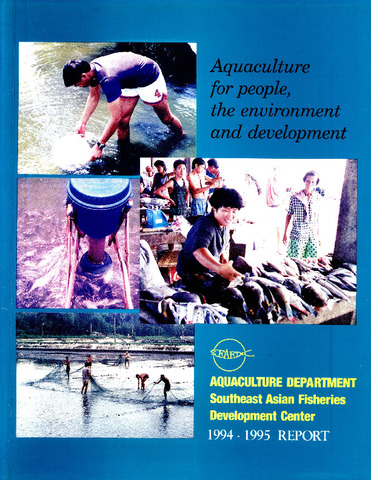
Aquaculture for people, the environment and development: 1994-1995 Report
(Aquaculture Department, Southeast Asian Fisheries Development Center, 1996)The report describes the research and development activities of the SEAFDEC Aquaculture Department conducted during the years 1994-1995. It also chronicles the progress of the pilot project on coastal fishery resources management at Malalison Island, Culasi, Antique. The major thrusts of the project include the implementation of territorial use rights in fisheries, community organizing, economic utilization of resources, and co-management of fishery resources. -
Developing a self-sufficient Philippine milkfish industry through value chain analysis
(Elsevier, 2021-02-15)The Philippine milkfish industry has been dependent on the importation of juveniles for grow-out ever since the decline of wild fry catch and with inadequate supply from local hatcheries. However, self-sufficiency is required to address recent global uncertainties. Value chain analysis of the upstream stages of the milkfish aquaculture pathway reveals options for efficient utilization of coastal aquaculture resources, capital investments and workforce. This paper presents a value chain that starts in an integrated breeding and hatchery (IBH) facility that will produce the required juveniles to yield 7.7 thousand mt milkfish valued at PHP 692 million per year (1 USD = 50 PHP). The number of IBH needed annually were determined, such that the country should have 60 IBH in 2030 to produce 448 thousand mt milkfish worth PHP 61 billion for its 128 million projected population. Economic analysis showed that public-private partnership should fund high-investment but low-profit IBH, while private investors should operate profit-earning hatcheries, nurseries and 4-cage mariculture system to secure the milkfish industry. -
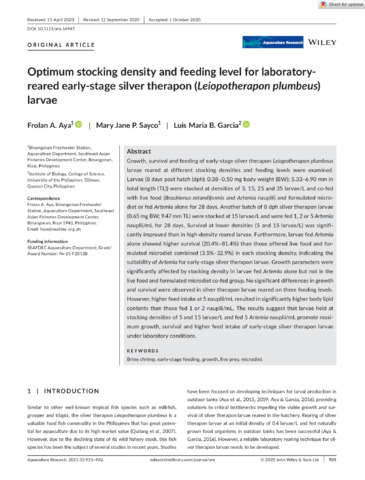
Optimum stocking density and feeding level for laboratory‐reared early‐stage silver therapon (Leiopotherapon plumbeus) larvae
Aya, Frolan ; ; Garcia, Luis Maria (Wiley, 2021)
Growth, survival and feeding of early‐stage silver therapon Leiopotherapon plumbeus larvae reared at different stocking densities and feeding levels were examined. Larvae (8 days post hatch (dph); 0.38–0.50 mg body weight (BW); 5.33–6.90 mm in total length (TL)) were stocked at densities of 5, 15, 25 and 35 larvae/L and co‐fed with live food (Brachionus rotundiformis and Artemia nauplii) and formulated microdiet or fed Artemia alone for 28 days. Another batch of 8 dph silver therapon larvae (0.65 mg BW; 9.47 mm TL) were stocked at 15 larvae/L and were fed 1, 2 or 5 Artemia nauplii/mL for 28 days. Survival at lower densities (5 and 15 larvae/L) was significantly improved than in high‐density reared larvae. Furthermore, larvae fed Artemia alone showed higher survival (20.4%–81.4%) than those offered live food and formulated microdiet combined (3.5%–32.9%) in each stocking density, indicating the suitability of Artemia for early‐stage silver therapon larvae. Growth parameters were significantly affected by stocking density in larvae fed Artemia alone but not in the live food and formulated microdiet co‐fed group. No significant differences in growth and survival were observed in silver therapon larvae reared on three feeding levels. However, higher feed intake at 5 nauplii/mL resulted in significantly higher body lipid contents than those fed 1 or 2 nauplii/mL. The results suggest that larvae held at stocking densities of 5 and 15 larvae/L and fed 5 Artemia nauplii/mL promote maximum growth, survival and higher feed intake of early‐stage silver therapon larvae under laboratory conditions.
; ; Garcia, Luis Maria (Wiley, 2021)
Growth, survival and feeding of early‐stage silver therapon Leiopotherapon plumbeus larvae reared at different stocking densities and feeding levels were examined. Larvae (8 days post hatch (dph); 0.38–0.50 mg body weight (BW); 5.33–6.90 mm in total length (TL)) were stocked at densities of 5, 15, 25 and 35 larvae/L and co‐fed with live food (Brachionus rotundiformis and Artemia nauplii) and formulated microdiet or fed Artemia alone for 28 days. Another batch of 8 dph silver therapon larvae (0.65 mg BW; 9.47 mm TL) were stocked at 15 larvae/L and were fed 1, 2 or 5 Artemia nauplii/mL for 28 days. Survival at lower densities (5 and 15 larvae/L) was significantly improved than in high‐density reared larvae. Furthermore, larvae fed Artemia alone showed higher survival (20.4%–81.4%) than those offered live food and formulated microdiet combined (3.5%–32.9%) in each stocking density, indicating the suitability of Artemia for early‐stage silver therapon larvae. Growth parameters were significantly affected by stocking density in larvae fed Artemia alone but not in the live food and formulated microdiet co‐fed group. No significant differences in growth and survival were observed in silver therapon larvae reared on three feeding levels. However, higher feed intake at 5 nauplii/mL resulted in significantly higher body lipid contents than those fed 1 or 2 nauplii/mL. The results suggest that larvae held at stocking densities of 5 and 15 larvae/L and fed 5 Artemia nauplii/mL promote maximum growth, survival and higher feed intake of early‐stage silver therapon larvae under laboratory conditions. -
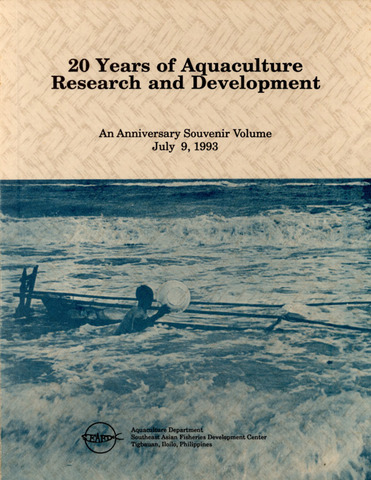
20 Years of aquaculture research and development: An anniversary souvenir volume July 9, 1993
(Aquaculture Department, Southeast Asian Fisheries Development Center, 1993-07)This publication gives an account of research and development activities conducted during the past 20 years at SEAFDEC/AQD. The following topics are covered: establishment; organization; stations and project sites; manpower support; technology generation; technology transfer; technical cooperation; and, financial matters. -
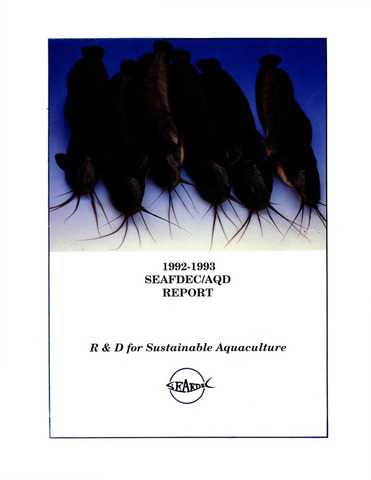
R & D for sustainable aquaculture: 1992-1993 report
(Aquaculture Department, Southeast Asian Fisheries Development Center, 1994)SEAFDEC was created in 1967 to develop fishery potentials in the Southeast Asian region, and the Aquaculture Department was established in the Philippines in 1973 as part of the objectives. This report chronicles the accomplishments of the Department during the period 1992-1993 in the following areas: research; training and information; and, management -
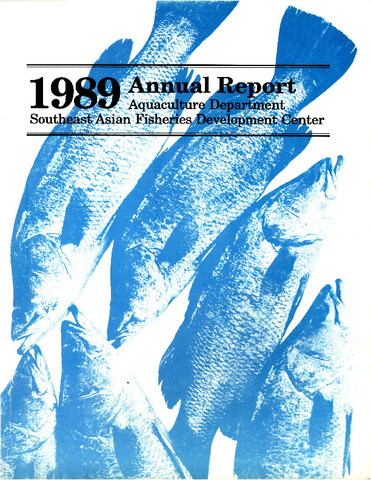
1989 annual report
(Aquaculture Department, Southeast Asian Fisheries Development Center, 1990)The report describes the activities of the Center during the year 1989 regarding the various research studies conducted, and the training, extension, and information services provided. -
On the relationship between aquaculture and food security: Why does aquaculture contribute more in some developing countries than it does in others?
(AkiNik Publications, 2020)As much as 78% of fish production is subject to international trade competition. While this may be positive for economic growth, it may be at odds with achieving food security. The purpose of this paper is to review the relationship between aquaculture and food security, focussing on trade and markets in some developing countries that account for more than 90% of aquaculture output. The international trade in fish products largely involves the movement of high value species from developing to developed countries and the opposite in reverse, which can contribute to food security. Countries where food security is not improving tend to rely on small-scale aquaculture production of species that are not desired in the main markets, themselves relying on imported fish to meet domestic demand. This suggests that an aquacultural revolution in these countries may contribute to food security, as well as economic growth. -
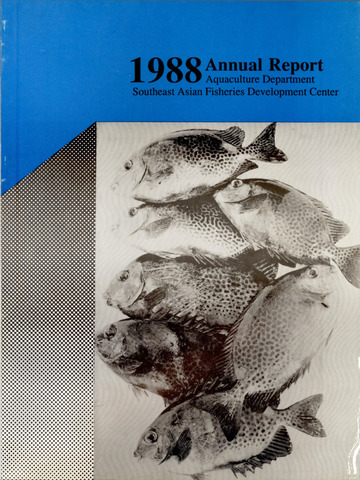
1988 annual report
(Aquaculture Department, Southeast Asian Fisheries Development Center, 1989)Since its establishment in 1973, AQD has shown sustained achievements in aquaculture, thus contributing greatly to the progress of the aquaculture industry in the region. Continuing research on prawn culture at AQD has ... -
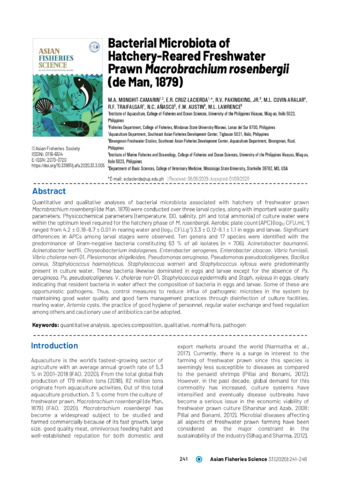
Bacterial microbiota of hatchery-reared freshwater prawn Macrobrachium rosenbergii (de Man, 1879)
; ; Pakingking, Rolando V., Jr.; ; ; ; ; (Asian Fisheries Society, 2020-09-30)
Quantitative and qualitative analyses of bacterial microbiota associated with hatchery of freshwater prawn Macrobrachium rosenbergii (de Man, 1879) were conducted over three larval cycles, along with important water quality parameters. Physicochemical parameters (temperature, DO, salinity, pH and total ammonia) of culture water were within the optimum level required for the hatchery phase of M. rosenbergii. Aerobic plate count (APC) (log10 CFU.mL-1) ranged from 4.2 ± 0.18–8.7 ± 0.01 in rearing water and (log10 CFU.g-1) 3.3 ± 0.12–9.1 ± 1.1 in eggs and larvae. Significant differences in APCs among larval stages were observed. Ten genera and 17 species were identified with the predominance of Gram-negative bacteria constituting 63 % of all isolates (n = 706). Acinetobacter baumannii, Acinetobacter lwoffii, Chryseobacterium indologenes, Enterobacter aerogenes, Enterobacter cloacae, Vibrio furnissii, Vibrio cholerae non-01, Plesiomonas shigelloides, Pseudomonas aeruginosa, Pseudomonas pseudoalcaligenes, Bacillus cereus, Staphylococcus haemolyticus, Staphylococcus warneri and Staphylococcus xylosus were predominantly present in culture water. These bacteria likewise dominated in eggs and larvae except for the absence of Ps. aeruginosa, Ps. pseudoalcaligenes, V. cholerae non-01, Staphylococcus epidermidis and Staph. xylosus in eggs, clearly indicating that resident bacteria in water affect the composition of bacteria in eggs and larvae. Some of these are opportunistic pathogens. Thus, control measures to reduce influx of pathogenic microbes in the system by maintaining good water quality and good farm management practices through disinfection of culture facilities, rearing water, Artemia cysts, the practice of good hygiene of personnel, regular water exchange and feed regulation among others and cautionary use of antibiotics can be adopted. -
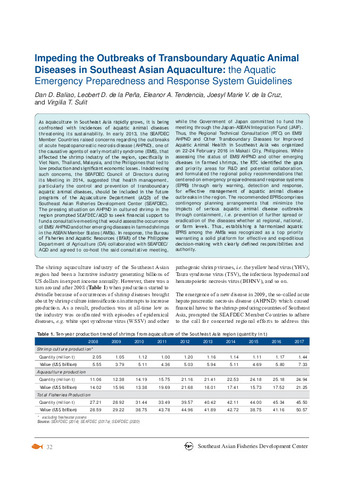
Impeding the outbreaks of transboundary aquatic animal diseases in Southeast Asian aquaculture: The aquatic emergency preparedness and response system guidelines
; ; Tendencia, Eleonor; ; (Secretariat, Southeast Asian Fisheries Development Center, 2020)
As aquaculture in Southeast Asia rapidly grows, it is being confronted with incidences of aquatic animal diseases threatening its sustainability. In early 2013, the SEAFDEC Member Countries raised concerns regarding the outbreaks of acute hepatopancreatic necrosis disease (AHPND), one of the causative agents of early mortality syndrome (EMS), that affected the shrimp industry of the region, specifically in Viet Nam, Thailand, Malaysia, and the Philippines that led to low production and significant economic losses. In addressing such concerns, the SEAFDEC Council of Directors during its Meeting in 2014, suggested that health management, particularly the control and prevention of transboundary aquatic animal diseases, should be included in the future programs of the Aquaculture Department (AQD) of the Southeast Asian Fisheries Development Center (SEAFDEC). The pressing situation on AHPND in cultured shrimp in the region prompted SEAFDEC/AQD to seek financial support to fund a consultative meeting that would assess the occurrence of EMS/AHPND and other emerging diseases in farmed shrimps in the ASEAN Member States (AMSs). In response, the Bureau of Fisheries and Aquatic Resources (BFAR) of the Philippine Department of Agriculture (DA) collaborated with SEAFDEC/AQD and agreed to co-host the said consultative meeting, while the Government of Japan committed to fund the meeting through the Japan-ASEAN Integration Fund (JAIF). Thus, the Regional Technical Consultation (RTC) on EMS/AHPND and Other Transboundary Diseases for Improved Aquatic Animal Health in Southeast Asia was organized on 22-24 February 2016 in Makati City, Philippines. While assessing the status of EMS/AHPND and other emerging diseases in farmed shrimps, the RTC identified the gaps and priority areas for R&D and potential collaboration, and formulated the regional policy recommendations that centered on emergency preparedness and response systems (EPRS) through early warning, detection and response, for effective management of aquatic animal disease outbreaks in the region. The recommended EPRS comprises contingency planning arrangements that minimize the impacts of serious aquatic animal disease outbreaks through containment, i.e. prevention of further spread or eradication of the diseases whether at regional, national, or farm levels. Thus, establishing a harmonized aquatic EPRS among the AMSs was recognized as a top priority warranting a solid platform for effective and expeditious decision-making with clearly defined responsibilities and authority. -
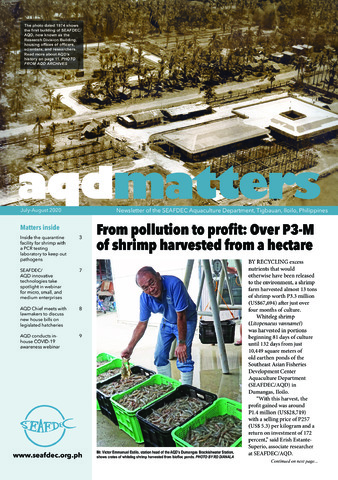
AQD Matters 2020 July - August
(Aquaculture Department, Southeast Asian Fisheries Development Center, 2020-09)In this issue: 1) Inside the quarantine facility for shrimp with a PCR testing laboratory to keep out pathogens; 2) SEAFDEC/AQD innovative technologies take spotlight in webinar for micro, small, and medium enterprises; ... -
Immune response of Litopenaeus vannamei juveniles immersed in Gracilariopsis heteroclada hot-water extract
(Research Unit of Philippine Science High School - Western Visayas Campus, 2019)The emergence of diseases such as Acute Hepatopancreatic Necrosis Disease and White Spot Syndrome has compelled researchers in shrimp aquaculture to develop more innovative methods in improving shrimp health management for the prevention of diseases. One of these methods involves the use of immunostimulants, which enhance the innate immunity of shrimp. Polysaccharides extracted from red seaweeds such as Gracilariopsis heteroclada, locally known as “Gulaman”, present a great source of immunostimulants. Thus, this study aimed to evaluate Gracilariopsis heteroclada as an immunostimulant for Litopenaeus vannamei, or Pacific white shrimp. Hot-water extracts of Gracilariopsis heteroclada were administered through immersion. Results showed no significant changes in total haemocyte count, ambiguous fluctuations in phenoloxidase activity, and a late temporary increase in respiratory burst activity. Overall, these indicate a lack of significant immunostimulation in Litopenaeus vannamei juveniles when immersed in Gracilariopsis heteroclada hot-water extract. -
Interaction between Rhodobacter sphaeroides and Harmful Algal Bloom (HAB) causing dinoflagellate Amphidinium carterae
(Research Unit of Philippine Science High School - Western Visayas Campus, 2019)The present study hopes to develop a further understanding regarding algal-bacteria interactions as an option for bioremediation. After the use of chemicals against the events of the red tide proved to be impractical due to its detrimental effects on the aquatic ecosystem, recent studies focused on bioremediation. To examine the algal – bacteria interactions, an in vitro co-culture system consisting of marine bacteria Rhodobacter sphaeroides and HAB – causing dinoflagellate Amphidinium carterae were used as the model organisms. The population count of each species in the co-culture were monitored for 14 days as well as positive (pure A. carterae) control and negative (pure Rb. sphaeroides) control. The co-culture system used for investigating the interactions was established based on the interdependence of the two organisms and later the bacteria would prevail over the dinoflagellate. The results of the population count shows an inverse progression on the growth between the two organisms. Furthermore, the analysis of the populations trend suggests that the bacteria growth was suppressed due to allelopathic interactions by the dinoflagellate specifically the production of toxins and chemical compounds detrimental to the growth of the bacteria proving that the bacteria was ineffective to mitigate the growth of the dinoflagellate. -
Small-scale freshwater aquaculture development: Experiences from the Philippines on giant freshwater prawn, milkfish and tilapia
Aya, Frolan (Japan International Cooperation Agency, 2013-12)
The Aquaculture Department of the Southeast Asian Fisheries Development Center (SEAFDEC/AQD) has been promoting a number of programs towards effective dissemination and adoption of science-based aquaculture technologies for rural aquaculture development. This is in line with the national government development program on sustainable aquaculture, which is implemented in agreement with the country’s Fisheries Code of 1998 and Local Government Code of 1991. SEAFDEC AQD, through its Binangonan Freshwater Station (BFS), offers extension services and training courses on freshwater aquaculture. Also, AQD has been providing technical support to other countries through a series of regional trainings on freshwater aquaculture to facilitate the dissemination of aquaculture technologies and to capacitate the various stakeholders on this aspect. Aside from training activities, AQD established the Agree-Build-Operate-Transfer (ABOT) AquaNegosyo program which caters to private investors. In this program, AQD assists fish farmers from site selection, design and construction of facilities and monitoring of production run until harvest. Another program is called the Institutional Capacity Development for Sustainable Aquaculture (ICDSA) which aims to establish partnerships and build the capacities of local government units (LGUs), community-based organization and non-government organizations (NGOs), fishery schools and other local institutions. This is through training and information dissemination, on-farm demonstration and on-site consultations on fish culture. AQD continues to carry out research and development (R&D) activities on various commodities and disciplines. One of the R&D programs developed by AQD is the “Meeting Social and Economic Challenges in Aquaculture Program” or MSECAP. This program aims to develop and implement social and economic strategies in aquaculture and resource management for food security and poverty alleviation in rural communities (Salayo et al. 2012). The five-year targets (2012-2016) of the MSECAP are directed on the implementation of R&D activities which include the (1) promotion of aquaculture technologies in inland and coastal communities through verification and on-site demonstration activities and (2) the development of appropriate technology adoption pathways for aquaculture technologies, among others (Salayo et al., 2012). -
Field efficacy evaluation of a formalin-inactivated white spot syndrome virus (WSSV) vaccine for the preventive management of WSSV infection in shrimp grow-out ponds
Amar, Edgar; Faisan, Joseph P., Jr. ; (Elsevier, 2021)
A shrimp grow-out trial was conducted in four 700 m2 earthen ponds in Dumangas Brackishwater Station of SEAFDEC Aquaculture Department, in Iloilo, Philippines to evaluate the efficacy of a combination of immersion- and orally-administered formalin inactivated vaccine (FIV) as an antiviral strategy against WSSV. Purified virus prepared by sucrose gradient ultracentrifugation was inactivated by overnight incubation in 0.5% buffered formalin. PCR-screened Penaeus monodon postlarvae (PL14) obtained from a commercial hatchery were divided into two groups: 1) immersed in FIV solution for 2 h before stocking in ponds (VAC); and 2) unexposed control (CON). Both groups were stocked at a density of 15 m−2 and grown for 115 d following recommended good practices. Pond water was aerated using two 20-HP electric blowers. Shrimp were given commercial feed following the manufacturer's protocol. They were booster-vaccinated by administering FIV-coated feed every 15 d until the termination of the trial. Shrimp samples were regularly collected to obtain estimates of growth, survival, and feed conversion ratio. In addition, shrimp and extraneous crustacean species were analyzed for the presence of WSSV and IHHNV by PCR. Water quality and bacterial load were monitored regularly. After 115 d of culture (DOC), shrimps grew to 12.93 ± 1.26 g in VAC and 8.54 ± 0.78 g in CON. Likewise, survival and yield was higher in VAC (71.2 ± 3.13% and 1311 ± 70.4 kg ha−1, respectively) compared to CON (52.7 ± 5.05% and 640 ± 3.0 kg ha−1, respectively). PCR analysis showed both shrimp and extraneous crustaceans to be lightly infected with WSSV and IHHNV. A few dead shrimp were noted during routine pond inspection as shrimp biomass increased towards the end of the trial. However, no mass mortalities occurred and shrimp were successfully harvested on 115 DOC. VAC and CON shrimp were also collected on day 70, 90, and 105 and experimentally infected with WSSV in tanks. Significant differences in survival rates (p < 0.05) between the groups were obtained 15 d post-challenge. Further studies in tanks and in ponds on prophylactic oral delivery of antiviral treatments with the use of protein vaccines and vectors/carriers are recommended. -
Annual report 1987
(Aquaculture Department, Southeast Asian Fisheries Development Center, 1988)The report describes activities conducted by the SEAFDEC Aquaculture Department during the year 1987. Research studies included breeding, farming systems, feed development and fish health. Training, extension services, information, administration facilities, pictorials and other activities are detailed. -
Annual report 1986
(Aquaculture Department, Southeast Asian Fisheries Development Center, 1987)The report describes activities conducted by the SEAFDEC Aquaculture Department during 1986. Research studies included breeding, farming systems, feed development, fish health, service laboratories. Training, documentation services, publications, techno-transfer, administrative matters, scientific publications, and collaborative projects are also detailed. -
Annual report 1985
(Aquaculture Department, Southeast Asian Fisheries Development Center, 1986)The 1985 annual report presents an overview of the SEAFDEC activities. Findings and indications from completed and ongoing studies are reported. Training and extension, administration, and institutional linkages are also covered.