SEAFDEC/AQD Institutional Repository: Recent submissions
Now showing items 4201-4220 of 4221
-
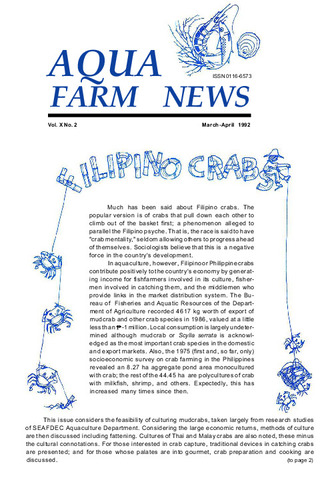
Aqua Farm News Volume 10(02) March - April 1992
(Aquaculture Department, Southeast Asian Fisheries Development Center, 1992)This issue considers the feasibility of culturing mudcrabs, taken largely from research studies of SEAFDEC Aquaculture Department. Considering the large economic returns, methods of culture are then discussed including ... -
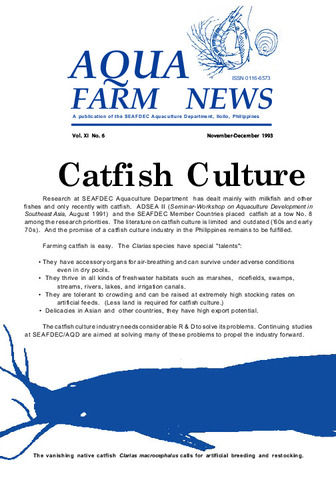
Aqua Farm News Volume 11(06) November - December 1993
(Aquaculture Department, Southeast Asian Fisheries Development Center, 1993) -
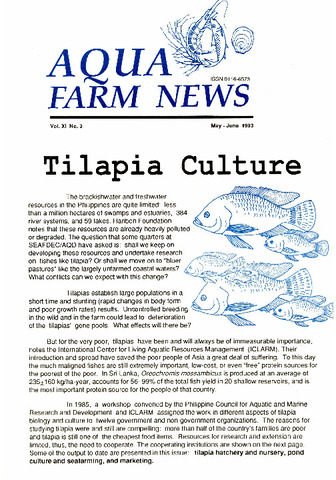
Aqua Farm News Volume 11(03) May - June 1993
(Aquaculture Department, Southeast Asian Fisheries Development Center, 1993) -
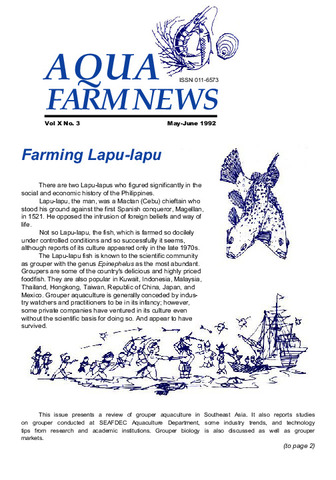
Aqua Farm News Volume 10(03) May - June 1992
(Aquaculture Department, Southeast Asian Fisheries Development Center, 1992)This issue presents a review of grouper aquaculture in Southeast Asia. It also reports studies on grouper conducted at SEAFDEC Aquaculture Department, some industry trends, and technology tips from research and academic ... -
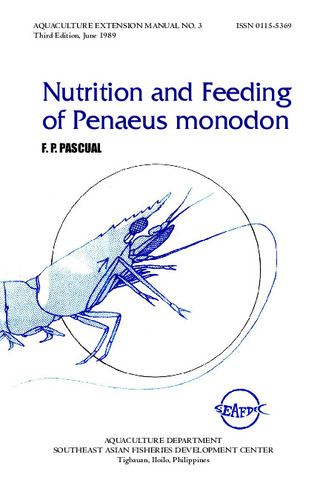
Series: Aquaculture extension manual; No. 3
Nutrition and feeding of Penaeus monodon
(Aquaculture Department, Southeast Asian Fisheries Development Center, 1989)Following an account of the feeding habits and nutritional needs of Penaeus monodon, diet formulation for cultured shrimp is discussed in detail. Equipment required, preparation of the diets and methods of feeding are detailed. -
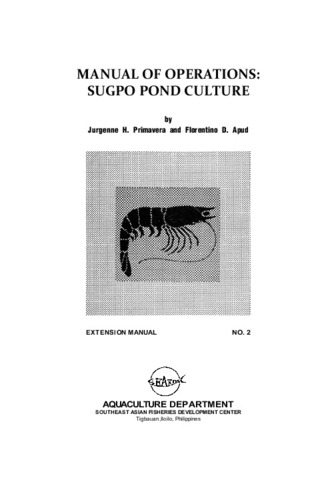
Series: Aquaculture extension manual; No. 2
Manual of operations: Sugpo pond culture
Primavera, Jurgenne ; (Aquaculture Department, Southeast Asian Fisheries Development Center, 1976)
This manual is intended for fish farmers, extension workers and others in their initial efforts to produce marketable sugpo (Penaeus monodon) for local consumption or export. Information is presented on pond preparation, stocking, transfer from nursery to rearing pond, rearing, harvesting, processing and transport. Appendices deal with the control of pests and predators, diseases, fertilization, and the estimation of rate of supplementary feeding.
; (Aquaculture Department, Southeast Asian Fisheries Development Center, 1976)
This manual is intended for fish farmers, extension workers and others in their initial efforts to produce marketable sugpo (Penaeus monodon) for local consumption or export. Information is presented on pond preparation, stocking, transfer from nursery to rearing pond, rearing, harvesting, processing and transport. Appendices deal with the control of pests and predators, diseases, fertilization, and the estimation of rate of supplementary feeding. -
Series: Aquaculture extension manual; No. 19
Prawn hatchery operations
; Quinitio, Emilia T.; (Aquaculture Department, Southeast Asian Fisheries Development Center, 1996-05)
The manual, an updated version of the 1984 SEAFDEC/AQD manual, presents the underlying principles and step-by-step instructions of prawn larval and post-larval rearing. The techniques described are not only applicable to Penaeus monodon, but may also be modified and applied to other penaeid and metapenaeid species. The following aspects are covered: Site selection; Life cycle; Hatchery design and planning; Hatchery operations; Diseases; and Economics. -
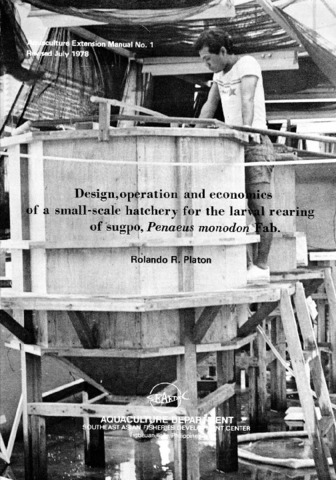
Series: Aquaculture extension manual; No. 1
Design, operation and economics of a small-scale hatchery for the larval rearing of sugpo, Penaeus monodon Fab.
(Aquaculture Department, Southeast Asian Fisheries Development Center, 1978)One of the major problems in the mass production of sugpo is how to obtain a constant supply of fry. Since ultimately it is the private sector which should produce the sugpo fry to fill the needs of the industry, the Barangay Hatchery Project under the Prawn Program of the Aquaculture Department of SEAFDEC has scaled down the hatchery technology from large tanks to a level which can be adopted by the private sector, especially in the villages, with a minimum of financial and technical inputs. This guide to small-scale hatchery operations is expected to generate more enthusiasm among fish farmers interested in venturing into sugpo culture. -
Series: Aquaculture extension manual; No. 10
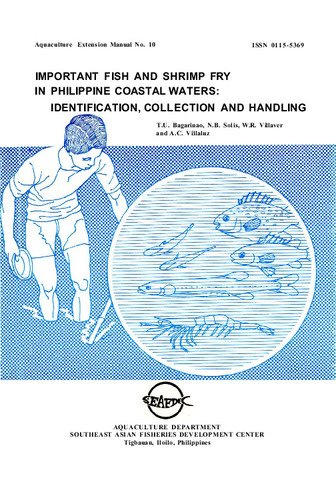
Important fish and shrimp fry in Philippine coastal waters : identification, collection and handling
Bagarinao, Teodora; ; ; (Aquaculture Department, Southeast Asian Fisheries Development Center, 1986)
-
Series: Aquaculture extension manual; No. 7
Broodstock of sugpo, (Penaeus monodon Fabricius)
Primavera, Jurgenne (Aquaculture Department, Southeast Asian Fisheries Development Center, 1989)
The manual provides information on the technology involved in induced maturation and broodstock of Penaeus monodon . Following background material on basic aspects of reproductive biology of the species such as mating, maturation, spawning and fecundity, a detailed discussion is presented on the broodstock tank and pen system and the ablation process. -
Stock enhancement of threatened species in Southeast Asia
; ; Quinitio, Emilia T.; ; Lebata, Ma. Junemie Hazel L. ; ; Garcia, Luis Maria ; Primavera, Jurgenne (Taylor & Francis, 2008)
Natural populations of global inshore fisheries are coming under heavy pressure, primarily due to overexploitation and habitat degradation. Stock enhancement of hatchery-reared seeds is perceived as an alternative strategy to enhance the regeneration process. The Aquaculture Department of the Southeast Asian Fisheries Development Center in the Philippines has been implementing activities related to stock enhancement of donkey’s ear abalone (Haliotis asinina), mud crabs (Scylla spp.), giant clam (Tridacna gigas), seahorses (Hippocampus spp.). Seed production techniques for abalone including a diet tagging method were established and juvenile abalone were released and monitored in a marine protected area. Mud crabs conditioned before release had higher recapture rates compared to the non-conditioned crabs, which can be translated to higher survivorship. Giant clams stocked at 8-10 cm shell length have higher survival 4 mo after stocking (90%), with initial mortalities occurring within the first few days due to transportation stress. Seed production trials for seahorse have begun. -
Research on marine and freshwater fishes
(Aquaculture Department, Southeast Asian Fisheries Development Center, 1995)Most of the fish research at SEAFDEC AQD in 1992-1994 was on milkfish. Studies were conducted on year-round spawning through hormonal or environmental manipulation; optimum lipid and protein levels and ration size for captive broodstock; and the influence of spawner age on reproductive performance. The economics of hatchery operations, alone or integrated with broodstock as a commercial enterprise, was assessed. Mass production of larvae was refined with the use of commercial or SEAFDEC-formulated larval diets. Alternative rearing schemes in large tanks and ponds were tried. Hatcheryproduced and wild-caught larvae were compared in terms of growth and production in experimental nursery and grow-out ponds. Supplemental diets for brackishwater grow-out culture were formulated. Studies on broodstock management of grouper Epinephelus spp. included lipid enrichment of the diet and hormonal induction of sex inversion. Seed production techniques were developed but survival rates were low. Grouper culture was found economically feasible in experimental ponds with 'trash' fish as feed. The mangrove red snapper Lutjanus argentimaculatus was successfully induced to spawn with injection of human chorionic gonadotropin. Initial larval rearing trials were successful but survival rates must be improved. Hormonal manipulation of spawning of the Asian sea bass Lates calcarifer allows seed production during most of the year. Photoperiod manipulation leads to maturation of females, but not males, beyond the natural breeding season (April-November). Nursery rearing of 9 mm juveniles is feasible in floating net cages with night lights that attract food zooplankton. The requirements of sea bass for lipid, protein, carbohydrates, and essential amino acids were determined. In the rabbitfish Siganus guttatus, weekly injections of luteinizing hormone releasing hormone analogue (LHRHa) sustains milt production for three weeks. Thyroid hormones injected into broodstocks improved the growth of larvae to day 7. Induced spawning techniques for the Asian catfish Clarias macrocephalus were refined by determining the seasonal responsiveness to LHRHa and pimozide injections and testing for pheromonal induction of spontaneous spawning. The optimum insemination rate was determined and egg hatchability was enhanced by removal of the adhesive coat before incubation. Several practical diets for catfish during grow-out culture were tested against 'trash' fish. The broodstock management for bighead carp Aristichthys nobilis was studied. Cage-reared juveniles from cage-reared broodstock showed the best growth. To improve the reproductive performance, the broodstock diets were supplemented with vitamins A, C, and E. Research on tilapias focused on genetics and strain selection. Several strain testing procedures for Nile tilapia were evaluated in their efficiency to detect economically important strain differences. Reference lines were developed from two existing red tilapia strains to measure and reduce the effects of uncontrolled nongenetic variables in strain evaluation experiments with Nile tilapia. The tolerance of two Nile tilapia strains to heavy metals was similar when gauged by the 24-hour and 96-hour lethal concentration and by fish growth, survival, and reproductive performance. In a separate study, four strains of red tilapia showed generally higher seed production when reared in tanks than in cages. Improvements in the feed and feeding management for Nile tilapia were also studied. Intensive tilapia farming and feeding have led to oxygen depletion and fish kills in Sampaloc Lake. To rehabilitate the lake, it is imperative to reduce the farming area from 30 to 6 hectares; stop the use of commercial feeds; and remove the water hyacinths and other debris. Fish kills in Laguna de Bay have also become serious in recent years, and a review of the occurrences, losses, and possible causes is currently being conducted. Studies on the epizootic ulcerative syndrome of snakeheads in Laguna de Bay have yet to pinpoint the pathogen. Skin lesions in tilapias in several ponds and lakes in the country were found to be due to bacteria. -
Seaweed: Gracilaria
(Aquaculture Department, Southeast Asian Fisheries Development Center, 1994)This paper reviews the studies on Gracilaria/Gracilariopsis conducted from 1988 to 1991 by the Aquaculture Department, Southeast Asian Fisheries Development Center. It includes 114 species of macrobenthic algae collected in Panay, the nomenclature of Gracilariopsis heteroclada previously described as Gracilaria sp., and the biology, ecology, and farming systems of Gracilariopsis. Agar quality of the different species of Gracilaria and the effect of seasonal variation on the quality and quantity of agar produced from Gracilariopsis heteroclada were also studied. -
Bivalves
(Aquaculture Department, Southeast Asian Fisheries Development Center, 1994)Mollusc research at the Aquaculture Department of the Southeast Asian Fisheries Development Center from 1989 to 1991 was primarily focused on the highly exploited window-pane oyster, Placuna placenta Linnaeus. Other species studied were the saddle-shaped oyster, Placuna sella, the slipper-shaped oyster, Crassostrea iredalei, and the green mussel, Perna viridis. Research on P. placenta aimed to develop techniques in seed production (broodstock maturation and induced spawning), transplantation, and stock assessment and restocking of depleted natural beds. The annual variations in the reproductive activity, condition index, and proximate composition of P. sella were determined. A socioeconomic study of oyster (C. iredalei) and mussel (P. viridis) farming practices in western Visayas, central Philippines is on-going and will provide information on current culture methods and their profitability. An inventory of mollusc researches conducted in the Philippines has been done and the culture techniques and research gaps are being reviewed and identified. This information will guide further research on molluscs in the Philippines. -
Shrimps
(Aquaculture Department, Southeast Asian Fisheries Development Center, 1994)During 1988-1991, research at the Aquaculture Department of SEAFDEC on the shrimp Penaeus monodon has been directed towards a) the development of captive broodstock, b) the refinement of hatchery and grow-out techniques, c) the development of diets for the various stages of culture, and d) the prevention and control of diseases. Biochemical, morphological, and histological characterization of the male and female reproductive systems were conducted to provide basic information for the development of techniques for pond-reared broodstock. Studies on the refinement of hatchery techniques included determination of the environmental and feeding requirements of larvae and postlarvae to serve as basis for the improvement of management practices. Refinement of grow-out techniques included studies on the physiological response of this species to vital environmental factors and studies on the role of natural food organisms during culture. Nutrition studies have resulted in the formulation, testing, and improvement of diets for broodstock, larvae and postlarvae, juveniles, and subadult shrimps. Methods of prevention and control of the luminous bacterial disease, chronic soft shell syndrome, aflatoxicosis, monodon baculovirus (MBV) infection, and other relevant diseases have been investigated through the identification of causative agents and bioassay of possible chemo-therapeutants. Studies to improve larval rearing of alternative shrimp species such as P. indicus, P. merguiensis, and P. japonicus have likewise been pursued. Nutritional requirements of the white shrimp species were evaluated to develop suitable formulated feeds for the different culture stages. -
Tilapia, carp and catfish
(Aquaculture Department, Southeast Asian Fisheries Development Center, 1994)Research activities on tilapia focused on Oreochromis niloticus and red tilapia. Experiments include developing new experimental and statistical procedures for strain evaluation, development of a stable reference strain, development of a high-yield red tilapia strain through introgressive hybridization, comparison of fish growth in different environments relevant to aquaculture, development of an index for routine monitoring of salinity tolerance of existing tilapia strains/experimental stocks, evaluation of nutritional requirements of red tilapia, and determination of heavy metal contents of tilapia in Laguna de Bay, Luzon, Philippines. Research on carp (Aristichthys nobilis) and catfish (Clarias macrocephalus) were focused on improvement of methods for induced spawning, development of seed production techniques, and nutritional requirement of bighead carp fry and broodstock. Research on carp (Aristichthys nobilis) and catfish (Clarias macrocephalus) were focused on improvement of methods for induced spawning, development of seed production techniques, and nutritional requirement of bighead carp fry and broodstock. -
Sea bass, groupers and snappers
(Aquaculture Department, Southeast Asian Fisheries Development Center, 1994)Studies on sea bass (Lates calcarifer) broodstock were directed at techniques to maximize egg production. Now known are the: optimum luteinizing hormone releasing hormone analogue (LHRHa) dose range to induce spawning, optimum egg size responsive to LHRHa induction, appropriate time for induction, proper storage conditions for LHRHa, and induction of spermiation in males. Gonadal maturation and spawning are successfully induced by LHRHa and/or 17 alphamethyltestosterone. An experiment on photoperiodic induction of sexual maturation is being conducted to produce seed year round. Increased information on larval morphology and physiology of sea bass led to improvements in feeding strategies and transport techniques. Studies on nutrient requirements and practical diets are currently being undertaken for different stages/sizes of sea bass. An economic assessment found an integrated sea bass production system viable. Studies on groupers (Epinephelus spp.) have been geared towards broodstock development including induction of sex inversion by hormonal control, intraspecific interaction, and sex control using synthetic anabolic steroids. Spontaneous maturation and successive spawnings of captive Epinephelus suillus were achieved in 1990. Larval rearing techniques used for other marine fish species were tried but with limited success. Culture techniques in ponds and floating cages using SEAFDEC-formulated diets or commercial pellets are being developed. Studies on snappers (Lutjanus spp.) have been started with the identification of species common in Panay Island. -
Milkfish, rabbitfish and mullet
(Aquaculture Department, Southeast Asian Fisheries Development Center, 1994)This paper reviews studies conducted on milkfish (Chanos chanos), rabbitfish (Siganus guttatus), and mullet (Mugil cephalus) at the SEAFDEC Aquaculture Department from 1968 to 1991. Milkfish studies focused on hormonal induction of off-season gonadal maturation, dietary manipulation of milkfish broodstock to improve egg and larval quality, improvement of larval rearing techniques for mass fry production and technology transfer to the private sector, and search for a low-cost, practical diet for milkfish and a supplemental diet to increase pond production. Preliminary success on alternate feed for larval rearing and spontaneous maturation of milkfish in concrete tanks may help alleviate milkfish fry supply in the future. Studies on rabbitfish centered on improvement of larval survival and search for the optimum diet for growth of rabbitfish fry and juveniles reared in ponds. The difficulty in rearing rabbitfish larvae due to high mortality at first week after hatching hinders the development of the rabbitfish industry. Research involving mullet was solely on the establishment of broodstock for fish propagation. -
Using local user perceptions to evaluate outcomes of protected area management in the Sagay Marine Reserve, Philippines
(Cambridge University Press, 2004)Local user perceptions of resource trajectory and indicators of protected area outcomes can be useful in the assessment of integrated conservation projects, both marine and terrestrial. In-depth stakeholder surveys using 12 performance indicators were used to evaluate the perceived outcomes of the Sagay Marine Reserve (SMR), the Philippines. These indicators were a measure of whether the SMR had achieved its management objectives in the recent past and what local stakeholders expected in the future. The respondents contextual situation could be correlated with their perceptions of SMR indicators. There was a generally high level of perceived equity and efficiency of SMR management outcomes, but the sustainability of the SMR, particularly the condition of the fisheries, had been poor over the previous 10 years. Few anticipated an improvement in sustainability indicators over the next 10 years. Respondents from an island village within the SMR had more negative (or less positive) perceptions of SMR outcomes because of their high dependence on the degraded resource, combined with physical and economic isolation. Specific remedies to enhance island villagers satisfaction, such as greater participation, empowerment, alternative economic opportunities and fisheries protection, and replenishment, are necessary. This research serves as an example of how indicators perceived by local resource-accessing stakeholders can and should be main components of both marine and terrestrial protected area assessment. -
Approaches to stock enhancement in mangrove-associated crab fisheries
; Lebata, Ma. Junemie Hazel L.; ; Primavera, Jurgenne ; Quinitio, Emilia T. ; ; ; ; ; ; ; (Taylor & Francis, 2008)
Over the last decade, hatchery production of mud crabs has become technically and economically more feasible, enabling evaluation of the potential effectiveness of hatchery release in fisheries enhancement. The high growth rates and limited movement of released crabs means that fisheries’ yields an isolated mangrove systems with restricted recruitment can be enhanced with a few months. Thus, a release program may be an effective strategy for short-term enhancement in carefully selected specific areas. To date, results are very promising; with recovery rates up to 50% and increases in fisheries’ yield up to 46% over baseline catches. In contrast, mark-recapture studies in more open mangrove system populations shows that recruitment success and subsequent stock abundance may be largely determined by habitat availability. For these populations, restoration of lost o degraded mangrove areas has been show to be effective in promoting stock recovery through natural recruitment, with replanted mangroves supporting fisheries of equivalent economic value to that of natural mangroves, though it may take some years to reach these levels. Thus, a balanced approach to stock management could integrate both hatchery-release and habitat restoration programs, depending on local conditions and over different thin scales, with parallel-co-management to support effectiveness.