Using local user perceptions to evaluate outcomes of protected area management in the Sagay Marine Reserve, Philippines


Share
Abstract
Local user perceptions of resource trajectory and indicators of protected area outcomes can be useful in the assessment of integrated conservation projects, both marine and terrestrial. In-depth stakeholder surveys using 12 performance indicators were used to evaluate the perceived outcomes of the Sagay Marine Reserve (SMR), the Philippines. These indicators were a measure of whether the SMR had achieved its management objectives in the recent past and what local stakeholders expected in the future. The respondents contextual situation could be correlated with their perceptions of SMR indicators. There was a generally high level of perceived equity and efficiency of SMR management outcomes, but the sustainability of the SMR, particularly the condition of the fisheries, had been poor over the previous 10 years. Few anticipated an improvement in sustainability indicators over the next 10 years. Respondents from an island village within the SMR had more negative (or less positive) perceptions of SMR outcomes because of their high dependence on the degraded resource, combined with physical and economic isolation. Specific remedies to enhance island villagers satisfaction, such as greater participation, empowerment, alternative economic opportunities and fisheries protection, and replenishment, are necessary. This research serves as an example of how indicators perceived by local resource-accessing stakeholders can and should be main components of both marine and terrestrial protected area assessment.
Suggested Citation
Web, E. L., Maliao, R. J., & Siar, S. V. (2004). Using local user perceptions to evaluate outcomes of protected area management in the Sagay Marine Reserve, Philippines. Environmental Conservation , 31(2), 138-148. https://doi.org/10.1017/S0376892904001377
Type
ArticleCollections
- Journal Articles [1267]
Related items
Showing items related by title, author, creator and subject.
-
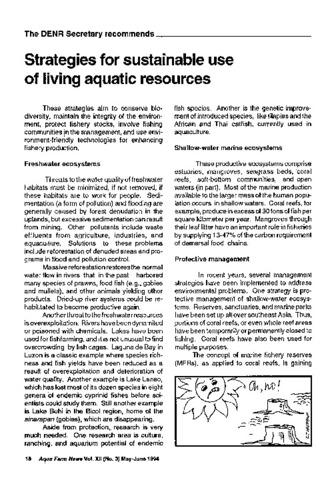
Strategies for sustainable use of living aquatic resources
(Aquaculture Department, Southeast Asian Fisheries Development Center, 1994) -
ASEAN-SEAFDEC directives related to species of international concern
(Aquaculture Department, Southeast Asian Fisheries Development Center, 2006)To achieve sustainable fisheries for food security in the ASEAN region, the Resolution (RES) and Plan of Action (POA) urge the Member Countries to rectify their fisheries practices through improvement of existing fisheries management policy, framework and practices as well as implementation of the Code of Conduct for Responsible Fisheries (CCRF), RES and POA. Improvement of fisheries management includes the gradual introduction of decentralized rights-based fisheries and co-management systems, regulation/control of fishing activities, protection/rehabilitation of important aquatic resource habitats, resource/stock enhancement, and so on. In addition, the RES and POA also highlight the need to enhance partnership among Member Countries in the region through the formulation of common positions as well as to increase their participation and involvement in international fora (FAO, CITES, etc.) to safeguard and promote ASEAN interests particularly on issues of international concern. In line with the above general directives, especially in relation to stock enhancement of species under international concern, senior fisheries officials of ASEAN and SEAFDEC have urged proactive approaches in tackling the issues and gave the following directives: 1) To increase support to national initiatives and to facilitate regional cooperation on stock enhancement including identification of concerned species and their status, interaction between concerned species and fishing, and integrated approach and community involvement in management and conservation of aquatic resources; 2) To identify issues/species of international concern and conduct review on status of the issues/species as basis for formulation of fisheries policy as well as common positions among the Member Countries in international fora; 3) To compile information on status and initiatives related to management and conservation of aquatic resources and to disseminate them in appropriate international fora to enhance awareness of the regional situation and seriousness of the issues; 4) To promote appropriate inter-agency coordination on the issues at national and regional levels, and 5) To promote involvement of national fisheries agencies in national/regional/international fora/mechanisms related to utilization and management of aquatic resources. -
Japan: Mangrove areas and their utilization
(Aquaculture Department, Southeast Asian Fisheries Development Center, 2000)Although Japan has large-scale aquaculture, there is no aquaculture development in mangrove areas because the total area is small (553 ha) and strictly protected. Mangroves are preserved in comparatively good condition. Future development of aquaculture in mangrove areas is considered small-scale. Rather than aquaculture, Japan practices enhancement and management of wild fisheries. Tourism is another industry that would have an important role in mangrove utilization. But basic research on mangrove ecosystems is essential prior to determining policies for utilization of mangrove areas. International cooperative research work is important to encourage mangrove-friendly aquaculture and protect the environment.