SEAFDEC/AQD Institutional Repository: Recent submissions
Now showing items 2801-2820 of 4221
-
Fishpen and cage farming in the Philippines
(Aquaculture Department, Southeast Asian Fisheries Development Center; International Development Research Centre, 1979)Paper was presented at the International Workshop on Cage and Pen Culture, SEAFDEC, Tigbauan, Iloilo, Philippines in February 1979. It deals with cage farming in freshwater lakes of milkfish (Chanos chanos) and mentions briefly Tilapia mossambica, T. nilotica and trial culture of the prawn Penaeus monodon. -
Series: Aquaculture extension manual; No. 25
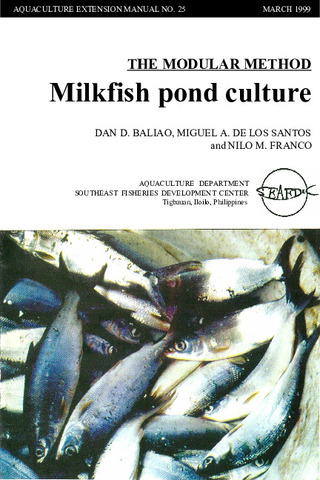
The modular method: Milkfish pond culture
(Aquaculture Department, Southeast Asian Fisheries Development Center, 1999)The modular method of milkfish culture (Chanos chanos) described in the manual is an improvement over the traditional extensive method. The manual is intended for the use of fish farmers and aquaculturists, extensionists, and students of aquaculture not only in the Philippines, but also in other milkfish-producing countries in Southeast Asia and the world. It covers the following: Interesting facts about milkfish -- biological characteristics, artificial breeding of milkfish; Design and operation of modular pond system -- pond preparation, stocking in the nursery or transition ponds, stocking in the rearing ponds, care of stock, pond utilization and production schedule, harvest and post-harvest; and, Economics and costing. -
Series: Aquaculture extension manual; No. 31
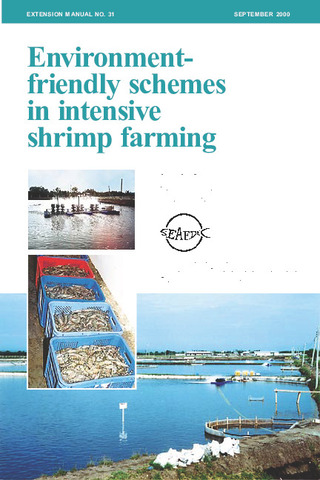
Environment-friendly schemes in intensive shrimp farming
(Aquaculture Department, Southeast Asian Fisheries Development Center, 2000)The black tiger shrimp, Penaeus monodon, has been successfully raised by the SEAFDEC Aquaculture Department, Technology Verification and Extension Section at its Dumangas Brackishwater Station. The approaches in the culture method employed in the series of verification runs in the brackishwater station are documented to serve as an interim guide for shrimp growers while these are still being further refined and standardized. -
Series: Aquaculture extension manual; No. 29
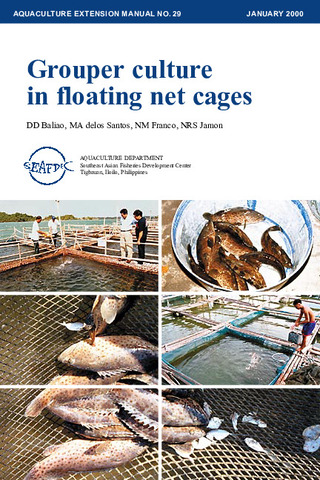
Grouper culture in floating net cages
(Aquaculture Department, Southeast Asian Fisheries Development Center, 2000)The manual describes the culture of groupers (Epinephelus) in floating cages, providing a farming option for grouper growers and also a production alternative to the farmed species being done today, such as shrimp, milkfish and tilapia. The following aspects are covered: species identification for commercially cultured groupers; source of stock; net cage specifications; anchor; hides and shelters; nursery net cage operation; production cages; harvesting; post-harvest; profitability analysis of grouper cage culture; and, cost and return of growing grouper in cages. -
AQD highlights 2004
(Aquaculture Department, Southeast Asian Fisheries Development Center, 2005)The SEAFDEC Aquaculture Department is mandated to: 1) conduct scientific research to generate aquaculture technologies appropriate for Southeast Asia; 2) develop managerial, technical and skilled manpower for the aquaculture sector; and, 3) disseminate and exchange aquaculture information. The Aquaculture Department in the Philippines maintains 4 stations: the Tigbauan Main Station and Dumangas Brackishwater Station in Iloilo; the Igang Marine Station in Guimaras; and, the Binangonan Freshwater Station in Rizal. Highlights are provided of the seven research programmes and activities conducted by the department during the year 2004. -
AQD highlights 2005
(Aquaculture Department, Southeast Asian Fisheries Development Center, 2006)The SEAFDEC Aquaculture Department is mandated to: 1) promote and undertake aquaculture research that is relevant and appropriate for the region; 2) develop human resources for the region; and, 3) disseminate and exchange information in aquaculture. The Aquaculture Department in the Philippines maintains 4 stations: in Iloilo Province, the Tigbauan Main Station and Dumangas Brackishwater Station; in Guimaras, the Igang Marine Station; and, in Rizal, the Binangonan Freshwater Substation. Highlights are provided of the research programmes and activities conducted by the department during the year 2005. -
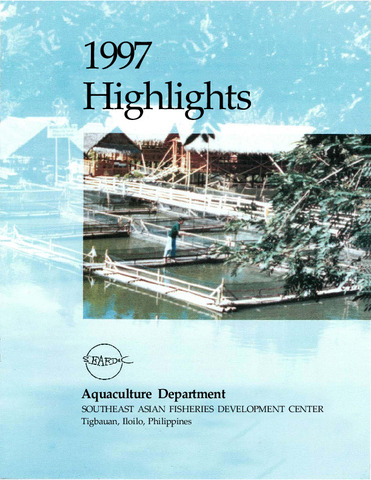
1997 highlights
(Aquaculture Department, Southeast Asian Fisheries Development Center, 1998)Discusses AQD's accomplishments in 1997 in the areas of: • poverty alleviation -- the community fishery resource management projects in Malalison Island and Honda Bay • food security issues -- the technical assistance to local government units on low input aquaculture products like tilapia and mussel-oyster • environment-friendly aquaculture technologies -- the development of mudcrab culture techniques in reforested mangrove areas, and the rehabilitation of mangroves / abandoned ponds through aquasilviculture • research into export or cash crops -- mudcrab, tiger shrimp, grouper, seabass, snapper, catfish, seaweeds, abalone, marine ornamental fish. Also discussed: technology verification activities, training, and information dissemination. -
Series: Aquaculture extension manual; No. 28
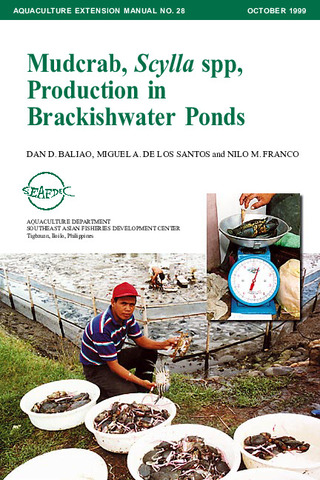
Mudcrab, Scylla spp, production in brackishwater ponds
(Aquaculture Department, Southeast Asian Fisheries Development Center, 1999)Mudcrab (Scylla spp) production in brackishwater ponds is now gaining popularity, especially in communities that need to supplement their income. The manual covers the following: Distribution; Grow-out operation in ponds - site selection, pond specification, pond preparation, source of juveniles, transport and stocking of juveniles, care of pond and stock, feeds and feeding, harvest, post-harvest; Production and profits; Cost and analysis. It is hoped that the manual will be of use to fishfarmers and aquaculturists, extensionists, and students of aquaculture not only in the Philippines but also in other mudcrab producing countries in Southeast Asia. -
Replacement of fish meal by animal by-product meals in a practical diet for grow-out culture of grouper Epinephelus coioides
(Elsevier, 2002)A feeding trial was conducted to evaluate the potential of replacing fish meal with processed animal by-product meals, meat meal and blood meal (4:1 ratio), in practical diets for juvenile grouper (Epinephelus coioides). Eight isonitrogenous diets were formulated to contain 45% protein and 12% lipid. Fish meal was replaced by 0%, 10%, 20%, 30%, 40%, 60%, 80%, and 100% of meat meal and blood meal (4:1) mixture (diets 1–8). The diet with 100% fish meal (diet 1) or trash fish as feed (diet 9) were used as controls. Grouper juveniles were reared in 250-l circular fiberglass tanks maintained in a flow-through seawater system. Each dietary treatment was tested in quadruplicate groups of 25 fish per tank arranged in a completely randomized design. Fish were fed the diets twice per day at a daily feeding rate of 5–6% of biomass and trash fish at 10–12% of biomass for 60 days. Percentage weight gain, specific growth rate (SGR), survival, feed conversion ratio (FCR) and body composition of grouper juveniles were measured. There were no significant differences (P>0.05) in growth performance among fish fed diets 1–7 (0–80% fish meal replacement) with those fed diet 9 (trash fish as feed). However, fish fed diet 3 had significantly higher (P<0.05) growth than those fed diet 8 (100% fish meal replacement). Survival among fish fed the experimental diets did not significantly differ (96–100%) but was significantly higher (P<0.05) than survival (90%) of fish fed trash fish. These results showed that up to 80% of fish meal protein can be replaced by processed meat meal and blood meal coming from terrestrial animals with no adverse effects on growth, survival, and feed conversion ratio of E. coioides juveniles. -
Vibrio harveyi isolated from cage-cultured seabass Lates calcarifer Bloch in the Philippines
Tendencia, Eleonor (Blackwell Publishing, 2002)
-
Bamboo back disease in tiger shrimp, Penaeus monodon
Tendencia, Eleonor (European Association of Fish Pathologists, 2002)
This report describes bamboo back disease affecting Penaeus monodon in the Philippines. Affected and normal shrimps were processed for bacterial isolation and histopathology. Morphological changes in the external anatomy were also noted. The cuticle of the abdominal segments of shrimp with bamboo back disease do not overlap properly which gives them a bamboo-like appearance. The appendages are shorter compared with normal shrimps. No bacteria were recovered from the hepatopancreas, lymphoid organ, and hemolymph thus ruling out bacterial infection. Histopathology shows normal hepatopancreas, but the muscle fibers of the abdominal segments are fragmented and necrotic. -
Identification of stressors that affect white spot syndrome virus (WSSV) infection and outbreak in pond cultured Penaeus monodon.
Tendencia, Eleonor; (The Society of Israeli Aquaculture and Marine Biotechnology, 2011)
White spot syndrome virus (WSSV) has been a big problem to the worldwide shrimp industry. Exposure to stressors related to physicochemical water parameters affect WSSV infection but not all WSSV infections result in outbreaks. This paper describes a detailed monitoring of important physicochemical water parameters on a farm with 11 ponds that had WSSV infection. The virus was detected in shrimp exposed to two or more simultaneous stress factors (temperature, pH, water level) or multiple stressors for a number of days. Exposure to more than three stressors resulted in an outbreak of the disease within 3-6 days. Outbreaks were experienced in ponds with a temperature of 26-27°C, a pH lower than 8.0, pH fluctuation of 1.0, and a water depth of less than 1 m. Shrimp stocked in eight of the ponds were successfully harvested after 128-173 days of culture. -
The first report of Vibrio harveyi infection in the sea horse Hippocampus kuda Bleekers 1852 in the Philippines
Tendencia, Eleonor (Blackwell Publishing, 2004)
-
Site selection, structural design, construction, management and production of floating cage culture system in Malaysia
(Aquaculture Department, Southeast Asian Fisheries Development Center; International Development Research Centre, 1979)The success of cage culture system is largely determined by correct selection of favourable sites, suitable cage size and facilities and management of the system. These three elements are considered in this paper in relation to culture systems in Malaysia. -
The European and Hungarian results of cage culture of fish
(Aquaculture Department, Southeast Asian Fisheries Development Center; International Development Research Centre, 1979)After a brief history of the cage culture of fish in Europe, the results of cage culture experiments in Hungary are presented with particular reference to the cage cultures of wels, Silurus glanis , bester (hybrid of Huso huso and Acinpenser ruthenus) and the common carp Cyprinus carpio . -
The use of aquatic plants as feed for Tilapia nilotica in floating cages
(Aquaculture Department, Southeast Asian Fisheries Development Center; International Development Research Centre, 1979)Three kinds of aquatic plants, namely, Hydrilla verticillata, Lemna minor , and Chara sp. were used as feed for the T. nilotica reared in floating cages at three levels of stocking densities: 5, 15, and 45 fishes per cage. Results of the study showed that Lemna minor gave the best effect on growth rate of the fish in every level of stocking density. Feed conversion rate ranged from 19 to 33; Lemna minor was the lowest (33:1), while Chara sp. was the highest (19:1). -
Prospects of fish farming in cages in Karnafuli reservoir (Bangladesh)
(Aquaculture Department, Southeast Asian Fisheries Development Center; International Development Research Centre, 1979)The Karnafuli Reservoir (Kaptai Lake) has immense prospects for aquaculture as shown by recent limnological and biological studies. It is therefore expected that fish cages culture will become a booming industry in Karnafuli Reservoir. -
Net cage culture of Lates calcarifer Bloch and other marine animals in Thailand
(Aquaculture Department, Southeast Asian Fisheries Development Center; International Development Research Centre, 1979)Feeding experiments on sea bass, Lates calcaifer , have been carried out in nylon net cages in Songkhla, since 1971, to obtain information on: (1) growth rates; (2) survival rates; (3) food conversion rates; (4) environmental conditions that affect the fish. Data from these experiments, some of which are briefly reproduced in this paper, prove that sea bass can be successfully cultured in net cage. Among other marine invertebrates, the cuttle fish, Sepia sp., showed the best potential for culture in net cage. -
Prospects of developing cage and pen culture in Sudan
(Aquaculture Department, Southeast Asian Fisheries Development Center; International Development Research Centre, 1979)This paper describes the prospects of cage and pen culture in Sudan and recommends that a project for developing pen and cage culture techniques be started for marine and freshwater aquaculture. -
Development of circular floating cages for milkfish broodstock at the SEAFDEC Aquaculture Department
(Aquaculture Department, Southeast Asian Fisheries Development Center; International Development Research Centre, 1979)The present attempt to develop floating cages for holding milkfish, Chanos chanos, broodstock at SEAFDEC was prompted by the need of the department to have more fish for experimentation. This paper briefly presents the departments experience in developing the cage culture system designed for holding milkfish for broodstock purposes. The following points are discussed: (1) site location; (2) biological factors; (3) floats; (4) netting; (5) framework; (6) layout and mooring; (7) maintenance; (8) cost. Designs are given for the net cage cover, frame and floats.