SEAFDEC/AQD Institutional Repository: Recent submissions
Now showing items 3221-3240 of 4221
-
Histopathology of microsporidian infection in white prawn, Penaeus merguiensis de Man, 1888.
(University of the Philippines, 1982)Different stages of the white prawn, Penaeus merguiensis de Man, were examined for microsporidian infection. The parasite was found only in adult female prawns exhibiting white instead of the normal olive-green ovaries. Non-germinal tissues were not infected. Spores found in the digestive tract, abdominal muscles, hepatopancreas, heart and gills were extracellular in location and did not have any histopathologic effect on these organs. -
Effect of light quality and eyestalk ablation on ovarian maturation in Penaeus monodon
; Primavera, Jurgenne (University of the Philippines Los Baños, 1981)
Prawns were subjected to the following treatments: blue light, red light, natural light, and natural light plus unilateral eyestalk ablation. Unablated prawns under blue and natural light developed stage III ovaries; under red light ovarian maturation reached only stage II. Ablation resulted in full maturation of ovaries and subsequent spawning. The external changes of the ovary were generally the same for both the ablated prawns under natural light and the unablated under different light qualities. Under blue light, however the ovary at stage III had numerous atretic cells and the diameter of its ova was more uniform. The maturation stage and mean gonadosomatic indices were high for the ablated and low for the unablated prawns.
(University of the Philippines Los Baños, 1981)
Prawns were subjected to the following treatments: blue light, red light, natural light, and natural light plus unilateral eyestalk ablation. Unablated prawns under blue and natural light developed stage III ovaries; under red light ovarian maturation reached only stage II. Ablation resulted in full maturation of ovaries and subsequent spawning. The external changes of the ovary were generally the same for both the ablated prawns under natural light and the unablated under different light qualities. Under blue light, however the ovary at stage III had numerous atretic cells and the diameter of its ova was more uniform. The maturation stage and mean gonadosomatic indices were high for the ablated and low for the unablated prawns. -
An assessment of algal growth in net cages in Laguna Lake
(Fisheries Research Society of the Philippines, 1981)Quantitative determination of the algal population, in terms of cells/ml and biomass/ml, was conducted during the first month of growing P. monodon postlarvae in Laguna Lake. Algae were sampled from each side of net cages at depths of 15, 30 and 45 cm below the water surface. Accumulation of algae appeared to be influenced by the direction of water flow. Moreover, growth of algal species was inversely proportional to depth of water. After two weeks, algal biomass was estimated to reach 4.5 kg per cage (1 x 1 x 1 m). Diatoms (Chrysophyta) predominated throughout the experimental period followed by members of Cyanophyta and Chlorophyta. -
A comparison of two prawn (Penaeus monodon ) brood stock systems—land–based tanks and marine pens
Primavera, Jurgenne; (World Aquaculture Society, 1981)
The paper compares two prawn (Penaeus monodon) brood stock systems—land-based tanks and marine offshore pens. Construction costs and annual maintenance and operating costs total US\$1,430 and \$2,550 for the tank and \$1,500 and \$3,680, respectively, for the pen. The 12 m3 ferrocement tank requires power for a 24-hour seawater flowthrough and can stock 50 animals/run for a projected yearly production of 8×10⁶ nauplii for 1.2 × 10⁶ juveniles (0.1 to 0.5 g body weight). The 16×16×4 m pen made of bamboo and nylon net materials can accommodate 300 brood stock/run with a projected annual production of 30 × 106 nauplii or 4.5 × 10⁶ juveniles. Discussion includes general requirements, mortality and maturation rates, and criteria for choosing a brood stock system. -
Lactate dehydrogenase isozyme patterns during the development of milkfish, (Chanos chanos (Forskal))
(University of the Philippines at Los Baños, 1981)Polyacrylamide disc gel electrophoresis was done to determine the lactate dehydrogenase (LDH) isozyme patterns for fry (5-3 mg), fingerling (6-12 g), pond-size (150-250 g) and adult (6-9 kg) milkfish. The patterns were tissue specific; the different tissues examined, viz., eye, liver, heart, and skeletal muscle had different expressions of LDH isozymes. The resolved patterns appeared to be products of LDH gene loci A, B, and C. Subunits A and B were present in all tissues. A4 and B4 were predominant in skeletal and heart muscle, respectively; the two associated non-randomly in vivo and formed only the heteropolymers A3B and AB3. A liver band, L4, was most conspicuous in the fingerling, pond-size, and adult; it was assumed to be coded by locus C. A negatively charged band, X4, was detected in fully developed ovary and in fry homogenized as whole individuals, but it could not be resolved in tissues of fingerling. Six-mo old stunts and 3-mo old fingerlings had similar LDH patterns for all tissues examined. The patterns for 11-mo old stunts and fingerlings also were similar but the one for the eye of the former was the same pattern resolved for the eye of adults. There was no change in the LDH isozyme patterns of milk fish stunted for 6 mo under different salinity levels (0-5, 15-20, 32-35 ppt). -
The hydraulic control structure: A threat to the fishpen industry in Laguna de Bay.
(Natural Resources Management Center, 1981) -
Identification of postlarvae of the genus Penaeus appearing in shore waters
(Carcinological Society of Japan, 1981)Diagnostic features for the identification of postlarval Penaeus found in the shore waters of the Philippines are described and categorized based on specimens caught from the wild and those hatched and reared in the laboratory. Differentiating features for postlarval Penaeus are given which include the relative length of the antennular flagellum, the shape of the rostrum and number of rostral teeth, the antennal spine, the spinules on the dorsal caina of the sixth abdominal segment, and chromatophore patterns. Postlarval Penaeus were classified into two species and two groups as follows: (1) P. monodon, larger in size with dense chromatophores, and the long inner antennular flagellum being more than 2.0 times the outer antennular flagellum; (2) P. semisulcatus, the inner flagellum being 1.6 to 2.0 times the outer antennular flagellum, the the absence of chromatophore on the middle portion of the telson and uropods; (3) P. merguiensis group, less pigmented, the inner flagellum being less than 1.6 times the outer flagellum and (4) P. japonicus group, a short rostum, presence of spinules on the dorsal carina of the sixth abdominal segment, and dense chromatophores. The determinations were confirmed by rearing experiments. -
Studies on the habitat and food of juvenile milkfish in the wild
; Bagarinao, Teodora (Fisheries Research Society of the Philippines, 1981)
Juvenile milkfish (Chanos chanos ) were collected from several different wild environments in Panay Island and neighboring islands. The fish were measured and the food ingested examined. Conditions of milkfish habitats were also described. It was found that the fish can live and grow in almost any kind of coastal wetlands of calm and rich sediments, such as coralline lagoon, mangrove lagoon, estuary, and bay. In the waters where plant materials were rich at the bottom, the fish fed on them and their intestines were significantly long, while in other waters where less plant materials were available at the bottom, the fish fed but with considerable amount of animal elements and possessed shorter intestines. These differences are considered as adaptations of the fish to different habitats. -
A new device for recording the feeding activity of milkfish
(The Japanese Society of Scientific Fisheries, 1981)Knowledge on the feeding activity is basic and very important for rearing fish. The information on the feeding activity rhythm of the animal suggests the proper time to feed it. Many devices have been designed to record the feeding activities of aquatic animals. Some are mechanical devices which are difficult to maintain in good conditions for a long time. None of the present devices can be applied to milk-fish because of its characteristic manner of taking food. In this paper, a new electrical device for recording the feeding activity of milkfish is reported. -
Viability of frozen algae used as food for larval penaeids
(Fisheries Research Society of the Philippines, 1981)Freezing with added chemicals as flocculants and protectants as means of preserving stock cultures was tried with four species commonly used as larval food. The species were Chaetoceros calcitrans, Skeletonema costatum, Tetraselmis chuii , and Isochrysis galbana. Except in I. galbana , this method successfully preserved the viability of the algae tested. C. calcitrans , was viable up to eighteen months storage; T. chuii , four months; and S. costatum , two months. Cryophylaxis did not seem to greatly increase the viability of frozen cells except with T. chuii ; however, with the diatoms, viability was preserved regardless of the harvesting flocculant used and whether or nor protectants were added. -
Effect of different stocking combinations on growth, production and survival of milkfish (Chanos chanos Forskal) and prawn (Penaeus monodon Fabricius) in polyculture in brackishwater ponds
; Primavera, Jurgenne (Elsevier, 1981)
Milkfish (Chanos chanos) and prawn (Penaeus monodon) were stocked in 500 m2 earthen ponds from 12 November 1978 to 15 March 1979 at the following combinations: 2000 milkfish fingerlings per ha (treatment I); 2000 milkfish fingerlings plus 4000 prawn juveniles per ha (treatment II); and 2000 milkfish fingerlings plus 8000 prawn juveniles per ha (treatment III), with three replicates per treatment. Highest combined net milkfish and prawn production was obtained in treatment III with 492.1 kg/ha followed by treatment II with 404.1 kg/ha, and treatment I (milkfish only) with 280 kg/ha. Differences in combined net production between treatments III and I and between treatments II and I were statistically significant at the 5% level. Average net production of milkfish alone was also highest in treatment III followed by treatment II and treatment I, although differences were not significant. Average net production for prawn was also better in treatment III than in treatment II but the difference was not significant. However, mean weight of prawn was higher in treatment II compared to treatment III. Average survival rates were high for milkfish in all treatments ranging from 90 to 96%, but low for prawn at around 50% for both treatments. There was no significant difference in survival rates of milkfish among treatments and of prawn between treatments II and III. The competition index between milkfish and prawn at the given stocking combinations was negative indicating a positive, advantageous influence of prawn on milkfish production. -
Acute toxicity of un-ionized ammonia to milkfish (Chanos chanos) fingerlings
(Fisheries Research Society of the Philippines, 1981)The acute toxicity of un-ionized ammonia to milkfish (Chanos chanos) fingerlings was determined using a static bioassay system. The 24-, 48-, 72-, and 96-hr LC50 values were calculated at 25.74 ppm NH3-N (1.89 ppm NH3), 23.06 ppm NH3-N (1.46 ppm NH3), 21.62 ppm NH3-N (1.25 ppm NH3) and 20.65 ppm NH3-N (1.12 ppm NH3), respectively. -
Developmental and ecological stages in the life history of milkfish Chanos chanos (F.)
(Fisheries Research Society of the Philippines, 1981)Seven stages in the life history of milkfish Chanos chanos are suggested: embryonic, yolksac larval, larval, postlarval, juvenile, sub-adult and adult stages. These were based on morphological differences and on their particular ecological requirements. The latter include: behavioral pattern, food and feeding habits, and habitat requirements. Throughout the life cycle of milkfish the stronger driving force with determines particular behavioral strategies can be attributed to the evolutionary response of the organism of food distribution (availability) followed by predation pressure. -
Pigmentation pattern in the early developmental stages of milkfish (Chanos chanos): A key for larval identification.
(Fisheries Research Society of the Philippines, 1981)Pigmentation patterns are presented for 5 - 20 day old milkfish (Chanos chanos) and are discussed in terms of their use in larval identification. -
Survival, growth and production of Penaeus monodon Fabricius at different stocking densities in earthen ponds with flow-through system and supplemental feeding.
(Fisheries Research Society of the Philippines, 1981)Penaeus monodon juveniles (P53-P54, 0.45 g) were stocked in 200 m2 earthen ponds with water exchange rate of 5-10% daily, and reared for 3.5 months. Stocking density levels of 2.5, 5.0, 10 and 20 prawns/m2 were designated as treatments A, B, C and D, respectively. Pelletized formula feed was given daily from the second week of stocking at 10% of biomass and was reduced bi-weekly by 1% to a final rate of 5% of biomass. Significantly, high survival was achieved in treatment A, 98.6% followed by B, 95.3%; D, 87.6% and C, 86.5% (P < 0.05). The final average body weight obtained varied inversely with stocking density. Mean body weight for treatments A and B were significantly higher than those of treatments C and B. Results also showed significant differences among all paired means of the final weights except between treatments C and D. -
Feeding behavior and food preference of Penaeus monodon Fabricius with scrap Tilapia mossambica
(Fisheries Research Society of the Philippines, 1981)The time of day during which P. monodon feeds at different depth levels in earthen ponds, and its preference for three types of tilapia feeds (dry, fresh and fermented) were determined. It was observed that P. monodon concentrated at the bottom beds during the day and along the periphery of dikes during night-time, with a slight tendency to swim and feed towards the surface as darkness increased. P. monodon showed special preference for dried tilapia compared to fresh and fermented tilapia. P. monodon also showed adaptability to the platform method of feeding, especially during night-time. -
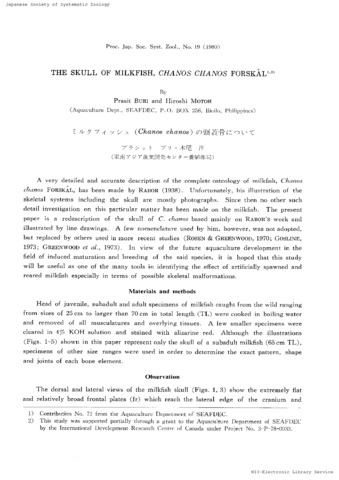
The skull of milkfish, Chanos chanos Forsskal
(Japanese Society of Systematic Zoology, 1980)The skull of the milkfish, C. chanos, is described so that it may be used as a tool in identifying the effect of artificial propagation in terms of skeletal malformations. -
The effects of feeds and feeding levels on the survival of a prawn, Penaeus monodon larvae
(Kagoshima University Research Center for the South Pacific, 1980)Penaeus monodon larvae were grown from zoea1 to mysis2 stages using varying levels of single-celled Chaetoceros sp., baker's yeast, and a combination of the two. The effects of feeds and feeding on the survival rates of the larvae were discussed. The highest survival rate of 76.8% was obtained when the larvae were fed on a mixture of Chaetoceros sp. and baker's yeast at feeding levels of 10-50 x 103 cells per ml of sea water and 1 g per ton per day, respectively. When the larvae were fed on Chaetoceros sp. alone, feeding level of 10-50 x 103 cells per ml of sea water seemed to give optimal survival rate. The results of the present study also suggest that baker's yeast could be applied in the mas culture of Penaeus monodon larvae. -
Studies on the fungal diseases in crustaceans. II. Haliphthoros philippinensis sp. nov. isolated from cultivated larvae of the jumbo tiger prawn (Penaeus monodon)
(Mycological Society of Japan, 1980)Haliphthoros philippinensis sp. nov., isolated from larvae of P. monodon is described and illustrated as new. The fungus grew at a temperature range of 13.5-36.3 C, with the optimum of 29.3-34.5 C. Growth occurred in peptone-yeast extract-glucose broth containing 0.3-7% NaCl, with optimum concentrations of 1-4%. At 8% NaCl concentrations, growth was not observed. Its pH range for growth was 5-11. -
Rearing of the larval stages of prawn, Penaeus japonicus Bate, using artificial diet.
(Kagoshima University Research Center for the South Pacific, 1980)Survival and growth rates of the zoeal and mysis stages of the prwn, Penaeus japonicus Bate, were studied using natural and artificial diets. The highest survival rate, 34.2%, was obtained in the larvae fed with the artificial diet, Diet-B. Larvae fed with the diatom, Chaetoceros gracilis, plus Artemia nauplii did not give the best survival; however, growth was the fastest in this group. The larvae metamorphosed into the mysis3 stage in 8 days. The results thus seem to demonstrate tat Diet-B is an effective diet for the early larval stages of the prawn, P. japonicus.