A preliminary study on the protein requirements of Chanos chanos (Forskal) fry in a controlled environment
View/
Date
1979Page views
3,080ASFA keyword

AGROVOC keyword
Taxonomic term

Metadata
Show full item recordShare
Abstract
Milkfish (Chanos chanos) fry with an average weight of 40 mg per fish were stocked in 60-l wooden-glass aquaria filled with 30 l of filtered sea water with a salinity of 32–34 p.p.t. and a temperature of 25–28°C. They were fed diets containing 20, 30, 40, 50 and 60% protein and 2740 kcal of digestible energy per kg at a daily rate of 10% of the biomass for a period of 30 days. Fish which were fed the diet containing 40% protein had the highest weight gain which was significantly higher (P < 0.05) than those of fish receiving the lower dietary levels of protein. Slightly lower weight gains were obtained when fish were fed diets containing 50 and 60% protein. Although feed conversion values were not statistically different (P < 0.05) among all treatments, the value for the 40% protein diet (1.96) was the best. The mean survival rates were low for all treatments but was highest for the 40% protein diet. No significant difference (P < 0.05) was found in the survival rates of fish receiving different treatments. Results show that a dietary level of 40% protein was required by milkfish fry for maximum growth, efficient feed conversion and high survival rate.
Description
Contribution No. 33 of the Aquaculture Department, SEAFDEC.
Suggested Citation
Lim, C., Sukhawongs, S., & Pascual, F. P. (1979). A preliminary study on the protein requirements of Chanos chanos (Forskal) fry in a controlled environment. Aquaculture , 17(3), 195-201. https://doi.org/10.1016/0044-8486(79)90123-6
Type
ArticleISSN
0044-8486Collections
- Journal Articles [1263]
Related items
Showing items related by title, author, creator and subject.
-
Series: Aquaculture extension manual; No. 25
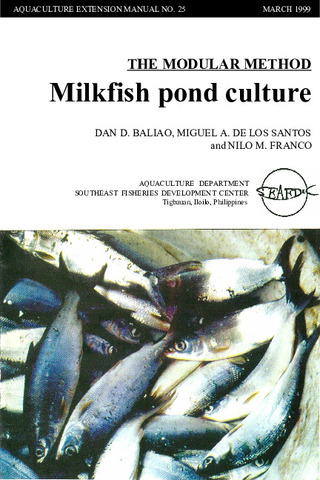
The modular method: Milkfish pond culture
(Aquaculture Department, Southeast Asian Fisheries Development Center, 1999)The modular method of milkfish culture (Chanos chanos) described in the manual is an improvement over the traditional extensive method. The manual is intended for the use of fish farmers and aquaculturists, extensionists, ... -
Evaluation of organic and inorganic fertilizers in brackishwater milkfish ponds
(Elsevier, 1989)The study was conducted in twelve 144-m2 ponds to evaluate the effect of different organic and inorganic fertilizers on the growth, survival, gross production, and profitability of marketable milkfish. The ... -
Milkfish breeding and hatchery technology at SEAFDEC/AQD
(Aquaculture Department, Southeast Asian Fisheries Development Center, 1999)Describes the techniques already adopted by the private sector: broodstock management, broodstock diet, commercial fry production, live transport, and larval diet. A list of AQD research publications on milkfish is included.