
03 SEAFDEC/AQD External Publications
Browse by
Sub-communities within this community
-
Theses and Dissertations [5]
These are theses and dissertations by SEAFDEC/AQD Researchers that were funded/sponsored by AQD.
Collections in this community
-
Others [1]
Recent Submissions
-
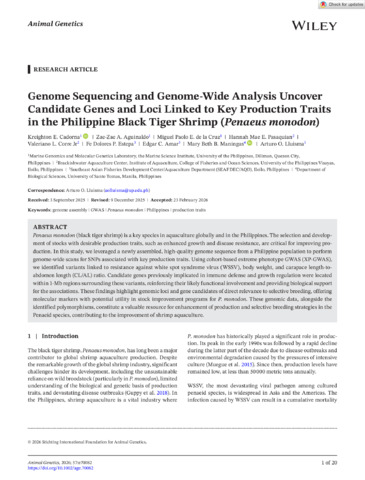
Genome sequencing and genome-wide analysis uncover candidate genes and loci linked to key production traits in the Philippine black tiger shrimp (Penaeus monodon)
Cadorna, Kreighton ; Aguinaldo, Zae-Zae ; ; ; ; Estepa, Fe Dolores ; Amar, Edgar ; ; (Wiley, 2026-03-16)
Penaeus monodon (black tiger shrimp) is a key species in aquaculture globally and in the Philippines. The selection and development of stocks with desirable production traits, such as enhanced growth and disease resistance, are critical for improving production. In this study, we leveraged a newly assembled, high-quality genome sequence from a Philippine population to perform genome-wide scans for SNPs associated with key production traits. Using cohort-based extreme phenotype GWAS (XP-GWAS), we identified variants linked to resistance against white spot syndrome virus (WSSV), body weight, and carapace length-to-abdomen length (CL/AL) ratio. Candidate genes previously implicated in immune defense and growth regulation were located within 1-Mb regions surrounding these variants, reinforcing their likely functional involvement and providing biological support for the associations. These findings highlight genomic loci and gene candidates of direct relevance to selective breeding, offering molecular markers with potential utility in stock improvement programs for P. monodon. These genomic data, alongside the identified polymorphisms, constitute a valuable resource for enhancement of production and selective breeding strategies in the Penaeid species, contributing to the improvement of shrimp aquaculture.
; Aguinaldo, Zae-Zae ; ; ; ; Estepa, Fe Dolores ; Amar, Edgar ; ; (Wiley, 2026-03-16)
Penaeus monodon (black tiger shrimp) is a key species in aquaculture globally and in the Philippines. The selection and development of stocks with desirable production traits, such as enhanced growth and disease resistance, are critical for improving production. In this study, we leveraged a newly assembled, high-quality genome sequence from a Philippine population to perform genome-wide scans for SNPs associated with key production traits. Using cohort-based extreme phenotype GWAS (XP-GWAS), we identified variants linked to resistance against white spot syndrome virus (WSSV), body weight, and carapace length-to-abdomen length (CL/AL) ratio. Candidate genes previously implicated in immune defense and growth regulation were located within 1-Mb regions surrounding these variants, reinforcing their likely functional involvement and providing biological support for the associations. These findings highlight genomic loci and gene candidates of direct relevance to selective breeding, offering molecular markers with potential utility in stock improvement programs for P. monodon. These genomic data, alongside the identified polymorphisms, constitute a valuable resource for enhancement of production and selective breeding strategies in the Penaeid species, contributing to the improvement of shrimp aquaculture. -
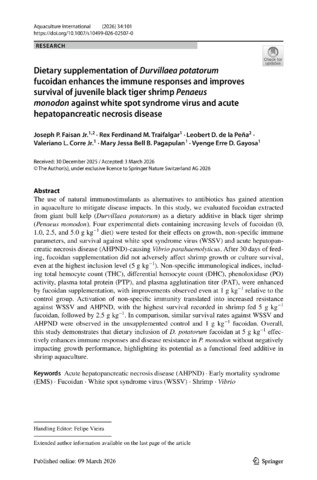
Dietary supplementation of Durvillaea potatorum fucoidan enhances the immune responses and improves survival of juvenile black tiger shrimp Penaeus monodon against white spot syndrome virus and acute hepatopancreatic necrosis disease
Faisan, Joseph P., Jr.; Traifalgar, Rex Ferdinand ; ; ; ; Gayosa, Vyenge Erre (Springer, 2026-03-09)
The use of natural immunostimulants as alternatives to antibiotics has gained attention in aquaculture to mitigate disease impacts. In this study, we evaluated fucoidan extracted from giant bull kelp (Durvillaea potatorum) as a dietary additive in black tiger shrimp (Penaeus monodon). Four experimental diets containing increasing levels of fucoidan (0, 1.0, 2.5, and 5.0 g kg−1 diet) were tested for their effects on growth, non-specific immune parameters, and survival against white spot syndrome virus (WSSV) and acute hepatopancreatic necrosis disease (AHPND)-causing Vibrio parahaemolyticus. After 30 days of feeding, fucoidan supplementation did not adversely affect shrimp growth or culture survival, even at the highest inclusion level (5 g kg−1). Non-specific immunological indices, including total hemocyte count (THC), differential hemocyte count (DHC), phenoloxidase (PO) activity, plasma total protein (PTP), and plasma agglutination titer (PAT), were enhanced by fucoidan supplementation, with improvements observed even at 1 g kg−1 relative to the control group. Activation of non-specific immunity translated into increased resistance against WSSV and AHPND, with the highest survival recorded in shrimp fed 5 g kg−1 fucoidan, followed by 2.5 g kg−1. In comparison, similar survival rates against WSSV and AHPND were observed in the unsupplemented control and 1 g kg−1 fucoidan. Overall, this study demonstrates that dietary inclusion of D. potatorum fucoidan at 5 g kg−1 effectively enhances immune responses and disease resistance in P. monodon without negatively impacting growth performance, highlighting its potential as a functional feed additive in shrimp aquaculture. -
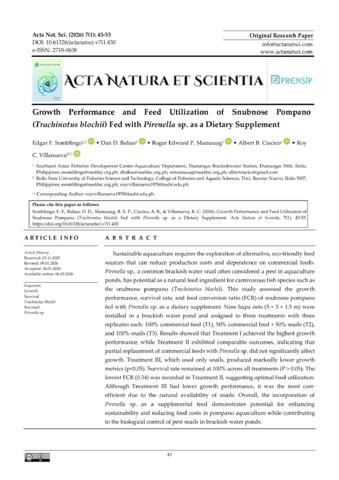
Growth performance and feed utilization of snubnose pompano (Trachinotus blochii) fed with Pirenella sp. as a dietary supplement
Somblingo, Edgar; ; Mamauag, Roger Edward ; Ciacico, Albert ; Villanueva, Roy (Prensip Publishing, 2026-03-06)
Sustainable aquaculture requires the exploration of alternative, eco-friendly feed sources that can reduce production costs and dependence on commercial feeds. Pirenella sp., a common brackish water snail often considered a pest in aquaculture ponds, has potential as a natural feed ingredient for carnivorous fish species such as the snubnose pompano (Trachinotus blochii). This study assessed the growth performance, survival rate, and feed conversion ratio (FCR) of snubnose pompano fed with Pirenella sp. as a dietary supplement. Nine hapa nets (5 × 5 × 1.5 m) were installed in a brackish water pond and assigned to three treatments with three replicates each: 100% commercial feed (T1), 50% commercial feed + 50% snails (T2), and 100% snails (T3). Results showed that Treatment I achieved the highest growth performance, while Treatment II exhibited comparable outcomes, indicating that partial replacement of commercial feeds with Pirenella sp. did not significantly affect growth. Treatment III, which used only snails, produced markedly lower growth metrics (p<0.05). Survival rate remained at 100% across all treatments (P > 0.05). The lowest FCR (0.34) was recorded in Treatment II, suggesting optimal feed utilization. Although Treatment III had lower growth performance, it was the most cost-efficient due to the natural availability of snails. Overall, the incorporation of Pirenella sp. as a supplemental feed demonstrates potential for enhancing sustainability and reducing feed costs in pompano aquaculture while contributing to the biological control of pest snails in brackish water ponds. -
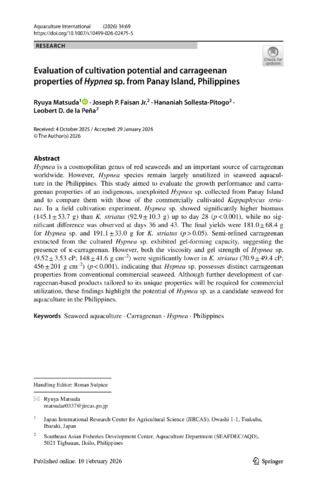
Evaluation of cultivation potential and carrageenan properties of Hypnea sp. from Panay Island, Philippines
Matsuda, Ryuya; Faisan, Jr., Joseph ; ; (Springer, 2026-02-10)
Hypnea is a cosmopolitan genus of red seaweeds and an important source of carrageenan worldwide. However, Hypnea species remain largely unutilized in seaweed aquaculture in the Philippines. This study aimed to evaluate the growth performance and carrageenan properties of an indigenous, unexploited Hypnea sp. collected from Panay Island and to compare them with those of the commercially cultivated Kappaphycus striatus. In a field cultivation experiment, Hypnea sp. showed significantly higher biomass (145.1 ± 53.7 g) than K. striatus (92.9 ± 10.3 g) up to day 28 (p < 0.001), while no significant difference was observed at days 36 and 43. The final yields were 181.0 ± 68.4 g for Hypnea sp. and 191.1 ± 33.0 g for K. striatus (p > 0.05). Semi-refined carrageenan extracted from the cultured Hypnea sp. exhibited gel-forming capacity, suggesting the presence of κ-carrageenan. However, both the viscosity and gel strength of Hypnea sp. (9.52 ± 3.53 cP; 148 ± 41.6 g cm⁻2) were significantly lower in K. striatus (70.9 ± 49.4 cP; 456 ± 201 g cm⁻2) (p < 0.001), indicating that Hypnea sp. possesses distinct carrageenan properties from conventional commercial seaweed. Although further development of carrageenan-based products tailored to its unique properties will be required for commercial utilization, these findings highlight the potential of Hypnea sp. as a candidate seaweed for aquaculture in the Philippines. -
Viral load differences associated with infection outcomes and resistance to white spot syndrome virus (WSSV) infection in mud crab, Scylla serrata
Aguila-Toral, Angela Camille; ; Logronio, Dan Joseph ; Bateman, Kelly ; Stentiford, Grant ; Amar, Edgar ; Ravago-Gotanco, Rachel June (Elsevier, 2026-02)
White spot syndrome virus (WSSV), the causative agent of white spot disease, remains a serious threat to crustacean aquaculture. Infecting a wide range of crustaceans, host species exhibit varying susceptibility and mortality rates. Mud crabs, Scylla serrata, a high-value aquaculture commodity across the Indo-Pacific region, are known to be relatively resistant to WSSV. However, there is limited information on the progression of WSSV infection in the species which can provide insight into mechanisms of resistance. Employing a time course experimental challenge of S. serrata with WSSV, this study characterized viral load dynamics in juveniles over a period of 144 h post infection (hpi) in relation to (1) disease outcomes (survival or mortality); (2) distribution among tissue types (gills, gut, hepatopancreas, and hemolymph); and (3) variability between two different juvenile cohorts. Viral load progression suggests that WSSV resistance in mud crabs may be due to two distinct mechanisms. One mechanism involves the capability of S. serrata for viral clearance following active viral replication. Viral growth in S. serrata demonstrates three phases: early stage or onset characterized by minimal change in viral load (0 to 24-hpi), logarithmic stage of active replication with rapid increase in viral copy number (24 to 72-hpi), with the third phase (96–144 hpi), exhibiting differential patterns with infection outcome. Dead crabs exhibited a plateau phase where viral loads remained similar to peak levels, while crabs that were still alive beyond 96 hpi exhibited a resolution phase, characterized by reduction in viral load, returning to non-infected levels. Another apparent mechanism for WSSV resistance involved overall inhibition of replication, with recalcitrant individuals exhibiting markedly low viral loads at expected logarithmic infection phase timepoints (48–72 hpi). This study also revealed tissue tropism of WSSV in S. serrata. Gills appear to be the primary site of WSSV replication, exhibiting the highest viral load from the early to peak stages of infection compared to other tissue types such as the gut, hepatopancreas, and hemolymph. The establishment of viral load curves to track the progression of WSSV infection, and characterization of viral abundance across different tissues through the course of infection, represents novel information that has key implications on the role of S. serrata as carriers/vectors of WSSV. This may have practical implications for disease mitigation measures for aquaculture facilities, and development of new strategies to prevent and reduce pathogen infection in mud crab to support sustainable aquaculture production.
 RSS 1.0