Comparison of various water replenishment and fertilization schemes in brackishwater milkfish ponds

View/
Date
1989Page views
2,123ASFA keyword

AGROVOC keyword
Taxonomic term

Metadata
Show full item recordShare
Abstract
The study was undertaken to determine the optimum combination of the frequency of water replenishment and fertilization that can yield the highest growth, survival, and gross production of milkfish. Results indicated that mean body weight and survival were not significantly different (P > 0.05) among the treatments. Gross fish production was higher in biweekly fertilization if considered as a single factor. However, when this was in combination with the weekly or biweekly water replenishment, similar gross fish production was attained. In any case, because biweekly fertilization has a better effect than a weekly schedule, the former should be used in combination with any other level of replenishment. A weekly water replenishment, however, is impractical in big pond areas of 5–10 ha compartments which are still common in some milkfish ponds in the Philippines. Therefore, biweekly water replenishment and fertilization with 16–20–0 at 50 kg ha-1 would be reasonable.
Description
Contribution No. 224 of the SEAFDEC Aquaculture Department.
Suggested Citation
Bombeo-Tuburan, I. (1989). Comparison of various water replenishment and fertilization schemes in brackishwater milkfish ponds. Journal of Applied Ichthyology , 5(2), 61-66. https://doi.org/10.1111/j.1439-0426.1989.tb00474.x
Type
ArticleISSN
0175-8659Collections
- Journal Articles [1266]
Related items
Showing items related by title, author, creator and subject.
-
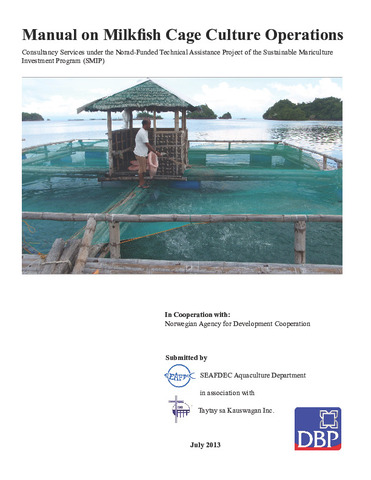
Manual on milkfish cage culture operations
(Aquaculture Department, Southeast Asian Fisheries Development Center, 2013-07)Milkfish (Chanos chanos, or bangus) culture is the largest finfish aquaculture industry in the Philippines and continues to be a top aquaculture commodity primarily because it is easy to culture and can be grown in a wide range of environments. Milkfish thrives in freshwater, brackishwater, marine, and even hypersaline habitats. Milkfish production is increasing rapidly with much of the production moving away from the traditional culture in brackishwater ponds to fish cages in coastal marine waters. To provide a general view of the milkfish culture industry, brief descriptions on breeding, hatchery production, and nursery operation are included in this manual. This manual is meant to serve as a guide for those interested to venture into marine cage farming of milkfish. Milkfish culture has been practiced in the Philippines, Indonesia, and Taiwan for centuries and has been the focus of aquaculture research in a number of institutions for several decades. Innovations in culture practices as a result of information from research data and from farmer’s experiences have been adopted by industry practitioners and these are documented in the recently published book entitled Milkfish Aquaculture in Asia (Liao and Leano, 2010). The recent concern about the rapid growth of aquaculture and its possible environmental impacts, and risks that can threaten the sustainability of this expanding industry has also been the subject of many conferences to develop good management practices in aquaculture. Principles and guidelines on better management practices in marine finfish culture had been drafted and included in this manual. -
Series: Summary of Proceedings No. 1/2013;
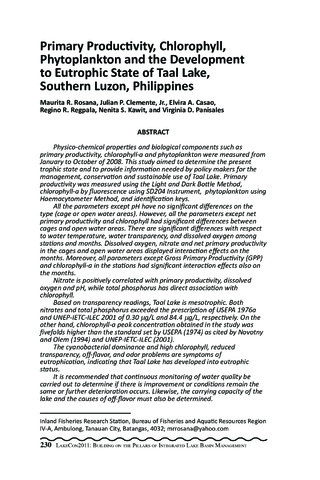
Primary productivity, chlorophyll, phytoplankton and the development to eutrophic state of Taal Lake, southern Luzon, Philippines
(PCAARRD-DOST, 2013)Physico-chemical properties and biological components such as primary productivity, chlorophyll-a and phytoplankton were measured from January to October of 2008. This study aimed to determine the present trophic state and to provide information needed by policy makers for the management, conservation and sustainable use of Taal Lake. Primary productivity was measured using the Light and Dark Bottle Method, chlorophyll-a by fluorescence using SD204 Instrument, phytoplankton using Haemacytometer Method, and identification keys. All the parameters except pH have no significant differences on the type (cage or open water areas). However, all the parameters except net primary productivity and chlorophyll had significant differences between cages and open water areas. There are significant differences with respect to water temperature, water transparency, and dissolved oxygen among stations and months. Dissolved oxygen, nitrate and net primary productivity in the cages and open water areas displayed interaction effects on the months. Moreover, all parameters except Gross Primary Productivity (GPP) and chlorophyll-a in the stations had significant interaction effects also on the months. Nitrate is positively correlated with primary productivity, dissolved oxygen and pH, while total phosphorus has direct association with chlorophyll. Based on transparency readings, Taal Lake is mesotrophic. Both nitrates and total phosphorus exceeded the prescription of USEPA 1976a and UNEP-IETC-ILEC 2001 of 0.30 mg/L and 84.4 mg/L, respectively. On the other hand, chlorophyll-a peak concentration obtained in the study was fivefolds higher than the standard set by USEPA (1974) as cited by Novotny and Olem (1994) and UNEP-IETC-ILEC (2001). The cyanobacterial dominance and high chlorophyll, reduced transparency, off-flavor, and odor problems are symptoms of eutrophication, indicating that Taal Lake has developed into eutrophic status. It is recommended that continuous monitoring of water quality be carried out to determine if there is improvement or conditions remain the same or further deterioration occurs. Likewise, the carrying capacity of the lake and the causes of off-flavor must also be determined. -
Acute nitrite toxicity and methemoglobinemia in juvenile milkfish (Chanos chanos Forsskal)
(Elsevier, 1987)Nitrite was about 55 times more toxic to milkfish juveniles in fresh water than in 16% brackish water: the 48-h median lethal concentrations were 12 mg NO2-N/l (95% confidence limit=7.4–19.6) and 675 mg NO2-N/l (95% confidence limit = 435.8–1,045.4) respectively. Methemoglobin levels were higher for a given concentration of nitrite in milkfish kept in fresh water than in the brackish water. Methemoglobin decreased to a normal level within 24–26 hours of the removal of nitrite.