Morphological aspects of the development of swimming and feeding functions in the milkfish Chanos chanos


Share
Abstract
Development of swimming and feeding abilities based on morphological development of larval and early juvenileChanos chanos was investigated. In larvae smaller than about 6.5 mm SL, mechanical supports of fins and branchial arches were in a primordial stage of development. Supports and rays of the vertical fins and branchial arches rapidly developed from 6.5 mm SL, and all components appeared by about 10.5 mm SL. Thereafter body depth proportion changed and the supports and rays of the paired fins and gill-rakers developed. These developmental events were nearly or totally completed by about 17 mm SL, and we concluded that the larvae transformed to juveniles at this size. By this time, the mode of swimming of the fish shifted from undulating locomotion to caudal propulsion and that of feeding from swallowing paniculate food to filtering and concentrating substrate food matters using gill-rakers and the epibranchial organ. One of the most characteristic, and well-known, phenomena in the life history ofChanos chanos is the mass occurrence in the surf zone of postlarvae of a limited size range. In view of the scheme of the development of mechanical supports of the body and fins, they may acquire a swimming ability strong enough to move against the current only upon reaching about 10.5 mm SL, and if active shoreward migration of the larvae occurs, it is only during the late period of their journey from the spawning grounds to the shore. The sudden disappearance from the surf zone of larvae larger than 15–16 mm SL is obviously related to a change in food habit.
Description
Contribution No. 213 of the SEAFDEC Aquaculture Department.
Suggested Citation
Taki, Y., Kohno, H., & Hara, S. (1987). Morphological aspects of the development of swimming and feeding functions in the milkfish Chanos chanos. Japanese Journal of Ichthyology , 34(2), 198-208. https://doi.org/10.1007/BF02912415
Type
ArticleISSN
0021-5090Collections
- Journal Articles [1266]
Related items
Showing items related by title, author, creator and subject.
-
Series: Aquaculture extension manual; No. 25
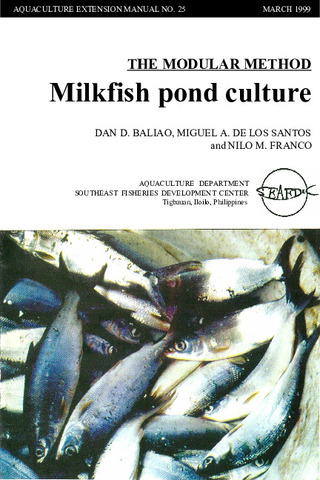
The modular method: Milkfish pond culture
(Aquaculture Department, Southeast Asian Fisheries Development Center, 1999)The modular method of milkfish culture (Chanos chanos) described in the manual is an improvement over the traditional extensive method. The manual is intended for the use of fish farmers and aquaculturists, extensionists, and students of aquaculture not only in the Philippines, but also in other milkfish-producing countries in Southeast Asia and the world. It covers the following: Interesting facts about milkfish -- biological characteristics, artificial breeding of milkfish; Design and operation of modular pond system -- pond preparation, stocking in the nursery or transition ponds, stocking in the rearing ponds, care of stock, pond utilization and production schedule, harvest and post-harvest; and, Economics and costing. -
Evaluation of organic and inorganic fertilizers in brackishwater milkfish ponds
(Elsevier, 1989)The study was conducted in twelve 144-m2 ponds to evaluate the effect of different organic and inorganic fertilizers on the growth, survival, gross production, and profitability of marketable milkfish. The following treatments were used: Treatment I, SEAFDEC traditional fertilization practice (16-20-0 at 50 kg/ha and 45-0-0 at 15 kg/ha); Treatment II, half-dosage of Treatment I; Treatment III, chicken manure at 0.5 ton/ha; and Treatment IV, MASA (processed from agricultural and industrial wastes) fertilizer at 0.5 ton/ha. All treatments were applied once in every 2 weeks. No significant difference (P > 0.05) existed in the harvest and production of milkfish among the treatments. However, economic indicators such as return-on-investment (ROI), payback period, and marginal analysis ranked the performance of the fertilizer treatments in the order of I, II, III and IV. Fish kills occurred in three ponds applied with chicken manure and MASA fertilizer. This could have been due to a heavy build-up of organic matter in the pond bottom which led to the collapse of the benthic algal community, depletion of dissolved oxygen and the presence of hydrogen sulfide. It is therefore suggested that a lower dosage of organic fertilizer should be applied in ponds especially during the rainy season. -
Milkfish breeding and hatchery technology at SEAFDEC/AQD
(Aquaculture Department, Southeast Asian Fisheries Development Center, 1999)Describes the techniques already adopted by the private sector: broodstock management, broodstock diet, commercial fry production, live transport, and larval diet. A list of AQD research publications on milkfish is included.