Effect of streamer tags on survival and growth of juvenile tiger prawns, Penaeus monodon, under laboratory conditions
View/
Date
1992Page views
2,297ASFA keyword

AGROVOC keyword
Taxonomic term

Metadata
Show full item recordShare
Abstract
The effects of streamer tags and initial prawn size on survival and growth in 2-month- and 7-month-old pond-reared juveniles of Penaeus monodon Fabricius (11-30 mm carapace length, CL) were assessed under laboratory conditions. Tagging did not cause immediate mortality in juveniles of 11-21 mm CL within a one-week period but led to a significantly lower survival rate after 6 to 8 weeks in 1-m3 tanks. However, tagged prawns of 21-30 mm CL showed high long-term survival rates up to 90% in a 12-m3 tank. The 2-month-old juveniles had lower survival rates than 7-month-old prawns. Specific growth rate was not affected by tagging but was significantly higher in smaller prawns. In general, there was no interaction between the effects of tagging and prawn size in terms of growth and survival rates.
The lower long-term survival rate associated with tags may be due to the attractiveness of tags to predators, or to trauma or stress caused by the weight of the tags. These factors are discussed in relation to findings for other penaeid species.
Suggested Citation
Primavera, J. H., & Caballero, R. M. (1992). Effect of streamer tags on survival and growth of juvenile tiger prawns, Penaeus monodon, under laboratory conditions. Marine and Freshwater Research , 43(4), 737-743. https://doi.org/10.1071/MF9920737
Type
ArticleISSN
1323-1650Collections
- Journal Articles [1266]
Related items
Showing items related by title, author, creator and subject.
-
A simple method of tagging prawns
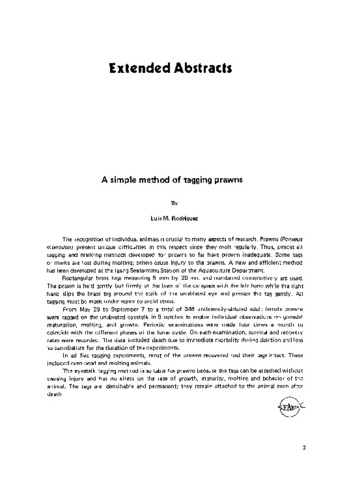
(Aquaculture Department, Southeast Asian Fisheries Development Center, 1977)The recognition of individual animals is crucial to many aspects of research. Prawns (Penaeus monodon) present unique difficulties in this respect since they molt regularly. Thus, almost all tagging and marking methods developed for prawns so far have proven inadequate. Some tags or marks are lost during molting; others cause injury to the prawns. A new and efficient method has been developed at the Igang Seafarming Station of the Aquaculture Department. Rectangular brass tags measuring 5 mm by 20 mm and numbered consecutively are used. The prawn is held gently but firmly at the base of the carapace with the left hand while the right hand slips the brass tag around the stalk of the unablated eye and presses the tag gently. All tagging must be made under water to avoid stress. From May 29 to September 7 to a total of 348 unilaterally-ablated adult female prawns were tagged on the unablated eyestalk in 5 batches to enable individual observations on gonadal maturation, molting, and growth. Periodic examinations were made four times a month to coincide with the different phases of the lunar cycle. On each examination, survival and recovery rates were recorded. The data included death due to immediate mortality during ablation and loss to cannibalism for the duration of the experiments. In all five tagging experiments, most of the prawns recovered had their tags intact. These included even dead and molting animals. The eyestalk tagging method is suitable for prawns because the tags can be attached without causing injury and has no effect on the rate of growth, maturity, molting and behavior of the animal. The tags are identifiable and permanent; they remain attached to the animal even after death. -
A simple method of tagging prawns
(University of the Philippines, 1976)The recognition of individual animals is crucial to many aspects of research. Prawns present unique difficulties in this respect since they molt regularly. Thus almost all tagging and marking methods developed for prawns so far have proven inadequate. Some are lost during molting; others cause injury to the prawns. A new and efficient method has been developed at the Igang Sea Farming Station of the Aquaculture Department. Brass tags measuring 5 mm by 20 mm and numbered consecutively are encircled around the eyestalk like a small bracelet. The prawn is gently held at the base of the carapace by the left hand while the right hand slips the brass tag over the eye. The tag is gently pressed around the eyestalk to prevent its slipping out. All tagging is done under water to avoid stress. -
Effect of tagging on maturation and survival of ablated Penaeus monodon in painted and unpainted tanks
Primavera, Jurgenne ; (San Carlos Publications, University of San Carlos, 1989)
A study was conducted to determine the effects of tags and tank color on reproductive performance and survival of pond-reared Penaeus monodon after eyestalk ablation. In 1986, the best over-all reproductive performance was frm eyestalk-tagged females in black tanks. Because of varying water flow through rates and loss of carepeace tags, statistical analysis was not possible. The 1987 study showed that tagging and tank color had no effect on maturation but survival rates of tagged (83.5%) in black and unpainted tanks. The 1986 results also showed lower survival rates of eyestalk-tagged females (31.2-59.0%) compared to untagged ones (90.0%). Monitoring of rematurations (by means of eyestalk tags) showed that among ablated females, 64% spawned once, 35% a second time, and 12% a third time with a maximum of seven spawns from a single female. Uniform spawn sizes characterized first and repeat spawns but hatch rate decreased with each consecutive spawns.
; (San Carlos Publications, University of San Carlos, 1989)
A study was conducted to determine the effects of tags and tank color on reproductive performance and survival of pond-reared Penaeus monodon after eyestalk ablation. In 1986, the best over-all reproductive performance was frm eyestalk-tagged females in black tanks. Because of varying water flow through rates and loss of carepeace tags, statistical analysis was not possible. The 1987 study showed that tagging and tank color had no effect on maturation but survival rates of tagged (83.5%) in black and unpainted tanks. The 1986 results also showed lower survival rates of eyestalk-tagged females (31.2-59.0%) compared to untagged ones (90.0%). Monitoring of rematurations (by means of eyestalk tags) showed that among ablated females, 64% spawned once, 35% a second time, and 12% a third time with a maximum of seven spawns from a single female. Uniform spawn sizes characterized first and repeat spawns but hatch rate decreased with each consecutive spawns.