In observance of the Lenten season, please be advised of the following adjustments to our repository services:
- Effective Date: Afternoon of April 1, 2026
- Service Resumption: Monday, April 6, 2026
Our repository remains online for browsing; however, "Request a Copy" responses will be paused starting April 1, 2026 afternoon. Standard processing and responses will resume on April 6, 2026. Thank you for your patience!
Ammonia excretion rates of the sea bass, Lates calcarifer, in fresh and sea water
View/
Date
1994Page views
2,840ASFA keyword

AGROVOC keyword
Taxonomic term

Metadata
Show full item recordShare
Abstract
The weight-specific ammonia excretion rate of sea bass (Lates calcarifer) fry in fresh water is higher than that of those in sea water. The allometric equation \(y = 24.426 \times ^{-0.4714}\) best describes the relationship between the ammonia excretion rate (y, in µg total \(NH_{3}-N/g/hour)\) and body weight (x, in g wet weight) for fry in fresh water and \(y = 19.891 \times ^{-0.6712}\) for fry in sea water. The ammonia excretion rate of sea bass fry in fresh or sea water did not significantly increase or decrease during prolonged starvation.
The pre-feeding ammonia excretion rate of sea bass subadults in fresh water was similar to those in sea water. The ammonia excretion rate of both groups ranged from 3.86 to 4.13 µg total NH3-N per g per hour. Half an hour after feeding, ammonia excretion rates rose to a significant level over pre-feeding values in both freshwater and seawater-adapted subadults. Both groups also showed the same peaks that were 7.5 times higher than pre-feeding levels 3 hours after feeding. By 10 hours after feeding, the ammonia excretion rate of both groups had returned to pre-feeding levels.
Suggested Citation
Almendras, J. M. E. (1994). Ammonia excretion rates of the sea bass, Lates calcarifer, in fresh and sea water. The Israeli Journal of Aquaculture-Bamidgeh , 46(2), 76-82. http://hdl.handle.net/10862/1441
Type
ArticleISSN
0792-156XCollections
- Journal Articles [1267]
Related items
Showing items related by title, author, creator and subject.
-
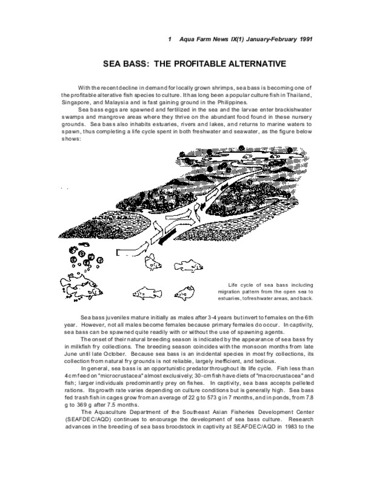
Sea bass: The profitable alternative
(Aquaculture Department, Southeast Asian Fisheries Development Center, 1991) -
Nursery culture of grouper (Epinephelus fuscoguttatus Forsskal) and sea bass (Lates calcarifer Bloch) in brackish water ponds: Co-feeding of zooplankton and formulated diets containing L-tryptophan
(Taylor & Francis, 2012)This study compared co-feeding zooplankton (ZP, mixed copepods and mysids) and formulated diets (FD) supplemented with L-tryptophan (TRP) on the survival and growth of grouper and sea bass fry nursed in brackish water ponds. Grouper (84 fry m−3) and sea bass (150 fry m−3) were reared for 30 days and 60 days, respectively, in net cages within two separate 743 m2 nursery ponds. Five treatments (with three replicates each) were compared (P < 0.05): FD-1 = ZP + basal FD (no added TRP, but containing 0.29% endogenous TRP); FD-2 = ZP + (FD 0.58% TRP); FD-3 = ZP + (FD 1.22% TRP); FD-4 = ZP + (FD 2.50% TRP); and FD-5 = minced fish (Sardinella sp.) + basal FD (no additional TRP). TRP supplementation in grouper diets produced no significant affect on growth but increased survival at rates of 0.58% and above. TRP supplementation at 2.5% (FD-4) produced significantly better sea bass growth than other diets but had no affect on survival. Zooplankton improved both survival and growth in both grouper and sea bass juveniles compared to the minced fish diet, and may be a practical and lower cost alternative to indoor nursing. -
Broodstock management and seed production of the rabbitfish Siganus guttatus (Bloch) and the sea bass Lates calcarifer (Bloch)
(Aquaculture Department, Southeast Asian Fisheries Development Center, 1988)This paper reviews results of studies conducted on the rabbitfish, Siganus guttatus (Bloch) and the sea bass Lates calcarifer (Bloch) at the Aquaculture Department of the Southeast Asian Fisheries Development Center. Studies include broodstock development and management, induced breeding, effect of handling stress and diet on egg quality, early life history, food, feeding strategy, weaning to artificial diets, effect of stocking density and salinity on egg development, larval growth and survival, and advancement of metamorphosis in sea bass by using thyroxine. A seed production technique had been developed for rabbitfish with survival rates ranging from 5-35% while the seed production technique for sea bass developed in Thailand had been modified to suit local conditions. Based on results from recent morphological and physiological studies, the stocking density, water management, and feeding scheme for the production of rabbitfish and sea bass fry had been modified to reduce cannibalism and improve survival.