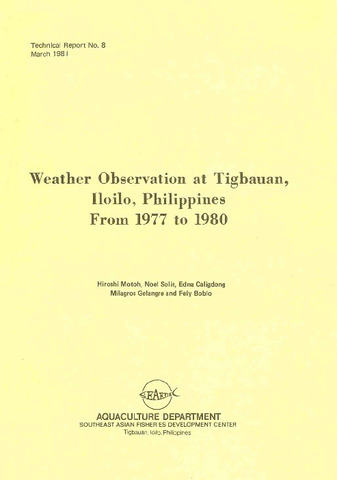
Weather observation at Tigbauan, Iloilo, Philippines from 1977 to 1980


Share
Abstract
The observations include: (1) air and sea water temperatures; (2) cloud cover; (3) rainfall; (4) wind direction and speed; (5) salinity; (6) sea wave condition.
Suggested Citation
Motoh, H., Solis, N., Caligdong, E., Gelangre, M., & Boblo, F. (1981). Weather observation at Tigbauan, Iloilo, Philippines from 1977 to 1980 (Technical Report No. 8). Tigbauan, Iloilo, Philippines: Aquaculture Department, Southeast Asian Fisheries Development Center.
Type
Technical ReportISSN
0115-4710Series
Technical report / SEAFDEC Aquaculture Department; no. 8Format
14 p. : ill.
Collections
- Technical Reports [13]
Related items
Showing items related by title, author, creator and subject.
-
Understanding community-based aquaculture through participatory approaches
(Southeast Asian Fisheries Development Center, 2008) -
Practical techniques for mapping small patches of mangroves
; Primavera, Jurgenne ; ; (Springer, 2010)
Practical mapping methods employing GPS field surveys and manual image analyses with affordable software were used to assess two mangrove sites in Aklan Province, NE Panay Island, central Philippines. The Jawili mangroves, absent from current maps, actually included 21.5 ha with 24 true mangrove species. On the other hand, the Batan Estuary mangroves, shown to be 4244 ha in available topographic maps, revealed only 406 ha of scattered patches. Actual mangrove data on specific areas worldwide is limited, especially in the Philippines where available maps show discrepancies from actual mangrove distribution. Remote sensing (RS) techniques provide promising results but require expensive setup, particularly for small areas. Therefore, financially limited users need affordable and rapid mapping alternatives. The practical techniques presented here can be immediately implemented at minimal cost and can produce useful estimates of actual mangrove area, fundamental for coastal management. Basic principles used here also have potential applications in other systems and locations. When resources are available though, additional confirmation and precise mapping are also further recommended.
; ; (Springer, 2010)
Practical mapping methods employing GPS field surveys and manual image analyses with affordable software were used to assess two mangrove sites in Aklan Province, NE Panay Island, central Philippines. The Jawili mangroves, absent from current maps, actually included 21.5 ha with 24 true mangrove species. On the other hand, the Batan Estuary mangroves, shown to be 4244 ha in available topographic maps, revealed only 406 ha of scattered patches. Actual mangrove data on specific areas worldwide is limited, especially in the Philippines where available maps show discrepancies from actual mangrove distribution. Remote sensing (RS) techniques provide promising results but require expensive setup, particularly for small areas. Therefore, financially limited users need affordable and rapid mapping alternatives. The practical techniques presented here can be immediately implemented at minimal cost and can produce useful estimates of actual mangrove area, fundamental for coastal management. Basic principles used here also have potential applications in other systems and locations. When resources are available though, additional confirmation and precise mapping are also further recommended. -
Socio-cultural context of fishers’ participation in coastal resources management in Anini-y, Antique in west central Philippines
(Elsevier, 2011)The vicious cycle of poverty, overfishing and resource degradation in coastal communities in the Philippines calls for action that will address the problem of declining fish catch and degraded fish habitats. The literature has shown that an efficient and effective coastal management program can be instrumental in approaching this problem. In order to secure food and livelihood of fishers, the Southeast Asian Fisheries Development Center/Aquaculture Department collaborated with the local government of Anini-y, Antique to develop a sustainable utilization of natural marine resources through sea ranching of abalone within the Nogas Island marine protected area. Establishing a marine protected area is a means of conserving natural stocks while sea ranching is considered an effective strategy that can increase fishery resources. The two management schemes are considered as effective coastal resources management strategies. The success of a sea-ranching project is dependent not only on biophysical but also on socioeconomic factors as determinants of community participation and cooperation. A social assessment was conducted to determine the fishers’ socio-cultural characteristics, their perceptions of their coastal resources and knowledge on how to effectively manage these coastal resources. The fishers’ awareness on fishing regulations and the extent of their participation in community's coastal resources management activities were also determined. Data were collected from a household survey using a semi-structured questionnaire, focus group discussions and in-depth interviews with key informants. The fishers generally scored low in almost all aspects of their socioeconomic wellbeing. Most fishers perceived that their coastal resources were in a bad condition which they attributed to illegal and commercial fishing, increasing number of fishers and the poor enforcement of fishery regulations. However, the weighted mean scores of their knowledge on coastal resources management, awareness to fishery regulations and participation in community coastal resource management activities were average. This implied that fishers when trained and developed can become potential partners for effective coastal resources management programs.