Small-scale fisheries of coral reefs and the need for community-based resource management in Malalison Island, Philippines

Share
Abstract
Fish landings in Malalison Island in the west central Philippines were monitored from February 1991 to January 1992 to determine the types of fishing gear employed, the predominant species caught, the catch per unit effort (CPUE), and the yield from the coral reefs. Fishing was monitored only during the spring tide periods, after a preliminary sampling showed no significant differences among four lunar phases. A total of 494 fishing operations was recorded. CPUE (kg per fisher h−1) by gear was 1.1 for spear guns, 1.4 for spear guns with compressor, 0.4 for set gill nets, 2.4 for drive-in gill nets, 1.2 for drift gill nets, and 0.7 for hook-and-lines. The CPUEs of Malalison gears are similar to those of other coral reef fisheries. Dominant species caught were fusiliers and surgeonfishes by gill net. surgeonfishes by spear gun, and snappers and groupers by hook-and-line. The fish yield from the Malalison coral reefs was estimated to be 5.8 t km−2 year−1, which is low, and similar to overexploited. reefs in the Philippines and elsewhere. Live coral cover averages 35% in Malalison. Reef degradation, high fishing effort, low yields, and the poverty of the fishing community suggest ‘Malthusian over-fishing’. Community based management and resource enhancement are being initiated by the SEAF-DEC Aquaculture Department to protect and sustain the fishery and improve the economy in Malalison Island.
Suggested Citation
Amar, E. C., Cheong, R. M. T., & Cheong, M. V. T. (1996). Small-scale fisheries of coral reefs and the need for community-based resource management in Malalison Island, Philippines. Fisheries Research , 25(3-4), 265-277. https://doi.org/10.1016/0165-7836(95)00439-4
Type
ArticleISSN
0165-7836Collections
- Journal Articles [1266]
Related items
Showing items related by title, author, creator and subject.
-
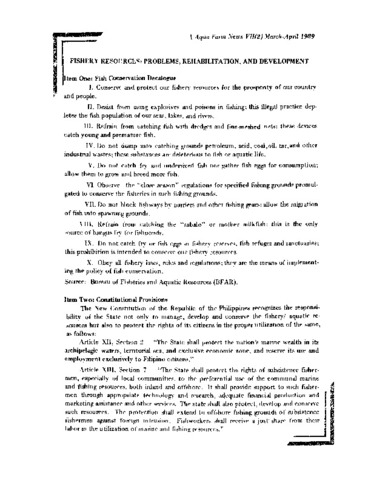
Fishery resources: Problems, rehabilitation, and development
(Aquaculture Department, Southeast Asian Fisheries Development Center, 1989) -
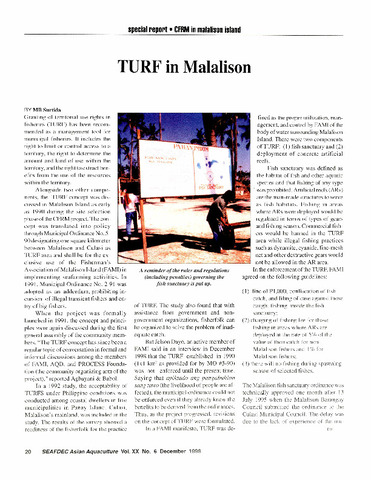
TURF in Malalison
(Aquaculture Department, Southeast Asian Fisheries Development Center, 1998) -
Marine protected areas in the Philippines: The case of Malalison island in community-based management of reef fisheries
Garcia, Luis Maria ; Primavera, Jurgenne (UNESCO Office, 2004)
The extensive Philippine coastline of more than 22,540 k m provides the natural habitat of a variety of flora and fauna that make the Philippine archipelago one of the centers of marine biodiversity in the world. Resource-use conflicts, overexploitation, and the pressure to feed the teeming population in many fishing communities have however degraded these habitats, seriously threatening marine biodiversity that supports the biological productivity of the country's coastal fishery. Encouraged by recent enabling national legislation (e.g., the Local Government Code of 1991, the National Integrated Protected Areas System Act of 1992, the Philippine Fisheries Code of 1998), grassroots advocacy in many municipalities has grown to address this threat, resulting in the establishment of marine protected areas (MPAs), particularly in coral reef management. The over 550 MPA s catalogued in the Philippines to date were established primarily to enhance local fishery yields for artisanal fishers and secondarily to protect coastal habitats for biodiversity conservation and multiple economic uses. Enforcement in a majority of these MPAs is a serious problem however. Many government and donor-assisted projects, such as the UNESCO Biosphere Reserves in Puerto Galera and Palawan, have promoted integrated management of both upland and coastal habitats, but these too suffer from persistent conflicts in multiple resource-use and the lack of sustained enforcement by stakeholders. Our recent experience in Malalison Island, central Philippines describes the efforts of empowering the island fishers themselves to be effective and responsible managers of their marine resources. Grassroots empowerment required organizing the island fisherfolks in 1991 into a working association to promote collective action on a number of local reef fishery management initiatives, particularly the establishment of exclusive-use rights over the island's reef fishing grounds, which entailed influencing the municipal government and neighboring villages. Specific interventions that followed were highlighted by the establishment of a no-take marine reserve and the deployment of concrete artificial habitats in one of their fishing grounds in Gui-ob reef in 1995-1996. Indicators of equity, efficiency, and sustainability suggest that island fisherfolks have gained greater control over their reef fishery resources, allocated their fair share of access rights, and influenced the formulation of fishery co-management policies through direct participation. In the process of empowerment, the island community leaders and many members have become bold and confident in publicly articulating their vision of sustaining harvest from their reef fisheries, a trait that they have not openly displayed prior to 1991. The experience in Malalison Island has demonstrated that fishery co-management, as exemplified by sustained protection of a no-take marine reserve, can be an achievable goal in the Philippines. It may serve as a valuable model to be followed by other coastal fishing communities in Southeast Asia and elsewhere.
; Primavera, Jurgenne (UNESCO Office, 2004)
The extensive Philippine coastline of more than 22,540 k m provides the natural habitat of a variety of flora and fauna that make the Philippine archipelago one of the centers of marine biodiversity in the world. Resource-use conflicts, overexploitation, and the pressure to feed the teeming population in many fishing communities have however degraded these habitats, seriously threatening marine biodiversity that supports the biological productivity of the country's coastal fishery. Encouraged by recent enabling national legislation (e.g., the Local Government Code of 1991, the National Integrated Protected Areas System Act of 1992, the Philippine Fisheries Code of 1998), grassroots advocacy in many municipalities has grown to address this threat, resulting in the establishment of marine protected areas (MPAs), particularly in coral reef management. The over 550 MPA s catalogued in the Philippines to date were established primarily to enhance local fishery yields for artisanal fishers and secondarily to protect coastal habitats for biodiversity conservation and multiple economic uses. Enforcement in a majority of these MPAs is a serious problem however. Many government and donor-assisted projects, such as the UNESCO Biosphere Reserves in Puerto Galera and Palawan, have promoted integrated management of both upland and coastal habitats, but these too suffer from persistent conflicts in multiple resource-use and the lack of sustained enforcement by stakeholders. Our recent experience in Malalison Island, central Philippines describes the efforts of empowering the island fishers themselves to be effective and responsible managers of their marine resources. Grassroots empowerment required organizing the island fisherfolks in 1991 into a working association to promote collective action on a number of local reef fishery management initiatives, particularly the establishment of exclusive-use rights over the island's reef fishing grounds, which entailed influencing the municipal government and neighboring villages. Specific interventions that followed were highlighted by the establishment of a no-take marine reserve and the deployment of concrete artificial habitats in one of their fishing grounds in Gui-ob reef in 1995-1996. Indicators of equity, efficiency, and sustainability suggest that island fisherfolks have gained greater control over their reef fishery resources, allocated their fair share of access rights, and influenced the formulation of fishery co-management policies through direct participation. In the process of empowerment, the island community leaders and many members have become bold and confident in publicly articulating their vision of sustaining harvest from their reef fisheries, a trait that they have not openly displayed prior to 1991. The experience in Malalison Island has demonstrated that fishery co-management, as exemplified by sustained protection of a no-take marine reserve, can be an achievable goal in the Philippines. It may serve as a valuable model to be followed by other coastal fishing communities in Southeast Asia and elsewhere.