Oxygen, sulphide and nutrient uptake of the mangrove mud clam Anodontia edentula (Family: Lucinidae)

View/
Date
2001Author
Page views
2,874ASFA keyword

AGROVOC keyword
Taxonomic term

Geographic names

Metadata
Show full item recordShare
Abstract
Oxygen, sulphide and nutrient (ammonia, nitrite and phosphate) uptake of Anodontia edentula was measured. Oxygen and sulphide were measured from sealed containers provided with 1 l fresh mangrove mud (sulphide source) and seawater (oxygen source) with two treatments (with and without clam) at 16 replicates each. Oxygen, sulphide and other parameters were measured at days 1 (initial), 3 and 5 (final). Nutrients were measured from containers filled with 1.5 l wastewater from a milkfish broodstock tank with two treatments (with and without clam) at eight replicates each. Ammonia, NO2 and PO4 were measured at days 0 (initial) 3, 6, 9 and 12 (final). Results showed significantly decreasing oxygen and sulphide concentrations in treatment with clams (ANOVA, p < 0.001). A significantly higher ammonia concentration (ANOVA, p < 0.05) was observed in treatment with clams while no significant difference was observed in nitrite and phosphate between the two treatments. A decreasing ammonia and an increasing nitrite trend was also observed in both treatments starting at day 3.
Suggested Citation
Lebata, M. J. H. L. (2001). Oxygen, sulphide and nutrient uptake of the mangrove mud clam Anodontia edentula (Family: Lucinidae). Marine Pollution Bulletin , 42(11), 1133-1138. https://doi.org/10.1016/S0025-326X(01)00113-8
Type
ArticleISSN
0025-326XCollections
- Journal Articles [1267]
Related items
Showing items related by title, author, creator and subject.
-
Gill structure, anatomy and habitat of Anodontia edentula: Evidence of endosymbiosis
Lebata, Ma. Junemie Hazel L. ; Primavera, Jurgenne (National Shellfisheries Association, 2001)
Surveys and interviews were conducted to determine sources and habitat of Anodontia edentula. Results showed that they inhabit muddy substrate of mangrove areas or the adjacent mudflats, burying at 20-60 cm deep in the mud. They are strategically situated in the sulfide-rich, low-oxygen layer of the substrate but have access to oxygen through their inhalant tube; both sulfide and oxygen are essential for their survival. Study of the clam s gross anatomy revealed thick, fleshy, deep purple to blackish brown gills; reduced digestive structure; and a highly elastic foot capable of extending several times longer than its body length. These observations conform with the anatomy of fellow lucinid clams. Furthermore, scanning electron micrographs showed coccoid or spherical bacteria occupying bacteriocytes in the clam s gills. Intermediate cells separating bacteriocytes observed in other lucinids were also noted in the SEM.
; Primavera, Jurgenne (National Shellfisheries Association, 2001)
Surveys and interviews were conducted to determine sources and habitat of Anodontia edentula. Results showed that they inhabit muddy substrate of mangrove areas or the adjacent mudflats, burying at 20-60 cm deep in the mud. They are strategically situated in the sulfide-rich, low-oxygen layer of the substrate but have access to oxygen through their inhalant tube; both sulfide and oxygen are essential for their survival. Study of the clam s gross anatomy revealed thick, fleshy, deep purple to blackish brown gills; reduced digestive structure; and a highly elastic foot capable of extending several times longer than its body length. These observations conform with the anatomy of fellow lucinid clams. Furthermore, scanning electron micrographs showed coccoid or spherical bacteria occupying bacteriocytes in the clam s gills. Intermediate cells separating bacteriocytes observed in other lucinids were also noted in the SEM. -
Collection of the clam Anodontia edentula in mangrove habitats in Panay and Guimaras, central Philippines
Primavera, Jurgenne; Lebata, M. J. H. L. ; ; Altamirano, Jon (Kluwer Academic Publishers, 2002)
The mangrove clam Anodontia edentula is highly prized in the Philippines for its flavor and large size. Because this infaunal species is found down to one meter deep in mangrove areas, harvesting the clam reportedly damages mangrove stands. To evaluate such reports, a survey of collection methods was undertaken in Panay and Guimaras, central Philippines in August 1997-December 1999. Host to chemosynthetic bacterial symbionts that utilize sulfide as energy source, A. edentula are strategically situated in sulfide-rich anoxic substrates but also gain access to oxygenated seawater through a ventilation burrow or tube. By locating the opening of this burrow, collectors can detect the presence of a buried clam and harvest it nondestructively with a blade or bare hands. In contrast, the indiscriminate tilling of wide mangrove areas can damage mangrove plants. Most collectors were 40-45 years old with 22-30 years collection experience, married with 5-7 children, and had low educational attainment. They sold clams directly in the local markets or through middlemen (to restaurants and beach resorts); sales provided from 10% to 100% of daily family income. Collectors complained of decreasing clam sizes and numbers and the physically strenuous work of collecting. -
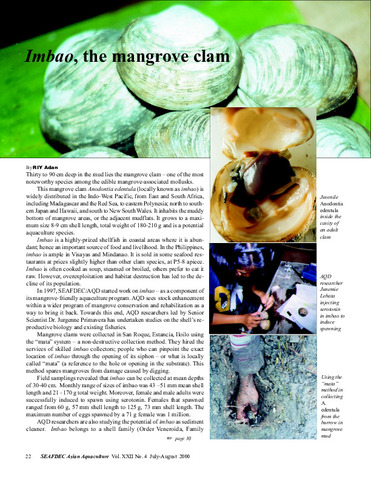
Imbao, the mangrove clam
(Aquaculture Department, Southeast Asian Fisheries Development Center, 2000)