In observance of the Lenten season, please be advised of the following adjustments to our repository services:
- Effective Date: Afternoon of April 1, 2026
- Service Resumption: Monday, April 6, 2026
Our repository remains online for browsing; however, "Request a Copy" responses will be paused starting April 1, 2026 afternoon. Standard processing and responses will resume on April 6, 2026. Thank you for your patience!
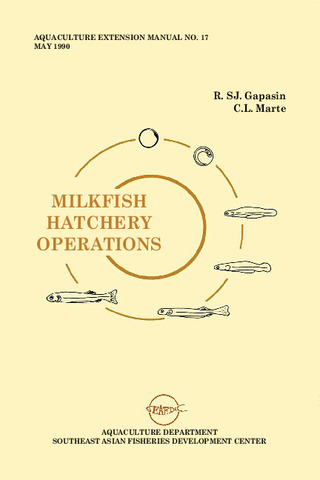
Milkfish hatchery operations


Share
Abstract
The manual is intended primarily for practicing prawn hatchery operators who would like to diversify their operations to include larval rearing of milkfish (Chanos chanos). Only those procedures important in the daily operations of a milkfish hatchery are described in detail, under the following headings: Essential facilities - tanks and equipment; Production of natural food - Chlorella culture and Brachionus culture; Production of milkfish fry - preparation of hatching and larval rearing tanks, hatching of milkfish eggs, stocking of larvae, larval rearing, and harvesting.
Suggested Citation
Gapasin, R. S. J., & Marte, C. L. (1990). Milkfish hatchery operations. Tigbauan, Iloilo, Philippines: SEAFDEC Aquaculture Department.
Type
BookISSN
0115-5369ISBN
9718511288Series
Aquaculture extension manual; No. 17Format
24 p. : ill.
Collections
Related items
Showing items related by title, author, creator and subject.
-
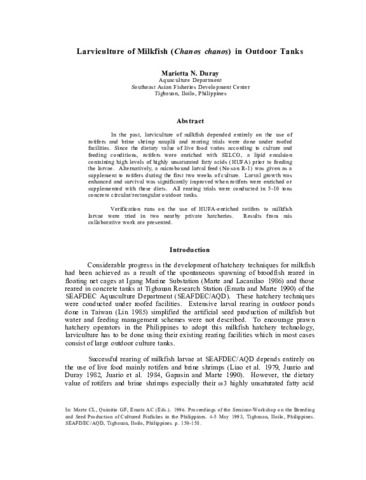
Larviculture of milkfish (Chanos chanos) in outdoor tanks
(Aquaculture Department, Southeast Asian Fisheries Development Center, 1996)In the past, larviculture of milkfish depended entirely on the use of rotifers and brine shrimp nauplii and rearing trials were done under roofed facilities. Since the dietary value of live food varies according to culture and feeding conditions, rotifers were enriched with SELCO, a lipid emulsion containing high levels of highly unsaturated fatty acids (HUFA) prior to feeding the larvae. Alternatively, a microbound larval feed (Nosan R-1) was given as a supplement to rotifers during the first two weeks of culture. Larval growth was enhanced and survival was significantly improved when rotifers were enriched or supplemented with these diets. All rearing trials were conducted in 5-10 tons concrete circular/rectangular outdoor tanks. Verification runs on the use of HUFA-enriched rotifers to milkfish larvae were tried in two nearby private hatcheries. Results from mis collaborative work are presented. -
Mass mortality of hatchery-reared milkfish (Chanos chanos) and mangrove red snapper (Lutjanus argentimaculatus) caused by Amyloodinium ocellatum (Dinoflagellida)
(Elsevier, 2004)Outbreaks of heavy infestation by the parasitic dinoflagellate Amyloodinium ocellatum in hatchery-reared milkfish (Chanos chanos) and mangrove red snapper (Lutjanus argentimaculatus) caused 100% mortality events in hatcheries in the Philippines. Parasites were recorded on the body surface in 14-day-old milkfish fry and on both skin and gills in 2-month-old snapper. Trophonts of A. ocellatum caused local erosions of fish skin and degeneration of epithelial cells at the sites of the parasite's attachment to the body surface. Separation and hyperplasia of gill epithelium and fusion of secondary lamellae at the distal parts of the gill filaments were common. High pathogenicity of A. ocellatum to fish may be attributed to the severe alterations of the fish gills, the disruption of the host's skin, and feeding of trophonts on hosts' epithelial cells. In-vivo treatments of A. ocellatum-infested snapper with a 1 h freshwater bath and 200 ppm H2O2 showed promising results. This is the first report of A. ocellatum infestation in milkfish and mangrove red snapper in the Philippines. -
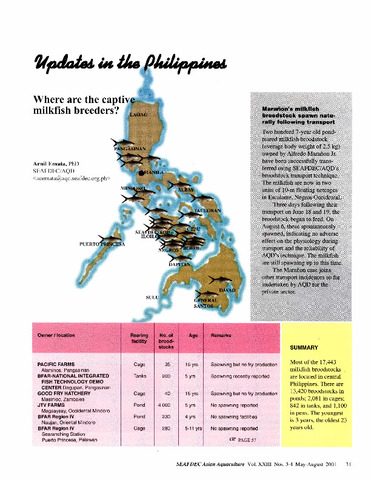
Updates in the Philippines: Where are the captive milkfish breeders?
(Aquaculture Department, Southeast Asian Fisheries Development Center, 2001)A map is provided showing the location of milkfish rearing facilities in the Philippines. Most of the 17,443 milkfish broodstocks are located in central Philippines. A table shows details as to the rearing facility (cage, pen, pond, tank), number of broodstocks, and age. There are 13,420 broodstocks in ponds; 2,081 in cages; 842 in tanks, and 1,100 in pens. The youngest is 3 years, the oldest 23 years old.