Growth and survival of milkfish (Chanos chanos), seabass (Lates calcarifer) and rabbitfish (Siganus guttatus) larvae reared at the same density in different sized tanks

View/
Date
1998Page views
4,274ASFA keyword

AGROVOC keyword
Taxonomic term

Metadata
Show full item recordShare
Abstract
Growth and survival of the larvae of milkfish (Chanos chanos), seabass (Lates calcarifer) and rabbitfish (Siganus guttatus) in 40, 200 and 500 liter rearing tanks were evaluated at day 14. Milkfish larvae survived better (46%) in 500 l than in 200 l (7%) tanks. All larvae died on day 6 in the 40 l tanks. Growth was better in the 200 l tanks than in the 500 l tanks. The survival rate of the seabass larvae was significantly different in the 40 l (47%), 200 l (61%) and 500 l (75%) tanks, but growth was highest in the 40 l tanks. Rabbitfish larvae had the highest survival in 500 l tanks (7%) but the same growth in all tank sizes.
The optimum tank size may vary for different fish species. However, small containers are more convenient to use because they require less manpower, are easily manipulated and more cost- effective.
Suggested Citation
Estudillo, C. B., Duray, M. N., & Marasigan, E. T. (1998). Growth and survival of milkfish (Chanos chanos), seabass (Lates calcarifer) and rabbitfish (Siganus guttatus) larvae reared at the same density in different sized tanks. The Israeli Journal of Aquaculture-Bamidgeh , 50(1), 20-24. http://hdl.handle.net/10862/1740
Type
ArticleISSN
0792-156XCollections
- Journal Articles [1267]
Related items
Showing items related by title, author, creator and subject.
-
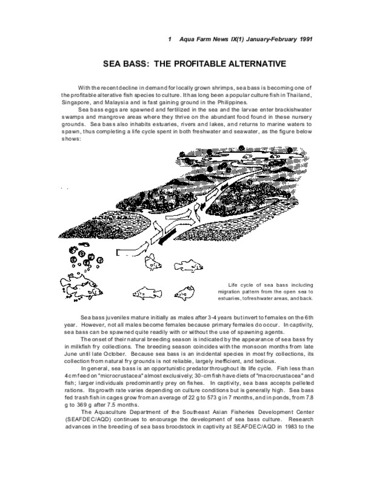
Sea bass: The profitable alternative
(Aquaculture Department, Southeast Asian Fisheries Development Center, 1991) -
Immunization regimen in Asian sea bass (Lates calcarifer) broodfish: A practical strategy to control vertical transmission of nervous necrosis virus during seed production
Pakingking, Rolando V., Jr. ; ; ; (Elsevier, 2018-08)
Outbreaks of viral nervous necrosis (VNN) in Asian sea bass (Lates calcarifer) at the larval stages via vertical transmission of nervous necrosis virus (NNV) from asymptomatic broodfish remain as a major deterrent during seed production. A five-year study was conducted to produce NNV-specific-free sea bass broodfish reared in land-based tanks through an annual immunization regimen with the formalin-inactivated NNV. We primarily immunized (intraperitoneal injection) sea bass juveniles (5 g) and monitored the neutralizing antibody (Nab) titers in the sera of these fish at scheduled intervals post-immunization. Nab titers in the sera of immunized fish peaked at Month 2 (titer: 1:4480 ± 1185) but thereafter gradually declined and significantly dropped (1:260 ± 83) at Month 12 post-primary immunization. Booster immunization of these fish at Month 12 post-immunization led to abrupt increases in Nab titers in booster immunized (B-Im) fish at Month 1 (1:12800 ± 6704) but thereafter declined and dropped at Month 12 (1:480 ± 165) post-booster immunization. The annual booster injections with the inactivated vaccine or L-15 (Unimmunized [U-Im]) were consecutively conducted for 4 years until the fish became sexually mature. Mature fish from both groups were successively induced to spawn twice (1-month interval) via intramuscular injection with luteinizing hormone-releasing hormone analogue (LHRH-a; 100 µg/kg BW). NNV was not detected by RT-PCR in oocytes and milts, and spawned eggs of B-Im fish. In contrast, oocytes and milts, and spawned eggs of U-Im fish were NNV positive. Spawned eggs of B-Im broodfish exhibited Nab titers ranging from 1:192 ± 34 to 1:240 while such was not detected (<1:40) in eggs of U-Im fish. Taken together, current data clearly demonstrate that annual immunization regimen with inactivated NNV vaccine is a pragmatic approach for sustaining immunocompetent sea bass broodfish reared in land-based tanks and circumvent the risk of vertical transmission of NNV from asymptomatic broodfish to their offspring under stress of repetitive spawning.
; ; ; (Elsevier, 2018-08)
Outbreaks of viral nervous necrosis (VNN) in Asian sea bass (Lates calcarifer) at the larval stages via vertical transmission of nervous necrosis virus (NNV) from asymptomatic broodfish remain as a major deterrent during seed production. A five-year study was conducted to produce NNV-specific-free sea bass broodfish reared in land-based tanks through an annual immunization regimen with the formalin-inactivated NNV. We primarily immunized (intraperitoneal injection) sea bass juveniles (5 g) and monitored the neutralizing antibody (Nab) titers in the sera of these fish at scheduled intervals post-immunization. Nab titers in the sera of immunized fish peaked at Month 2 (titer: 1:4480 ± 1185) but thereafter gradually declined and significantly dropped (1:260 ± 83) at Month 12 post-primary immunization. Booster immunization of these fish at Month 12 post-immunization led to abrupt increases in Nab titers in booster immunized (B-Im) fish at Month 1 (1:12800 ± 6704) but thereafter declined and dropped at Month 12 (1:480 ± 165) post-booster immunization. The annual booster injections with the inactivated vaccine or L-15 (Unimmunized [U-Im]) were consecutively conducted for 4 years until the fish became sexually mature. Mature fish from both groups were successively induced to spawn twice (1-month interval) via intramuscular injection with luteinizing hormone-releasing hormone analogue (LHRH-a; 100 µg/kg BW). NNV was not detected by RT-PCR in oocytes and milts, and spawned eggs of B-Im fish. In contrast, oocytes and milts, and spawned eggs of U-Im fish were NNV positive. Spawned eggs of B-Im broodfish exhibited Nab titers ranging from 1:192 ± 34 to 1:240 while such was not detected (<1:40) in eggs of U-Im fish. Taken together, current data clearly demonstrate that annual immunization regimen with inactivated NNV vaccine is a pragmatic approach for sustaining immunocompetent sea bass broodfish reared in land-based tanks and circumvent the risk of vertical transmission of NNV from asymptomatic broodfish to their offspring under stress of repetitive spawning. -
Sulphur amino acid requirement of juvenile Asian sea bass Lates calcarifer
(John Wiley and Sons, 1999)The dietary requirement of juvenile Asian sea bass Lates calcarifer for total sulphur amino acids was studied. Fish (average initial weight of 2.59 plus or minus 0.08 g) were reared in twelve 500 L fibreglass tanks provided with flow-through seawater at 26 degree C and salinity of 31 ppt for 12 weeks. They were fed semipurified test diets containing 6.2, 7.2, 8.1, 9.0, 10.8, or 12.6 g methionine/kg dry diet and a basal level of 3.1 g cystine/kg dry diet. The mean crude protein of the diets (containing defatted Peruvian fishmeal, squid meal, soybean meal, and free amino acid mixture to simulate the pattern of hydrolysed sea bass protein) was 46.02 %. The crude fat content of the diets was 10.51 % from a 1:1 mixture of cod liver oil and soybean oil. Survival was 100 % in all treatments. On the basis of the growth response, the total sulphur amino acid requirement of juvenile Asian sea bass was estimated to be 13.4 g/kg dry diet (2.9 % of protein). Fish fed low levels of L-methionine had significantly lower weight gains and feed efficiency ratios as well as slightly higher hepatosomatic indices. No nutritional deficiency signs were observed other than growth depression in fish fed on diets that were low in methionine. This information is valuable in further refinement of formulations of practical diets for the Asian sea bass.