Sargassum Studies in Currimao, Ilocos Norte, Northern Philippines II. Seasonal Variations in Alginate Yield and Viscosity of Sargassum carpophyllum J. Agardh, Sargassum ilicifolium (Turner) C. Agardh and Sargassum siliquosum J. Agardh (Phaeophyta, Sargassaceae)
View/
Date
1999Page views
2,776ASFA keyword

AGROVOC keyword
Taxonomic term

Metadata
Show full item recordShare
Abstract
The yield (%) and viscosity (cps) of alginate from Sargassum carpophyllum, S. ilicifolium and S. siliquosum collected along the inter- and subtidal zones of Currimao, Ilocos Norte were determined monthly for a period of one year. Results show that each species demonstrated an individual pattern of alginate characteristics which is significantly influenced by the collecting zone, fertility state, and collecting month (P < 0.05). Positive correlations were observed in alginate yield and viscosity with species and fertility states. Among the three species, S. ilicifolium is the best species for alginate production for the food industry based on viscosity characteristics, followed by S. siliquosum and S. carpophyllum.
Suggested Citation
Ragaza, A. R., & Hurtado, A. Q. (1999). Sargassum Studies in Currimao, Ilocos Norte, Northern Philippines II. Seasonal Variations in Alginate Yield and Viscosity of Sargassum carpophyllum J. Agardh, Sargassum ilicifolium (Turner) C. Agardh and Sargassum siliquosum J. Agardh (Phaeophyta, Sargassaceae). Botanica Marina , 42(4), 327-331. https://doi.org/10.1515/BOT.1999.037
Type
ArticleISSN
0006-8055Collections
- Journal Articles [1266]
Related items
Showing items related by title, author, creator and subject.
-
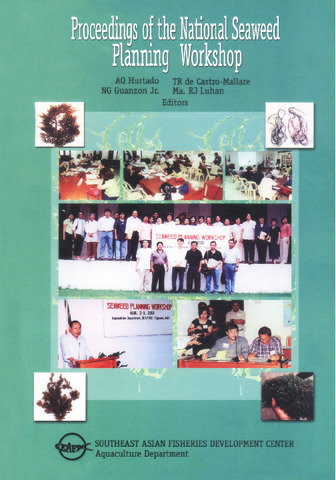
Proceedings of the National Seaweed Planning Workshop held on August 2-3, 2001, SEAFDEC Aquaculture Department, Tigbauan, Iloilo
(Aquaculture Department, Southeast Asian Fisheries Development Center, 2002)Seaweed forming is one of the major livelihoods among coastal communities in the Philippines, particularly to some 180,000 families in the Sulu Archipelago. In 1999, the Philippines exported more than 35,000 tons of dried ... -
Changes in the fish diversity and abundance on a heavily fished fringing reef on Santiago Island, Pangasinan, Philippines
(Bureau of Agricultural Research, Department of Agriculture, 2007)Fish assemblages on the reef slope, reef flat, and seagrass beds on Santiago Island were sampled over 18 months in 1992-1993 as part of a 6-year reef monitoring project started in 1986. Abundance and species diversity were analyzed by a variety of indices, and by multi-dimensional scaling and correlated ordered similarity matrix. The monitoring showed a distinct shift in the reef slope fish composition during the first half of 1988. Of the 100 most abundant species, 21 species showed significant reductions in abundance, and 20 species showed significant increases. Differences were not due to depth preference or feeding habits. Fishing pressure was apparently responsible for declines in Cheilinus trilobatus, Acanthurus nigricauda, and Naso literatus, as well as a general decline in the family Acanthuridae (surgeonfishes). However, analysis of site preferences of the decreasing species and the increasing species indicated a shift in community composition from those species preferring more coral cover to those preferring more sand, rock, and possibly Sargassum seaweed. Site preferences were determined from benthic life form transects done in 1992. Of 35 significantly changing species for which habitat data was obtained, 24 fit the hypothesis of habitat change. This supports the proposition from previous studies that the major cause of change in the reef slope fish community was the destructive fishing activity associated with Malthusian overfishing. Similar analyses of the fish assemblages on the reef flat and on the seagrass beds showed seasonal effects, particularly in the latter, but no strong shift comparable to that of the reef slope. These latter areas had been subjected to greater fishing pressure for a longer period. Reef fish populations such as those in Bolinao tend to be highly resilient provided the larval supply is not adversely affected. However, subtle changes in the cover of coral on a reef can lead to major changes in the composition of the fish community. Coral cover is being widely diminished on Philippine reefs, and substantial changes in the fish communities may be anticipated, even on reefs with initially low coral cover. These changes may affect the utility and immediate value of the fish to local fishers and the market systems they supply. It is of great urgency to stop destructive fishing practices such as blasting and use of cyanide, and to develop anchoring methods that are minimally destructive. There is a strong predictive relation between the numbers of fish (abundance) in an area and the numbers of species (biodiversity) they include. As fish populations decline due to destructive fishing, or highly concentrated non-destructive fishing, the local species richness may be expected to decline. This decline may have serious short-term social and economic consequences, as well as far-reaching long-term environmental effects. Efforts to reduce overfishing must be intensified—though reduction of birth rate, provision of alternative livelihoods, and curbing of destructive fishing — in order to prevent a very distressing future for the Philippine marine environment and the people it supports. -
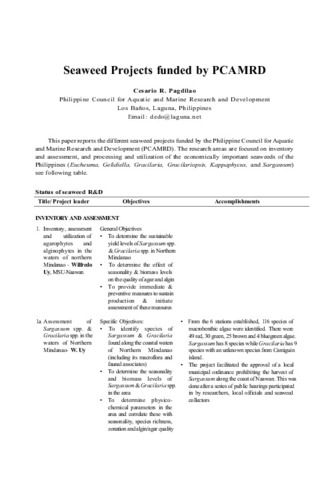
Seaweed projects funded by PCAMRD
(Aquaculture Department, Southeast Asian Fisheries Development Center, 2002)