Commercial evaluation of monosex pond culture of the mud crab Scylla species at three stocking densities in the Philippines.
View/
Date
1999Page views
1,892ASFA keyword

AGROVOC keyword
Taxonomic term

Metadata
Show full item recordShare
Abstract
The effects of three levels of stocking density (0.5, 1.5 or 3.0 m−2) and monosex culture (male or female) on the growth, apparent feed conversion ratio (FCR), survival, and production of mixed species of mud crabs, Scylla serrata and S. tranquebarica, were investigated. The juvenile crabs were stocked in 150 m2 earthen ponds with Gracilariopsis bailinae as shelter and fed a mixed diet of 75% fresh mussel flesh and 25% fish bycatch. There was no interaction between stocking density levels and monosex culture (P<0.05) so that data were pooled for each sex or stocking density treatment. Highest survival and the most efficient FCR were obtained from stocking density of 0.5 m−2 (P<0.05). Crab growth rates in different stocking densities were not significantly different (P>0.05). Male crabs attained significantly higher (P<0.05) final weight and specific growth rate (SGR) than female crabs. However, final crab length, width, FCR, survival, and production were not significantly different between male and female crabs (P>0.05). Highest return on investment (ROI) and lowest production cost were obtained from 0.5 m−2. Partial budgeting analysis showed that no net benefit accrued from stocking beyond 1.5 m−2. Both male or female monosex cultures gave high net revenue and ROI of more than 100%. Results suggest that the culture of male or female mud crabs at 0.5–1.5 m−2 is economically viable but male monosex culture is more profitable.
Suggested Citation
Triño, A. T., Millamena, O. M., & Keenan, C. (1999). Commercial evaluation of monosex pond culture of the mud crab Scylla species at three stocking densities in the Philippines. Aquaculture , 174(1-2), 109-118. https://doi.org/10.1016/S0044-8486(99)00002-2
Type
ArticleISSN
0044-8486Collections
- Journal Articles [1267]
Related items
Showing items related by title, author, creator and subject.
-
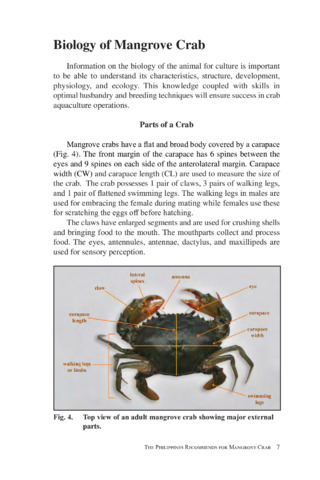
[The Philippines recommends for mangrove crab:] Biology of mangrove crab
(DOST-PCAARRD, 2021) -
Development of protocol for the production of hatchery-reared mud crab Scylla serrata juveniles for soft-shell crab farming
Quinitio, Emilia T. ; ; (Aquaculture Department, Southeast Asian Fisheries Development Center, 2017)
Development of economically viable techniques for growing hatchery-reared juvenile crabs to suitable sizes will address the problem on the source of seed stocks for soft-shell crab farming. This paper reports the production of hatchery-reared mud crab Scylla serrata from juveniles in the nursery to 73-106 g body weight (BW) crabs in the grow-out pond for the individual system soft-shell crab farming. Likewise, the performance of hatchery-reared S. serrata, and wild S. tranquebarica and S. olivacea juveniles was determined in the soft-shell crab production set-up. The BW increased from 1.8-1.9 g to 78-113.7 g when stocked at 0.5 ind m-2 and from 1.6-2.3 g to 73-106.7 g at 1.0 ind m-2 after 75 days. Growth rates at both stocking densities were comparable. However, survival was significantly higher (P<0.05) in lower (63.6~c1.01%) than in higher (35.6~c3.34%) stocking density. Male S. serrata (46.0 ~c 1.75%) had significantly higher BW increase than females (39.4 ~c 2.05%). Crabs stocked at sizes of 51-60 g showed significantly greater percent increase in BW (43.26~c 0.98%) compared with those at 61-70 g (40.98~c1.33%), 71-80 g (38.55~c 1.04%), 81-90 g (36.34 ~c 1.27%) and 91-100 g (38.52 ~c 1.67%). Among the three species, hatchery-reared S. serrata (42.14 ~c 1.34%) had significantly higher mean percent BW increase compared with S. olivacea (38.23 ~c 0.49%) and S. tranquebarica (36.16 ~c 0.78%). S. serrata had significantly shorter mean culture period (24.11 ~c 0.95 days) than S. tranquebarica (28.48 ~c 0.54 days) and S. olivacea (28.75 ~c 0.34 days).
; ; (Aquaculture Department, Southeast Asian Fisheries Development Center, 2017)
Development of economically viable techniques for growing hatchery-reared juvenile crabs to suitable sizes will address the problem on the source of seed stocks for soft-shell crab farming. This paper reports the production of hatchery-reared mud crab Scylla serrata from juveniles in the nursery to 73-106 g body weight (BW) crabs in the grow-out pond for the individual system soft-shell crab farming. Likewise, the performance of hatchery-reared S. serrata, and wild S. tranquebarica and S. olivacea juveniles was determined in the soft-shell crab production set-up. The BW increased from 1.8-1.9 g to 78-113.7 g when stocked at 0.5 ind m-2 and from 1.6-2.3 g to 73-106.7 g at 1.0 ind m-2 after 75 days. Growth rates at both stocking densities were comparable. However, survival was significantly higher (P<0.05) in lower (63.6~c1.01%) than in higher (35.6~c3.34%) stocking density. Male S. serrata (46.0 ~c 1.75%) had significantly higher BW increase than females (39.4 ~c 2.05%). Crabs stocked at sizes of 51-60 g showed significantly greater percent increase in BW (43.26~c 0.98%) compared with those at 61-70 g (40.98~c1.33%), 71-80 g (38.55~c 1.04%), 81-90 g (36.34 ~c 1.27%) and 91-100 g (38.52 ~c 1.67%). Among the three species, hatchery-reared S. serrata (42.14 ~c 1.34%) had significantly higher mean percent BW increase compared with S. olivacea (38.23 ~c 0.49%) and S. tranquebarica (36.16 ~c 0.78%). S. serrata had significantly shorter mean culture period (24.11 ~c 0.95 days) than S. tranquebarica (28.48 ~c 0.54 days) and S. olivacea (28.75 ~c 0.34 days). -
Larval rearing of mud crab (Scylla): What lies ahead
; ; Quinitio, Emilia T.; ; ; ; ; ; ; (Elsevier, 2018)
The increasing global demand for mud crabs (genus Scylla) and threats to the wild populations highlight the urgency of fully rearing them in captivity. Despite considerable progress in mud crab production, most crab farms still rely heavily on wild-caught crablets and juveniles while the low and inconsistent success rates of larviculture remain as the main bottleneck impeding the development of mud crab aquaculture. Over the years, numerous studies have been conducted to determine the optimum larval rearing parameters, the ontogenic changes in digestive function and feeding behaviour, and the diets for different larval stages. These data, however, are dispersed and not summarised to inform culture practices. This review provides an update on the current progresses and to pinpoint the gaps in knowledge regarding mud crab larval rearing. We include all four mud crab species under the genus Scylla, i.e. Scylla serrata, Scylla olivacea, Scylla tranquebarica and Scylla paramamosain. Knowledge compiled in this review serves as an important guideline for prospective mud crab larviculture. Future research should gear towards filling in the gaps in our knowledge to advance mud crab larval rearing, thus fully incorporating mud crab into the aquaculture sector.