Culture and economics of wild grouper (Epinephelus coioides) using three feed types in ponds

Download URL
citeseerx.ist.psu.eduDate
2001Page views
2,614ASFA keyword

AGROVOC keyword
Metadata
Show full item recordShare
Abstract
The performance of wild Epinephelus coioides juveniles was compared by feeding with live tilapia juveniles, fish by-catch, and formulated diet for 5 months in grow-out ponds. To minimize cannibalism, the groupers were graded into small (BW=24.9±7.3 g), medium (45.8±5.7 g), and large (84.1±30.0 g) size groups as block in a Randomized Complete Block Design (RCBD) and reared in nine 350-m2 ponds. To supply the tilapia juveniles, adult tilapia were grown 2 months prior to stocking of grouper at a rate of 15 tilapia/grouper. Grouper fed by-catch were significantly higher (P<0.01) than the other treatments in terms of final length and total production. The quality of by-catch could be gleaned by its efficient feed conversion ratio (FCR) of 1.0 (dry basis), significantly better (P<0.01) than the formulated diet that had an FCR of 2.8. Using by-catch, 47% of the harvest weighed >400 g and only 14% was classified <200 g. The cost of juvenile grouper and feeds represented 88–89% of the total investment in all treatments. Economic sensitivity analysis showed that a combination of improvement in factors such as price of grouper juveniles, feeds, yield, survival, and FCR would result in higher return-on-investment (ROI). When cost and returns were considered, feeding juveniles with by-catch was more profitable because it resulted in net income of Php 361,623/ha/year, an ROI of 155%, and a payback period of 0.4 year. The results clearly show that these economic indicators appear to be attractive, thus making grouper pond culture using by-catch a viable industry. More research efforts should, however, be directed towards developing a cost-effective formulated diet for the grow-out culture of E. coioides.
Suggested Citation
Bombeo-Tuburan, I., Coniza, E. B., Rodriguez, E. M., & Agbayani, R. F. (2001). Culture and economics of wild grouper (Epinephelus coioides) using three feed types in ponds. Aquaculture , 201(3-4), 229-240. https://doi.org/10.1016/S0044-8486(01)00744-X
Type
ArticleISSN
0044-8486Collections
- Journal Articles [1267]
Related items
Showing items related by title, author, creator and subject.
-
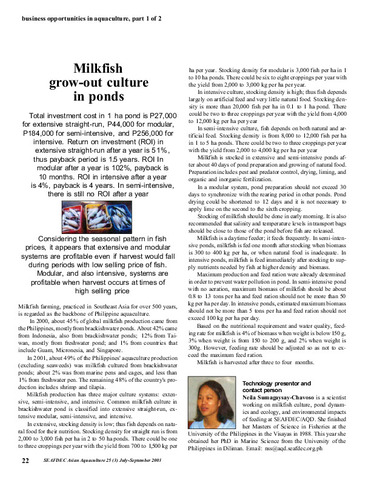
Milkfish grow-out culture in ponds
(Aquaculture Department, Southeast Asian Fisheries Development Center, 2003)Milkfish farming is regarded as the backbone of Philippine aquaculture. In 2001, nearly 50% of the Philippines' aquaculture production was milkfish cultured from brackishwater ponds. It has 3 major culture systems: extensive; semi-intensive and intensive. A brief outline is given of the stocking and feeding procedures, providing also some details as to investment costs and returns. -
Series: Aquaculture extension manual; No. 41
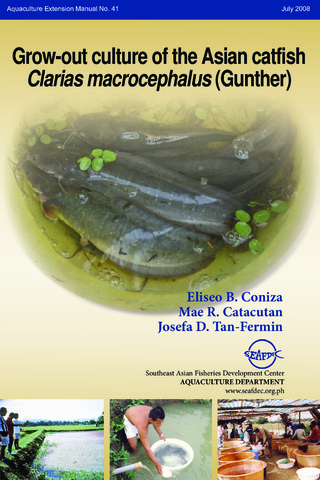
Grow-out culture of the Asian catfish Clarias macrocephalus (Gunther)
(Aquaculture Department, Southeast Asian Fisheries Development Center, 2008)Asian catfish Clarias macrocephalus is an esteemed food fish especially in Southeast Asia due to its tender and delicious meat. This commodity constitutes a valuable fishery for small-scale fishers in the region and has a great potential for aquaculture. The important considerations in the grow-out culture of catfish are reliable water supply, soil with good compaction properties for dike construction, supply of fingerlings, feeds, labor, pond supplies and technology assistance. The farm must also be accessible by road, near to market facilities and has a peaceful environment. Rearing catfish in ponds is the most popular and commonly practiced. The pen culture is a system fully enclosed by nets on all sides but utilizes the dug-out pond, dam or lake bed as bottom enclosure. Tanks in abandoned old hatcheries with freshwater source can be used for catfish culture. In the cage culture system the stock is fully enclosed by nylon nets on all sides and bottom similar to an inverted mosquito net installed in suitable areas like reservoirs, dams, lakes and dug-out ponds. The rice-fish (catfish) culture is also practiced where the rice pond canals are utilized to retain water at 1-2 m depth to provide shelter to the fish while the rice plot maintains 10-20 cm water depth. For the stock, select fingerlings that are active, healthy and uniform in size. Handling of fish stock is important to avoid mortality due to stress during harvest, sorting, counting and transport. Furthermore, stocking of fish is recommended during the cooler part of the day. Catfish fingerlings stocking density is about 5 to 20 pcs/m2 depending on the water supply and support facilities of the farm. The catfish, C. macrocephalus, requires a substantial amount of dietary protein for growth. For this species a formulated diet with crude protein (CP) of 34%, moist diet (trash fish or blanched chicken entrails plus rice bran or cooked broken rice), and a combination of pellet feeds (50%) and moist diet (50%) have been tested and acceptable for the grow-out culture. Economic evaluation based on a grow-out culture in pond with an area of 1,000 m2 showed that feeds and fingerlings are the major variable costs. The net income, return on investments and payback period, respectively range from PhP22,972-PhP35,741, 80-122% and 0.8-1.2 years when using pellet, moist feed or a combination of these feeds. Feeding using formulated diet has an advantage of convenience, quality and quantity over moist diet which has issues such as inconsistent supply, storage requirement and fouling the rearing water. -
Formulated feeds for Penaeus monodon
(ASEAN/UNDP/FAO Regional Small-Scale Coastal Fisheries Development Project, 1989)The paper discusses the food and feeding habits of Penaeus monodon , present knowledge of nutrient requirements and available formulation in the market including those developed at the Aquaculture Department, Southeast Asian Fisheries Development Center. Economics of feeding is also presented. Further research on the use of indigenous feed ingredients and nutritional requirement studies should be carried out to lower cost of feed and increase profits for the farmers.