Nursery rearing of the Asian catfish, Clarias macrocephalus (Günther), at different stocking densities in cages suspended in tanks and ponds


Share
Abstract
Growth and survival of hatchery-bred Asian catfish, Clarias macrocephalus (Günther), fry reared at different stocking densities in net cages suspended in tanks and ponds were measured. The stocking densities used were 285, 571 and 1143 fry m−3 in tanks and 114, 228 and 457 fry m−3 in ponds. Fish were fed a formulated diet throughout the 28-day rearing period. Generally, fish reared in cages in ponds grew faster, with a specific growth rate (SGR) range of 10.3–14.6% day−1, than those in cages suspended in tanks (SGR range 9–11.3% day−1). This could be attributed to the presence of natural zooplankton (copepods and cladocerans) in the pond throughout the culture period, which served as additional food sources for catfish juveniles. In both scenarios, the fish reared at lower densities had significantly higher SGR than fish reared at higher densities. In the pond, the SGR of fish held at 228 and 457 m−3 were similar to each other but were significantly lower than those of fish held at 114 m−3. The zooplankton in ponds consisted mostly of copepods and cladocerans, in contrast to tanks, in which rotifers were more predominant. Per cent survival ranged from 85% to 89% in tanks and from 78% to 87% in ponds and did not differ significantly among stocking densities and between rearing systems. In conclusion, catfish nursery in cages suspended in tanks and ponds is density dependent. Catfish fry reared at 285 m−3 in tanks and at 114 m−3 in ponds had significantly faster growth rates than fish reared at higher densities. However, the desired fingerling size of 3–4 cm total length for stocking in grow-out culture can still be attained at stocking densities of 457 m−3 in nursery pond and 571 m−3 in tanks.
Suggested Citation
Bombeo, R. F., Fermin, A. C., & Tan-Fermin, J. D. (2002). Nursery rearing of the Asian catfish, Clarias macrocephalus (Günther), at different stocking densities in cages suspended in tanks and ponds. Aquaculture Research , 33(13), 1031-1036. https://doi.org/10.1046/j.1365-2109.2002.00763.x
Type
ArticleISSN
1355-557XCollections
- Journal Articles [1266]
Related items
Showing items related by title, author, creator and subject.
-
The culture of tilapia
(Aquaculture Department, Southeast Asian Fisheries Development Center, 1998) -
Prospects of milkfish sea cage farming
(Aquaculture Department, Southeast Asian Fisheries Development Center, 1998) -
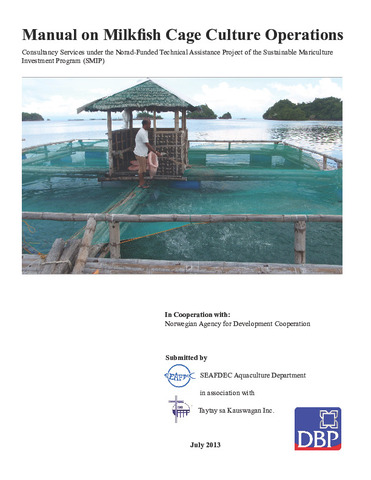
Manual on milkfish cage culture operations
(Aquaculture Department, Southeast Asian Fisheries Development Center, 2013-07)Milkfish (Chanos chanos, or bangus) culture is the largest finfish aquaculture industry in the Philippines and continues to be a top aquaculture commodity primarily because it is easy to culture and can be grown in a wide range of environments. Milkfish thrives in freshwater, brackishwater, marine, and even hypersaline habitats. Milkfish production is increasing rapidly with much of the production moving away from the traditional culture in brackishwater ponds to fish cages in coastal marine waters. To provide a general view of the milkfish culture industry, brief descriptions on breeding, hatchery production, and nursery operation are included in this manual. This manual is meant to serve as a guide for those interested to venture into marine cage farming of milkfish. Milkfish culture has been practiced in the Philippines, Indonesia, and Taiwan for centuries and has been the focus of aquaculture research in a number of institutions for several decades. Innovations in culture practices as a result of information from research data and from farmer’s experiences have been adopted by industry practitioners and these are documented in the recently published book entitled Milkfish Aquaculture in Asia (Liao and Leano, 2010). The recent concern about the rapid growth of aquaculture and its possible environmental impacts, and risks that can threaten the sustainability of this expanding industry has also been the subject of many conferences to develop good management practices in aquaculture. Principles and guidelines on better management practices in marine finfish culture had been drafted and included in this manual.