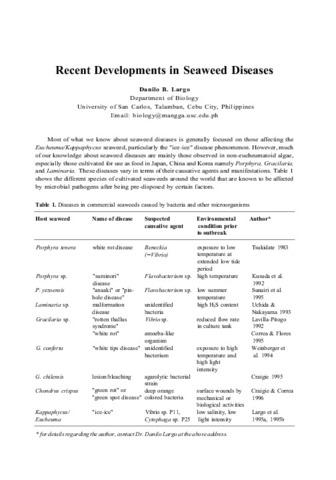
Recent developments in seaweed diseases


Share
Suggested Citation
Largo, D.B. (2002). Recent developments in seaweed diseases. In: A.Q. Hurtado, N.G. Guanzon, Jr., T.R. de Castro-Mallare, & M.R.J. Luhan (Eds.) Proceedings of the National Seaweed Planning Workshop held on August 2-3, 2001, SEAFDEC Aquaculture Department, Tigbauan, Iloilo. (pp. 35-42). Tigbauan, Iloilo : SEAFDEC Aquaculture Department.
Type
Conference paperCollections
Related items
Showing items related by title, author, creator and subject.
-
Preliminary survey of pests and diseases of eucheumatoid seaweed farms in the Philippines
Faisan, Joseph P., Jr. ; ; Sibonga, Rema ; ; ; ; ; ; ; ; ; (Springer, 2021-05-04)
Farmed eucheumatoids are the top aquaculture commodity in the Philippines, contributing more than 60% of total national aquaculture production by volume. Despite significant production losses observed in recent years due to pests and diseases, data relating to the temporal and spatial geographic distribution, seasonality, prevalence, and etiology of these critical problems at the farm level are lacking. Here, we assessed the prevalence of pests and diseases at 16 farm sites within several major seaweed growing areas, including Luzon (Palawan), Visayas (Bohol), and Mindanao (Zamboanga City, Davao del Norte, and Tawi-Tawi). Prevalence of pests and diseases were recorded by assessment of individual seaweed plants in situ, comprising ≥5% of the total number of seaweed plants on each farm. Results from this survey revealed “ice-ice” disease (IID) at all sites, albeit at low prevalence rates of below 25%, the exception being one site where prevalence was 100%. No significant difference in the prevalence of IID was found between farms in shallow (≈0.5 m during low tide) and deep water sites (depths exceeding 4 m during the lowest tide) (p>0.05). Moderate prevalence (26–50%) of the macro-epiphyte pests Sargassum and Ulva was reported in Luzon. Further, epiphytic filamentous algae (EFA), black spots, and evidence of grazing were recorded in several farms with low prevalence (0.2–11.2%). The three farms with the highest prevalence of IID and EFA were evaluated to determine the severity of cover on the thallus of infected plants. A very high severity of IID (76–100% coverage) was observed on the secondary and primary branches, while for EFA, low severity (≤25%) was found in all regions of the thallus. Our results suggest the widespread occurrence of yield-limiting diseases and pests affecting eucheumatoid farms in the Philippines. Strategies for the diagnosis, surveillance, and management of yield-limiting pests and diseases are needed to ensure maintenance and sustainable expansion of this important aquaculture sector in the Philippines.
; ; Sibonga, Rema ; ; ; ; ; ; ; ; ; (Springer, 2021-05-04)
Farmed eucheumatoids are the top aquaculture commodity in the Philippines, contributing more than 60% of total national aquaculture production by volume. Despite significant production losses observed in recent years due to pests and diseases, data relating to the temporal and spatial geographic distribution, seasonality, prevalence, and etiology of these critical problems at the farm level are lacking. Here, we assessed the prevalence of pests and diseases at 16 farm sites within several major seaweed growing areas, including Luzon (Palawan), Visayas (Bohol), and Mindanao (Zamboanga City, Davao del Norte, and Tawi-Tawi). Prevalence of pests and diseases were recorded by assessment of individual seaweed plants in situ, comprising ≥5% of the total number of seaweed plants on each farm. Results from this survey revealed “ice-ice” disease (IID) at all sites, albeit at low prevalence rates of below 25%, the exception being one site where prevalence was 100%. No significant difference in the prevalence of IID was found between farms in shallow (≈0.5 m during low tide) and deep water sites (depths exceeding 4 m during the lowest tide) (p>0.05). Moderate prevalence (26–50%) of the macro-epiphyte pests Sargassum and Ulva was reported in Luzon. Further, epiphytic filamentous algae (EFA), black spots, and evidence of grazing were recorded in several farms with low prevalence (0.2–11.2%). The three farms with the highest prevalence of IID and EFA were evaluated to determine the severity of cover on the thallus of infected plants. A very high severity of IID (76–100% coverage) was observed on the secondary and primary branches, while for EFA, low severity (≤25%) was found in all regions of the thallus. Our results suggest the widespread occurrence of yield-limiting diseases and pests affecting eucheumatoid farms in the Philippines. Strategies for the diagnosis, surveillance, and management of yield-limiting pests and diseases are needed to ensure maintenance and sustainable expansion of this important aquaculture sector in the Philippines. -
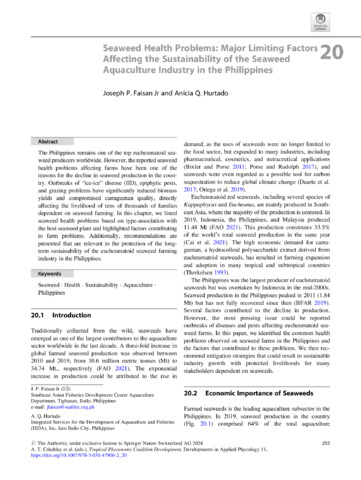
Seaweed health problems: Major limiting factors affecting the sustainability of the seaweed aquaculture industry in the Philippines
Faisan, Jr., Joseph; (Springer International Publishing, 2024)
The Philippines remains one of the top eucheumatoid seaweed producers worldwide. However, the reported seaweed health problems affecting farms have been one of the reasons for the decline in seaweed production in the country. Outbreaks of “ice-ice” disease (IID), epiphytic pests, and grazing problems have significantly reduced biomass yields and compromised carrageenan quality, directly affecting the livelihood of tens of thousands of families dependent on seaweed farming. In this chapter, we listed seaweed health problems based on type-association with the host seaweed plant and highlighted factors contributing to farm problems. Additionally, recommendations are presented that are relevant to the protection of the long-term sustainability of the eucheumatoid seaweed farming industry in the Philippines. -
Seasonal growth, carrageenan properties, and resistance to disease and epiphytic pests between Kappaphycus alvarezii (Rhodophyta) var. tambalang (brown) tissue-cultured and farm-sourced seaweeds
Faisan, Jr., Joseph; ; ; ; ; (Springer, 2024-01-08)
Growth performance (specific growth rate [SGR] and biomass yield), carrageenan properties (yield, viscosity, and gel strength), and disease and pest incidence were compared between Kappaphycus alvarezii var. tambalang (brown) tissue-cultured (TC) plantlets and farm-sourced (FS) seedlings. Seedlings used in the trials were propagules (4‒19 g pieces) and these were deployed on lines in sea cages over three separate runs of 60 days. The highest growth rate was recorded in TC plantlets and the SGRs were significantly higher (1.5‒6.5x) in TC than FS after Day of Culture (DOC) 15 (i.e., measurements taken every 15 days in each cycle). The carrageenan properties did not differ between treatments, with the exception of viscosity at DOC 45, where TC was higher than FS. “Ice-ice” disease (IID) was observed in both FS and TC in May‒June and August‒October at DOC 45 to 60, coinciding with changes in environmental conditions (i.e., dry‒wet and wet seasons). IID in FS had a moderate to very high incidence (31.2‒86.2%), while TC IID had a lower range of incidence (12.8‒60.6%). On the other hand, epiphytic filamentous algae (EFA) were observed only in August‒October with a low incidence (≤25%). However, EFA appeared earlier in FS than in TC. Taken together, these results highlight that tissue-cultured seaweeds had higher growth performance without compromising carrageenan quality and may be more resistant to health problems than farm-sourced seedlings. Studies should now assess the long-term viability of using tissue-cultured seaweeds over farm-sourced seedlings scaling to allow testing in standard farm settings, including the size of the initial seed.