In observance of the Lenten season, please be advised of the following adjustments to our repository services:
- Effective Date: Afternoon of April 1, 2026
- Service Resumption: Monday, April 6, 2026
Our repository remains online for browsing; however, "Request a Copy" responses will be paused starting April 1, 2026 afternoon. Standard processing and responses will resume on April 6, 2026. Thank you for your patience!
Pen culture of mudcrab in mangroves


Share
Abstract
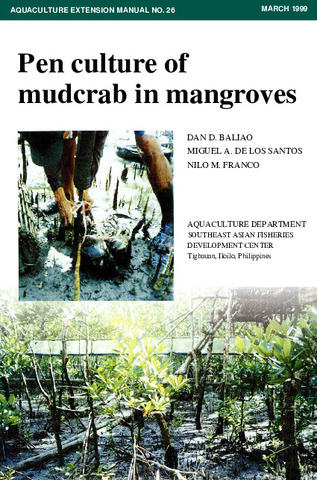
This manual, describing the pen culture of mudcrab (Scylla spp) in mangroves, is intended for the use of fishfarmers and aquaculturists, extensionists, and students of aquaculture, not only in the Philippines but also in other mudcrab-producing countries in Southeast Asia. It covers the following: Site selection; Installation of net enclosure; Materials; Rearing operation; Feeds and feeding; Stock sampling; Water quality and pen management; Harvesting; and, marketing.
Suggested Citation
Baliao, D. D., De los Santos, M. A., & Franco, N. M. (1999). Pen culture of mudcrab in mangroves. Tigbauan, Iloilo, Philippines: Aquaculture Department, Southeast Asian Fisheries Development Center.
Type
BookISBN
9718511377Series
Aquaculture extension manual; No. 26Format
10 p. : ill.
Collections
Related items
Showing items related by title, author, creator and subject.
-
Aquaculture industry profile and trends
(University of the Philippines Aquaculture Society, Inc., 2001) -
Aquaculture in Malaysia
(Aquaculture Department, Southeast Asian Fisheries Development Center, 1995)Aquaculture in Malaysia is experiencing rapid growth. Total production in 1992 amounted to 79,699 tons valued at RM 207.4 million. These figures are 23% and 25% higher than the previous year's. Semi-culture of the cockle Anadara granosa was still predominant, contributing about 70% of the total output. Culture and production of the oyster Crassostrea iredalei is still insignificant. Sea bass Lates calcarifer constituted over 80% of the production from marine cages. Cage culture of grouper Epinephelus sp., snapper Lutjanus sp. and pompano Trachinotus blochii were also done in much smaller scale. The mangrove snapper Lutjanus argentimaculatus was recently spawned in captivity and larvae and juveniles were produced. In 1992, the tiger shrimp Penaeus monodon constituted about 87% of brackishwater pond production. Pond culture of the white shrimp P. merguiensis and the mudcrab Scylla sp. is at the experimental stage. Red tilapia hybrid was the major freshwater species cultured in cages, with 1,486 tons harvested in 1992. Freshwater pond production was valued at RM 100.85 million, 22% of which was due to the eel Anguilla japonica. Production of freshwater ornamental fishes is also becoming significant. Other exotic species recently bred and cultured are the African catfish Clarias gariepinus and the pacu Piaractus brachypomus. The indigenous freshwater catfish Mystus nemurus and carp Probarbus julleini have recently been bred in captivity and cultured experimentally. Lately, there have been attempts to culture non-conventional species such as the bullfrog Rana catesbeiana, the soft-shell turtle Trionyx sinensis, and aquatic ornamental plants. -
Coastal aquaculture in Thailand
(Aquaculture Department, Southeast Asian Fisheries Development Center, 1995)Coastal aquaculture in Thailand has expanded rapidly in both area and production in the last decade. The important cultured species are the shrimps (Penaeus monodon and P. merguiensis), sea bass Lates calcarifer, groupers Epinephelus malabaricus and E. tauvina, green mussel Perna viridis, horse mussel Modiolus senhausenii, blood cockles Anadara granosa and A. nodifera and the oysters Crassostrea belcheri, C. lugubris and Saccostrea commercialis. The total production from coastal aquaculture in 1991 was 230,444 tons, consisting of 70.3% shrimp, 28.8% mollusks, and 0.9% fishes. The seaweeds Gracilaria spp., pearl oysters, scallops, and abalones are cultured on a pilot scale in some places. Hatchery technologies have recently been developed for groupers, oysters, scallops, and abalones. Expanded aquaculture has had some adverse effects on the environment and has also suffered from the environmental changes and conflicts due to other sectors using the same water and other resources.