
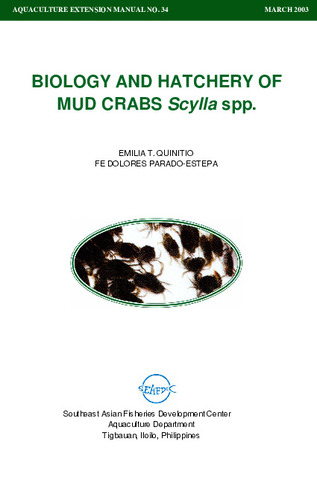
Biology and hatchery of mud crabs Scylla spp.


Share
Abstract
This manual describes the principles and procedures for spawning the mature crabs (Scylla serrata, S. tranquebarica, and S. olivacea) and rearing the zoeae to juveniles. Hatchery conditions should satisfy the ecological requirements of each specific stage, thus the manual starts with a section on biology of mud crabs.
Suggested Citation
Quinitio, E. T., & Parado-Estepa, F. D. (2003). Biology and hatchery of mud crabs Scylla spp. Tigbauan, Iloilo, Philippines: Aquaculture Department, Southeast Asian Fisheries Development Center.
Type
BookISBN
9718511636Series
Aquaculture extension manual; No. 34Format
42 p. : ill. (some col.).
Collections
Related items
Showing items related by title, author, creator and subject.
-
Development of protocol for the production of hatchery-reared mud crab Scylla serrata juveniles for soft-shell crab farming
Quinitio, Emilia T. ; ; (Aquaculture Department, Southeast Asian Fisheries Development Center, 2017)
Development of economically viable techniques for growing hatchery-reared juvenile crabs to suitable sizes will address the problem on the source of seed stocks for soft-shell crab farming. This paper reports the production of hatchery-reared mud crab Scylla serrata from juveniles in the nursery to 73-106 g body weight (BW) crabs in the grow-out pond for the individual system soft-shell crab farming. Likewise, the performance of hatchery-reared S. serrata, and wild S. tranquebarica and S. olivacea juveniles was determined in the soft-shell crab production set-up. The BW increased from 1.8-1.9 g to 78-113.7 g when stocked at 0.5 ind m-2 and from 1.6-2.3 g to 73-106.7 g at 1.0 ind m-2 after 75 days. Growth rates at both stocking densities were comparable. However, survival was significantly higher (P<0.05) in lower (63.6~c1.01%) than in higher (35.6~c3.34%) stocking density. Male S. serrata (46.0 ~c 1.75%) had significantly higher BW increase than females (39.4 ~c 2.05%). Crabs stocked at sizes of 51-60 g showed significantly greater percent increase in BW (43.26~c 0.98%) compared with those at 61-70 g (40.98~c1.33%), 71-80 g (38.55~c 1.04%), 81-90 g (36.34 ~c 1.27%) and 91-100 g (38.52 ~c 1.67%). Among the three species, hatchery-reared S. serrata (42.14 ~c 1.34%) had significantly higher mean percent BW increase compared with S. olivacea (38.23 ~c 0.49%) and S. tranquebarica (36.16 ~c 0.78%). S. serrata had significantly shorter mean culture period (24.11 ~c 0.95 days) than S. tranquebarica (28.48 ~c 0.54 days) and S. olivacea (28.75 ~c 0.34 days).
; ; (Aquaculture Department, Southeast Asian Fisheries Development Center, 2017)
Development of economically viable techniques for growing hatchery-reared juvenile crabs to suitable sizes will address the problem on the source of seed stocks for soft-shell crab farming. This paper reports the production of hatchery-reared mud crab Scylla serrata from juveniles in the nursery to 73-106 g body weight (BW) crabs in the grow-out pond for the individual system soft-shell crab farming. Likewise, the performance of hatchery-reared S. serrata, and wild S. tranquebarica and S. olivacea juveniles was determined in the soft-shell crab production set-up. The BW increased from 1.8-1.9 g to 78-113.7 g when stocked at 0.5 ind m-2 and from 1.6-2.3 g to 73-106.7 g at 1.0 ind m-2 after 75 days. Growth rates at both stocking densities were comparable. However, survival was significantly higher (P<0.05) in lower (63.6~c1.01%) than in higher (35.6~c3.34%) stocking density. Male S. serrata (46.0 ~c 1.75%) had significantly higher BW increase than females (39.4 ~c 2.05%). Crabs stocked at sizes of 51-60 g showed significantly greater percent increase in BW (43.26~c 0.98%) compared with those at 61-70 g (40.98~c1.33%), 71-80 g (38.55~c 1.04%), 81-90 g (36.34 ~c 1.27%) and 91-100 g (38.52 ~c 1.67%). Among the three species, hatchery-reared S. serrata (42.14 ~c 1.34%) had significantly higher mean percent BW increase compared with S. olivacea (38.23 ~c 0.49%) and S. tranquebarica (36.16 ~c 0.78%). S. serrata had significantly shorter mean culture period (24.11 ~c 0.95 days) than S. tranquebarica (28.48 ~c 0.54 days) and S. olivacea (28.75 ~c 0.34 days). -
Monosex culture of the mud crab Scylla serrata at three stocking densities with Gracilaria as crab shelter
(Australian Centre for International Agricultural Research, 1999)The effects of three levels of stocking density (0.5, 1.5 or 3.0/m2) and monosex culture (male or female) on the growth, survival and production of Scylla serrata were investigated. Juvenile crabs were stocked in 150 m2 enclosures in earthen ponds with Gracilaria as shelter and fed a mixed diet of 75% fresh brown mussel flesh and 25% fish bycatch. There was no interaction between stocking density levels and monosex culture (P<0.05) so the data were pooled for each sex or stocking density treatment. Results showed that highest survival was obtained from a stocking density of 0.5/m2 (P<0.05). Crab growth at different stocking densities was not significantly different (P>0.05). Highest return on investment (ROI) and lowest production costs were attained from 0.5/m2. Partial budgeting analysis showed that no net benefit accrued from stocking beyond 1.5/m2. Male crabs attained significantly better (P<0.05) final weight and specific growth rate than female crabs. Length, width, survival and production between male and female crabs were not significantly different (P>0.05). Male and female monoculture gave high net revenue and ROI of more than 100 but male monoculture is more profitable. Overall the results suggest that the culture of male or female mud crabs at 0.5–1.5/m2 with Gracilaria is economically viable. -
Series: Aquaculture extension manual; No. 61
Soft-shell crab production using hatchery-reared mud crab
(Aquaculture Department, Southeast Asian Fisheries Development Center; Philippine Council for Agriculture, Aquatic and Natural Resources Research and Development (PCAARRD), 2015)"The production of soft-shell crabs is well established in other Asian countries but its sustainability is already being threatened due to the decreasing mud crab population in the wild where the seedstocks are sourced. In the Philippines, production of soft-shell crabs has only been practiced recently due to lack of seedstock and technology. Sourcing of crablets from the natural environment is not encouraged due to dwindling populations of all sizes of mud crabs. Instead, it is recommended that crablets for soft-shell crab production come from hatcheries. The project on soft-shell mud crab production at SEAFDEC/AQD started in 2012 and was later funded by the Philippine Council for Agriculture, Aquatic and Natural Resources Research and Development of the Department of Science and Technology. The project is adopting the individual crab culture sytem of Thailand and Myanmar in pilot-scale and uses hatchery-reared crablets grown to 60-100 g in earthen ponds and stocked in trays. The pilotscale soft-shell production set-up is showcased at the Dumangas Brackishwater Station of SEAFDEC/AQD using crab boxes available in the country. Various sectors are interested to learn how soft-shell crabs are produced. Hence, the previous manual on Soft-shell Mud Crab Farming by Emilia T. Quinitio and May Myat Noe Lwin published in 2009 was revised to include the recent refinements using hatchery-reared crabs and locally available materials. This manual includes sections on the biology of mud crab, how to set-up the facility, management of soft-shell crab production and the cost and return analysis. We hope that various sectors will benefit from this revised manual" -- Foreword


