Biology and hatchery of mangrove crabs Scylla spp.

View/
Date
2018Author
Page views
10,494ASFA keyword

AGROVOC keyword
Taxonomic term

Metadata
Show full item recordShare
Abstract
This manual includes the biology of crab (Scylla serrata, S. tranquebarica, and S. olivacea), and describes principles and procedures for spawning the mature crabs and rearing the zoea to ‘fly’ size crabs. It focuses on the hatchery rearing of S. serrata as the farming of this species is more economically viable than the two other species. The techniques may be modified depending on the conditions or problems encountered in a specific site.
Suggested Citation
Quinitio, E. T., Parado-Estepa, F. D., & dela Cruz-Huervana, J. J. (2018). Biology and hatchery of mangrove crabs Scylla spp. (3rd Ed.). Tigbauan, Iloilo, Philippines: Aquaculture Department, Southeast Asian Fisheries Development Center.
Contents
- Foreword
- Introduction
- Biology of Scylla spp.
- Crab anatomy
- Taxonomy and identification
- Life history and habitat
- Food and feeding
- Molting and regeneration
- Sexual maturity
- Mating
- Spawning
- Embryonic development and hatching
- Larval development
- Hatchery Operations
- Setting up the hatchery
- Preparation of tanks and seawater
- Production of natural food
- Management of broodstock
- Larval rearing
- Culture of megalopa
- Harvesting, packing, and transport of crablets
- Common problems and possible solutions
- Economics of mangrove crab hatchery
- References
- Acknowledgement
- Appendix
- Glossary
Type
BookISSN
0115-5369Series
Aquaculture extension manual; No. 34Format
45 pages : illustrations (chiefly color).
Collections
Related items
Showing items related by title, author, creator and subject.
-
Series: Aquaculture extension manual; No. 61
Soft-shell crab production using hatchery-reared mud crab
(Aquaculture Department, Southeast Asian Fisheries Development Center; Philippine Council for Agriculture, Aquatic and Natural Resources Research and Development (PCAARRD), 2015)"The production of soft-shell crabs is well established in other Asian countries but its sustainability is already being threatened due to the decreasing mud crab population in the wild where the seedstocks are sourced. In the Philippines, production of soft-shell crabs has only been practiced recently due to lack of seedstock and technology. Sourcing of crablets from the natural environment is not encouraged due to dwindling populations of all sizes of mud crabs. Instead, it is recommended that crablets for soft-shell crab production come from hatcheries. The project on soft-shell mud crab production at SEAFDEC/AQD started in 2012 and was later funded by the Philippine Council for Agriculture, Aquatic and Natural Resources Research and Development of the Department of Science and Technology. The project is adopting the individual crab culture sytem of Thailand and Myanmar in pilot-scale and uses hatchery-reared crablets grown to 60-100 g in earthen ponds and stocked in trays. The pilotscale soft-shell production set-up is showcased at the Dumangas Brackishwater Station of SEAFDEC/AQD using crab boxes available in the country. Various sectors are interested to learn how soft-shell crabs are produced. Hence, the previous manual on Soft-shell Mud Crab Farming by Emilia T. Quinitio and May Myat Noe Lwin published in 2009 was revised to include the recent refinements using hatchery-reared crabs and locally available materials. This manual includes sections on the biology of mud crab, how to set-up the facility, management of soft-shell crab production and the cost and return analysis. We hope that various sectors will benefit from this revised manual" -- Foreword -
Fish farming handbook
(Aquaculture Department, Southeast Asian Fisheries Development Center, 1980)A handy reference for farm broadcasters, information writers, extension workers, fishfarmers, teachers, and students. -
Series: Aquaculture extension manual; No. 47
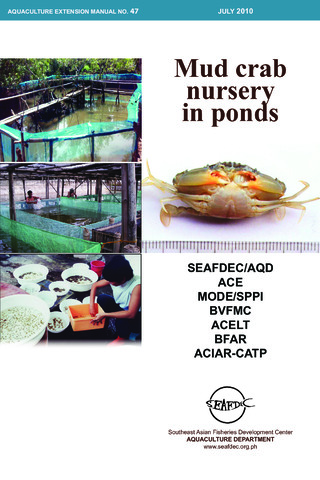
Mud crab nursery in ponds
Quinitio, Emilia T.An extension manual that is highly illustrated, detailing the biology, nursery, harvest, marketing, costs-and-returns of mudcrab nursery in ponds. ; ; ; ; ; ; (Aquaculture Department, Southeast Asian Fisheries Development Center, 2010)