In observance of the Lenten season, please be advised of the following adjustments to our repository services:
- Effective Date: Afternoon of April 1, 2026
- Service Resumption: Monday, April 6, 2026
Our repository remains online for browsing; however, "Request a Copy" responses will be paused starting April 1, 2026 afternoon. Standard processing and responses will resume on April 6, 2026. Thank you for your patience!
A lesson from cyclone Larry: An untold story of the success of good coastal planning

Download URL
www.seagrasswatch.orgDate
2007Author

Page views
1,283ASFA keyword

AGROVOC keyword
Metadata
Show full item recordShare
Abstract
When tropical cyclone Larry crossed the Queensland coast on 20 March 2006, commercial, recreational and naval vessels in the port of Cairns, 60 km north of the eye of the cyclone and others closer to the eye, were protected from the destructive winds by sheltering in deep mangrove creeks in Trinity Inlet and off other coastal rivers. The Trinity Inlet mangroves are protected under the comprehensive multi-use Trinity Inlet Management Plan, agreed by the local and state government agencies (Cairns City Council, the Cairns Port Authority and the Queensland Government). Using this Australian example and one from the town of Palompon in Leyte province, central Philippines, we show how long-term mangrove habitat protection resulting from well-conceived coastal planning can deliver important economic and infrastructure benefits.
Suggested Citation
Williams, M. J., Coles, R., & Primavera, J. (2007). A lesson from cyclone Larry: An untold story of the success of good coastal planning. Estuarine, Coastal and Shelf Science , 71(3-4), 364-367. https://doi.org/10.1016/j.ecss.2006.09.010
Type
ArticleISSN
0272-7714Collections
- Journal Articles [1267]
Related items
Showing items related by title, author, creator and subject.
-
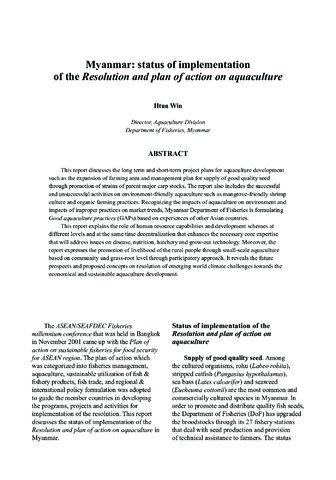
Myanmar: Status of implementation of the resolution and plan of action on aquaculture.
(Aquaculture Department, Southeast Asian Fisheries Development Center, 2011)This report discusses the long term and short-term project plans for aquaculture development such as the expansion of farming area and management plan for supply of good quality seed through promotion of strains of parent major carp stocks. The report also includes the successful and unsuccessful activities on environment-friendly aquaculture such as mangrove-friendly shrimp culture and organic farming practices. Recognizing the impacts of aquaculture on environment and impacts of improper practices on market trends, Myanmar Department of Fisheries is formulating Good aquaculture practices (GAPs) based on experiences of other Asian countries. This report explains the role of human resource capabilities and development schemes at different levels and at the same time decentralization that enhances the necessary core expertise that will address issues on disease, nutrition, hatchery and grow-out technology. Moreover, the report expresses the promotion of livelihood of the rural people through small-scale aquaculture based on community and grass-root level through participatory approach. It reveals the future prospects and proposed concepts on resolution of emerging world climate challenges towards the economical and sustainable aquaculture development. -
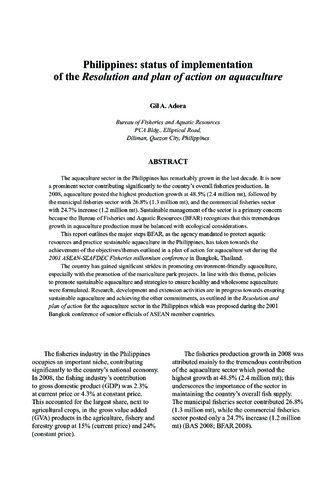
Philippines: Status of implementation of the resolution and plan of action on aquaculture.
(Aquaculture Department, Southeast Asian Fisheries Development Center, 2011)The aquaculture sector in the Philippines has remarkably grown in the last decade. It is now a prominent sector contributing significantly to the country s overall fisheries production. In 2008, aquaculture posted the highest production growth at 48.5% (2.4 million mt), followed by the municipal fisheries sector with 26.8% (1.3 million mt), and the commercial fisheries sector with 24.7% increase (1.2 million mt). Sustainable management of the sector is a primary concern because the Bureau of Fisheries and Aquatic Resources (BFAR) recognizes that this tremendous growth in aquaculture production must be balanced with ecological considerations. This report outlines the major steps BFAR, as the agency mandated to protect aquatic resources and practice sustainable aquaculture in the Philippines, has taken towards the achievement of the objectives/themes outlined in a plan of action for aquaculture set during the 2001 ASEAN-SEAFDEC Fisheries millennium conference in Bangkok, Thailand. The country has gained significant strides in promoting environment-friendly aquaculture, especially with the promotion of the mariculture park projects. In line with this theme, policies to promote sustainable aquaculture and strategies to ensure healthy and wholesome aquaculture were formulated. Research, development and extension activities are in progress towards ensuring sustainable aquaculture and achieving the other commitments, as outlined in the Resolution and plan of action for the aquaculture sector in the Philippines which was proposed during the 2001 Bangkok conference of senior officials of ASEAN member countries. -
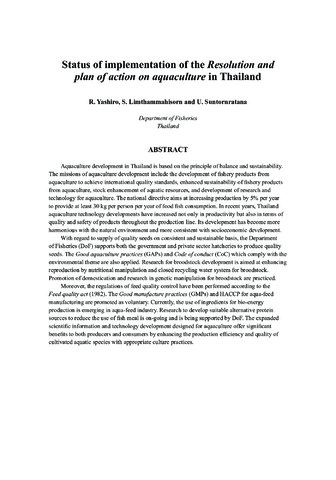
Status of implementation of the resolution and plan of action on aquaculture in Thailand.
(Aquaculture Department, Southeast Asian Fisheries Development Center, 2011)Aquaculture development in Thailand is based on the principle of balance and sustainability. The missions of aquaculture development include the development of fishery products from aquaculture to achieve international quality standards, enhanced sustainability of fishery products from aquaculture, stock enhancement of aquatic resources, and development of research and technology for aquaculture. The national directive aims at increasing production by 5% per year to provide at least 30 kg per person per year of food fish consumption. In recent years, Thailand aquaculture technology developments have increased not only in productivity but also in terms of quality and safety of products throughout the production line. Its development has become more harmonious with the natural environment and more consistent with socioeconomic development. With regard to supply of quality seeds on consistent and sustainable basis, the Department of Fisheries (DoF) supports both the government and private sector hatcheries to produce quality seeds. The Good aquaculture practices (GAPs) and Code of conduct (CoC) which comply with the environmental theme are also applied. Research for broodstock development is aimed at enhancing reproduction by nutritional manipulation and closed recycling water system for broodstock. Promotion of domestication and research in genetic manipulation for broodstock are practiced. Moreover, the regulations of feed quality control have been performed according to the Feed quality act (1982). The Good manufacture practices (GMPs) and HACCP for aqua-feed manufacturing are promoted as voluntary. Currently, the use of ingredients for bio-energy production is emerging in aqua-feed industry. Research to develop suitable alternative protein sources to reduce the use of fish meal is on-going and is being supported by DoF. The expanded scientific information and technology development designed for aquaculture offer significant benefits to both producers and consumers by enhancing the production efficiency and quality of cultivated aquatic species with appropriate culture practices.