Comparative study on the embryonic development of three mud crabs Scylla spp.
View/
Date
2012Author
Page views
2,693ASFA keyword

AGROVOC keyword
Taxonomic term

Metadata
Show full item recordShare
Abstract
Morphological changes in the embryos, egg size and development, incubation period and morphological structures of newly hatched zoea of three mud crab Scylla species were determined. The three species exhibited similar embryonic development composed of 10 stages. The mean egg diameter of Scylla serrata was significantly larger (P<0.05) at the prehatch stage. The mean egg diameters of Scylla tranquebarica and Scylla olivacea were similar (P>0.05). The incubation period was the longest in S. serrata and the shortest in S. olivacea. There was a positive relationship between egg size and larval size, as S. serrata exhibited the largest egg size and first zoea. However, no correlation was detected between egg size at prehatch and lengths of the morphological structures of the newly hatched zoea. The three species exhibited similar lengths of cephalic structures, but S. olivacea had significantly shorter (P<0.05) abdominal structures. The duration of spawning from ablation was the shortest in S. tranquebarica and the longest in S. olivacea. The study is relevant to aquaculture and fisheries management of Scylla species.
Suggested Citation
Ates, M. C. D., Quinitio, G. F., Quinitio, E. T., & Sanares, R. C. (2012). Comparative study on the embryonic development of three mud crabs Scylla spp. Aquaculture Research , 43(2), 215-225. https://doi.org/10.1111/j.1365-2109.2011.02818.x
Type
ArticleISSN
1355-557X; 1365-2109Collections
- Journal Articles [1267]
Related items
Showing items related by title, author, creator and subject.
-
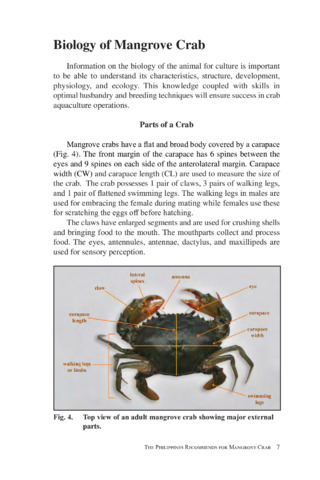
[The Philippines recommends for mangrove crab:] Biology of mangrove crab
(DOST-PCAARRD, 2021) -
European Union's special project on mudcrab
(Aquaculture Department, Southeast Asian Fisheries Development Center, 2003) -
Mangrove-friendly aquaculture studies at the SEAFDEC Aquaculture Department
; Primavera, Jurgenne (Aquaculture Department, Southeast Asian Fisheries Development Center, 2001)
The SEAFDEC Aquaculture Department studies on mangrove-friendly aquaculture (MFA) can be categorized under two models: a) mangrove filters where mangrove forests are used to absorb effluents from high-density culture ponds, and b) aquasilviculture or the low-density culture of crabs, shrimp and fish integrated with mangroves. In a study using the first model, shrimp pond effluents were retained in an enclosed mangrove area prior to release to receiving waters. Nutrients and other water quality parameters, and bacterial levels were monitored in the untreated effluents and post-mangrove water. In the second MFA model, mangrove pens and ponds installed in old growth and newly regenerating mangrove sites in Aklan, central Philippines were stocked with mud crab Scylla olivacea/S. tranquebarica and shrimp Penaeus monodon. Investment costs, survival and production, and cost-return analysis for the pens and ponds are reported in the paper. Aside from the aquasilviculture trials in collaboration with local government units, other activities in the Aklan mangrove sites are the survey and mapping of the 75-ha area in Ibajay, construction of a treehouse, and the educational use as field site by Coastal Resource Management trainees of SEAFDEC Aquaculture Department and field biology students of the University of the Philippines in the Visayas.
(Aquaculture Department, Southeast Asian Fisheries Development Center, 2001)
The SEAFDEC Aquaculture Department studies on mangrove-friendly aquaculture (MFA) can be categorized under two models: a) mangrove filters where mangrove forests are used to absorb effluents from high-density culture ponds, and b) aquasilviculture or the low-density culture of crabs, shrimp and fish integrated with mangroves. In a study using the first model, shrimp pond effluents were retained in an enclosed mangrove area prior to release to receiving waters. Nutrients and other water quality parameters, and bacterial levels were monitored in the untreated effluents and post-mangrove water. In the second MFA model, mangrove pens and ponds installed in old growth and newly regenerating mangrove sites in Aklan, central Philippines were stocked with mud crab Scylla olivacea/S. tranquebarica and shrimp Penaeus monodon. Investment costs, survival and production, and cost-return analysis for the pens and ponds are reported in the paper. Aside from the aquasilviculture trials in collaboration with local government units, other activities in the Aklan mangrove sites are the survey and mapping of the 75-ha area in Ibajay, construction of a treehouse, and the educational use as field site by Coastal Resource Management trainees of SEAFDEC Aquaculture Department and field biology students of the University of the Philippines in the Visayas.