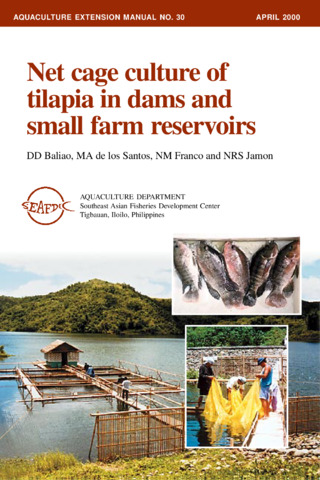
Net cage culture of tilapia in dams and small farm reservoirs


Share
抄録
The manual describes the net cage of tilapia in dams and small farm reservoirs, which has been found to be a low-cost yet high-income earning farm activity and offers an excellent option as an alternative livelihood for poor inland fisherfolks. The following aspects are covered: 1) Characteristics of a suitable site; 2) Design of the net cages - the floating cage, the stationary/fixed cage; 3) Stocking the net cages - source of juveniles, stocking rate, stocking time, acclimation; 4) Management of the cages - feeds and feeding, monitoring activities; 5) Harvesting - partial harvest, total harvest; and, 6) Profitability analysis.
記述
A 14-page manual that details net cage design and cage management after tilapia has been stocked. Some data on operating costs included.
Suggested Citation
Baliao, D. D., de los Santos, M. A., Franco, N. M., & Jamon, N. R. S. (2000). Net cage culture of tilapia in dams and small farm reservoirs. Tigbauan, Iloilo, Philippines: SEAFDEC Aquaculture Department.
Type
BookISBN
9718511415シリーズ
Aquaculture extension manual; No. 30Format
14 p. : ill.
Collections
Related items
Showing items related by title, author, creator and subject.
-
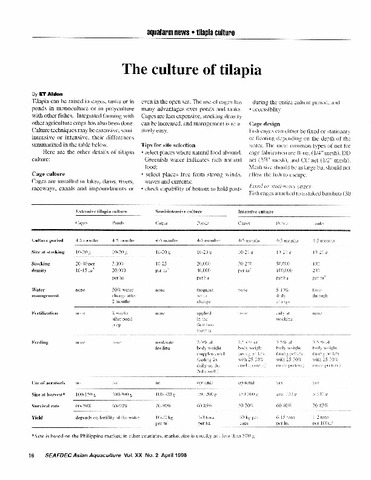
The culture of tilapia
(Aquaculture Department, Southeast Asian Fisheries Development Center, 1998) -
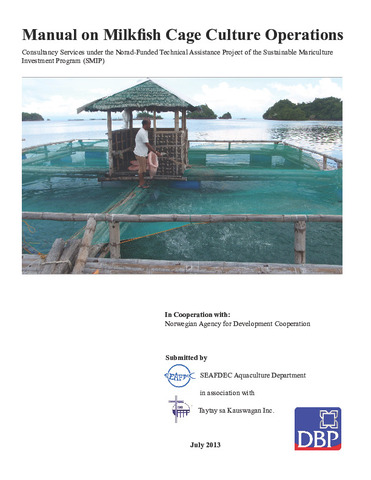
Manual on milkfish cage culture operations
(Aquaculture Department, Southeast Asian Fisheries Development Center, 2013-07)Milkfish (Chanos chanos, or bangus) culture is the largest finfish aquaculture industry in the Philippines and continues to be a top aquaculture commodity primarily because it is easy to culture and can be grown in a wide range of environments. Milkfish thrives in freshwater, brackishwater, marine, and even hypersaline habitats. Milkfish production is increasing rapidly with much of the production moving away from the traditional culture in brackishwater ponds to fish cages in coastal marine waters. To provide a general view of the milkfish culture industry, brief descriptions on breeding, hatchery production, and nursery operation are included in this manual. This manual is meant to serve as a guide for those interested to venture into marine cage farming of milkfish. Milkfish culture has been practiced in the Philippines, Indonesia, and Taiwan for centuries and has been the focus of aquaculture research in a number of institutions for several decades. Innovations in culture practices as a result of information from research data and from farmer’s experiences have been adopted by industry practitioners and these are documented in the recently published book entitled Milkfish Aquaculture in Asia (Liao and Leano, 2010). The recent concern about the rapid growth of aquaculture and its possible environmental impacts, and risks that can threaten the sustainability of this expanding industry has also been the subject of many conferences to develop good management practices in aquaculture. Principles and guidelines on better management practices in marine finfish culture had been drafted and included in this manual. -
Prospects of milkfish sea cage farming
(Aquaculture Department, Southeast Asian Fisheries Development Center, 1998)