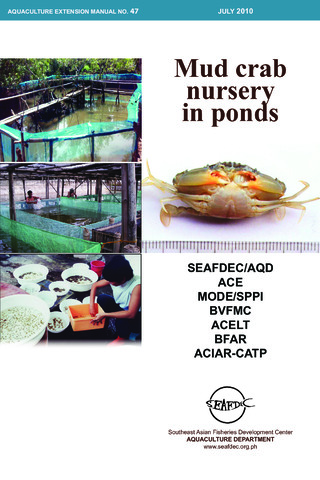
Mud crab nursery in ponds
View/
Date
2010Author
Page views
13,630ASFA keyword

AGROVOC keyword
Taxonomic term

Metadata
Show full item recordShare
Description
An extension manual that is highly illustrated, detailing the biology, nursery, harvest, marketing, costs-and-returns of mudcrab nursery in ponds.
Suggested Citation
SEAFDEC/AQD, ACE, MODE/SPPI, BVFMC, ACELT, BFAR & ACIAR/CATP. 2010. Mud crab nursery in ponds. Aquaculture Extension Manual No. 47, SEAFDEC Aquaculture Department, Iloilo, Philippines. 26 p.
Type
BookISSN
0115-5369Series
Aquaculture extension manual; No. 47Format
[iv], 26 p. : ill.
Collections
Related items
Showing items related by title, author, creator and subject.
-
Development of protocol for the production of hatchery-reared mud crab Scylla serrata juveniles for soft-shell crab farming
Quinitio, Emilia T. ; ; (Aquaculture Department, Southeast Asian Fisheries Development Center, 2017)
Development of economically viable techniques for growing hatchery-reared juvenile crabs to suitable sizes will address the problem on the source of seed stocks for soft-shell crab farming. This paper reports the production of hatchery-reared mud crab Scylla serrata from juveniles in the nursery to 73-106 g body weight (BW) crabs in the grow-out pond for the individual system soft-shell crab farming. Likewise, the performance of hatchery-reared S. serrata, and wild S. tranquebarica and S. olivacea juveniles was determined in the soft-shell crab production set-up. The BW increased from 1.8-1.9 g to 78-113.7 g when stocked at 0.5 ind m-2 and from 1.6-2.3 g to 73-106.7 g at 1.0 ind m-2 after 75 days. Growth rates at both stocking densities were comparable. However, survival was significantly higher (P<0.05) in lower (63.6~c1.01%) than in higher (35.6~c3.34%) stocking density. Male S. serrata (46.0 ~c 1.75%) had significantly higher BW increase than females (39.4 ~c 2.05%). Crabs stocked at sizes of 51-60 g showed significantly greater percent increase in BW (43.26~c 0.98%) compared with those at 61-70 g (40.98~c1.33%), 71-80 g (38.55~c 1.04%), 81-90 g (36.34 ~c 1.27%) and 91-100 g (38.52 ~c 1.67%). Among the three species, hatchery-reared S. serrata (42.14 ~c 1.34%) had significantly higher mean percent BW increase compared with S. olivacea (38.23 ~c 0.49%) and S. tranquebarica (36.16 ~c 0.78%). S. serrata had significantly shorter mean culture period (24.11 ~c 0.95 days) than S. tranquebarica (28.48 ~c 0.54 days) and S. olivacea (28.75 ~c 0.34 days).
; ; (Aquaculture Department, Southeast Asian Fisheries Development Center, 2017)
Development of economically viable techniques for growing hatchery-reared juvenile crabs to suitable sizes will address the problem on the source of seed stocks for soft-shell crab farming. This paper reports the production of hatchery-reared mud crab Scylla serrata from juveniles in the nursery to 73-106 g body weight (BW) crabs in the grow-out pond for the individual system soft-shell crab farming. Likewise, the performance of hatchery-reared S. serrata, and wild S. tranquebarica and S. olivacea juveniles was determined in the soft-shell crab production set-up. The BW increased from 1.8-1.9 g to 78-113.7 g when stocked at 0.5 ind m-2 and from 1.6-2.3 g to 73-106.7 g at 1.0 ind m-2 after 75 days. Growth rates at both stocking densities were comparable. However, survival was significantly higher (P<0.05) in lower (63.6~c1.01%) than in higher (35.6~c3.34%) stocking density. Male S. serrata (46.0 ~c 1.75%) had significantly higher BW increase than females (39.4 ~c 2.05%). Crabs stocked at sizes of 51-60 g showed significantly greater percent increase in BW (43.26~c 0.98%) compared with those at 61-70 g (40.98~c1.33%), 71-80 g (38.55~c 1.04%), 81-90 g (36.34 ~c 1.27%) and 91-100 g (38.52 ~c 1.67%). Among the three species, hatchery-reared S. serrata (42.14 ~c 1.34%) had significantly higher mean percent BW increase compared with S. olivacea (38.23 ~c 0.49%) and S. tranquebarica (36.16 ~c 0.78%). S. serrata had significantly shorter mean culture period (24.11 ~c 0.95 days) than S. tranquebarica (28.48 ~c 0.54 days) and S. olivacea (28.75 ~c 0.34 days). -
Updates on the seed production of mud crab
Quinitio, Emilia T.; ; ; (Aquaculture Department, Southeast Asian Fisheries Development Center, 2015)
Widespread interest in mud crab species is increasing because these are highly prized both in domestic and export markets. Among the three mud crab species commonly found in the Philippines, Scylla serrata, S. olivacea, and S. tranquebarica, S. serrata is preferred by farmers because it is larger and less aggressive than the other species. Likewise, S. serrata is the most widely distributed species in the Indo-west Pacific region. Hatchery-produced seedstock are presently used by some crab farmers in their grow-out operations. In the hatchery phase, feeding mud crab larvae with shrimp formulated diets and natural food was found to reduce the occurrence of molt death syndrome, one of the major problems in seed production. Larvae given 25% formulated diet (FD) + 75% natural food (NF; rotifers and Artemia) and 50% FD + 50% NF showed better performance than those larvae fed 100% FD, 100% NF and 75% FD + 25% NF indicating that usage of natural food, especially the expensive Artemia, can be reduced. Since the early crab instar (C) produced in the hatchery need to be grown further before stocking in grow-out ponds, two phases of nursery culture have been developed. C1-2 are grown to 1.5-2.0 cm carapace width (CW) size in the first phase and further grown to 3.0-4.0 cm CW in the second phase. Nursery rearing is done in net cages installed in ponds for easy retrieval. A combination of mussel or trash fish and formulated diet is used as feed. Domestication of the mud crab S. serrata as a prerequisite to selective breeding has been done at SEAFDEC/AQD. Likewise, defining criteria for the determination of quality of newly hatched zoeae for stocking in the hatchery was initiated. Newly hatched zoeae were subjected to starvation and stress test using formalin. Starvation failed to elicit responses that were significantly different between the good and poor quality larvae hence it is not suitable for larval quality evaluation. Based on three-year data, the formalin stress test gave mean cumulative mortalities of 2.38±0.32, 8.24±0.88, 20±1.58 in good quality larvae, and 43.74±2.39 while 22.93±4.19, 63.68±7.17, 84.29±3.88 and 97.65±1.06 for poor quality larvae at 0 (control), 20, 30 and 40 ppm formalin, respectively. As formalin level increased, cumulative larval mortality also increased regardless of the quality of the larvae. Formalin stress test proved to be a reliable method to determine whether a batch of newly hatched zoeae was of good or poor quality. -
Series: Aquaculture extension manual; No. 34
Biology and hatchery of mangrove crabs Scylla spp.
Quinitio, Emilia T.; ; (Aquaculture Department, Southeast Asian Fisheries Development Center, 2018)
This manual includes the biology of crab (Scylla serrata, S. tranquebarica, and S. olivacea), and describes principles and procedures for spawning the mature crabs and rearing the zoea to ‘fly’ size crabs. It focuses on the hatchery rearing of S. serrata as the farming of this species is more economically viable than the two other species. The techniques may be modified depending on the conditions or problems encountered in a specific site.