Seed production of sandfish (Holothuria scabra) in Vietnam

View/
Date
2010Page views
5,520ASFA keyword

AGROVOC keyword
Taxonomic term

Metadata
Show full item recordShare
Description
An extension manual describing broodstock management, larval rearing, and management of nursery systems.
Suggested Citation
Duy, N. D. Q. (2010). Seed production of sandfish (Holothuria scabra) in Vietnam. Tigbauan, Iloilo, Philippines: SEAFDEC Aquaculture Department.
Type
BookISSN
0115-5369Series
Aquaculture extension manual; No. 48Format
[v], 12 p. : ill.
Collections
Related items
Showing items related by title, author, creator and subject.
-
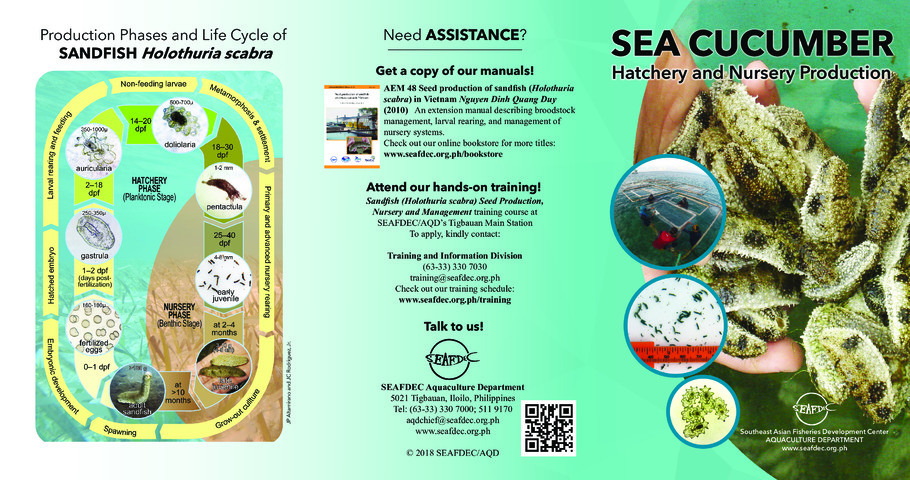
Sea cucumber hatchery and nursery production
(Aquaculture Department, Southeast Asian Fisheries Development Center, 2018)Contains information on the hatchery and nursery culture of the sea cucumber, Holothuria scabra. -
Sea bass, groupers and snappers
(Aquaculture Department, Southeast Asian Fisheries Development Center, 1994)Studies on sea bass (Lates calcarifer) broodstock were directed at techniques to maximize egg production. Now known are the: optimum luteinizing hormone releasing hormone analogue (LHRHa) dose range to induce spawning, optimum egg size responsive to LHRHa induction, appropriate time for induction, proper storage conditions for LHRHa, and induction of spermiation in males. Gonadal maturation and spawning are successfully induced by LHRHa and/or 17 alphamethyltestosterone. An experiment on photoperiodic induction of sexual maturation is being conducted to produce seed year round. Increased information on larval morphology and physiology of sea bass led to improvements in feeding strategies and transport techniques. Studies on nutrient requirements and practical diets are currently being undertaken for different stages/sizes of sea bass. An economic assessment found an integrated sea bass production system viable. Studies on groupers (Epinephelus spp.) have been geared towards broodstock development including induction of sex inversion by hormonal control, intraspecific interaction, and sex control using synthetic anabolic steroids. Spontaneous maturation and successive spawnings of captive Epinephelus suillus were achieved in 1990. Larval rearing techniques used for other marine fish species were tried but with limited success. Culture techniques in ponds and floating cages using SEAFDEC-formulated diets or commercial pellets are being developed. Studies on snappers (Lutjanus spp.) have been started with the identification of species common in Panay Island. -
Aquaculture in Vietnam
(Aquaculture Department, Southeast Asian Fisheries Development Center, 1995)Aquaculture in Vietnam has gained momentum and now produces 370,000 tons of various aquatic commodities. Aquaculture includes shrimp culture in the Mekong Delta; fish culture in cages in rivers, reservoirs, and coastal waters; fish culture in ponds and lakes; mollusk culture in the northern provinces, culture of soft-shell turtle in some provinces, culture of the seaweed Gracilaria. In north and central Vietnam, aquaculture has increased the protein supply, the foreign exchange earnings, employment opportunities, and the living conditions of the people. Vietnam aims to develop aquaculture to produce more than 600,000 tons of aquatic products by the year 2000.