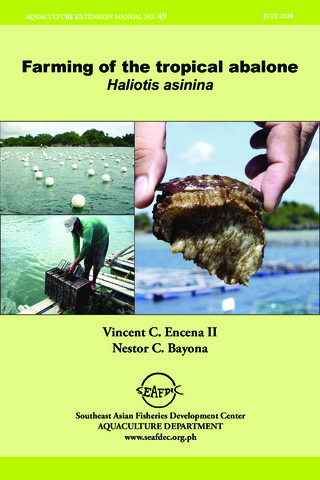
Farming of the tropical abalone Haliotis asinina
View/
Date
2010Page views
NaNASFA keyword

AGROVOC keyword
Taxonomic term

Metadata
Show full item recordShare
Abstract
This manual was written to provide abalone growers a practical guide on how to culture abalone based on the studies and trials conducted by SEAFDEC Aquaculture Department.
Suggested Citation
Encena II, V. C., & Bayona, N. C. (2010). Farming of the tropical abalone Haliotis asinina. Tigbauan, Iloilo, Philippines: SEAFDEC Aquaculture Department.
Type
BookISSN
0115-5369Series
Aquaculture extension manual; No. 49Format
24 p. : ill.
Collections
Related items
Showing items related by title, author, creator and subject.
-
Artificial diet development [for abalone]
(Aquaculture Department, Southeast Asian Fisheries Development Center, 1997) -
Can Ulva reticulata replace Gracilariopsis heteroclada as natural food for the abalone Haliotis asinina?
Lebata-Ramos, Ma. Junemie Hazel ; (Springer, 2021-02-04)
Abalone are among the most important fishery resources with high commercial values worldwide, with Haliotis asinina being the most in demand and widely studied species in the Philippines. Abalone culture in the country mainly depends on the red alga, Gracilariopsis heteroclada, as food for cultured stocks. This however, is not sustainable as this alga is also being farmed both for agar production and human consumption. Hence, other sources of natural food need to be explored for large-scale culture of abalone. This study investigated the viability of Ulva reticulata as food for abalone. This green alga is common in the intertidal zones of the Philippines but of no commercial value. H. asinina early juveniles (N = 60, shell length 2.12–3.07 cm, body weight 1.7–5.9 g) obtained from the Abalone Hatchery of SEAFDEC Aquaculture Department were randomly distributed (n = 10) in three replicate containers and fed with G. heteroclada and U. reticulata for 15 days. After 15 days, abalone fed with G. heteroclada were significantly larger and heavier (2.82 ± 0.04 cm and 4.64 ± 0.19 g) than those fed with U. reticulata (2.62 ± 0.03 cm and 3.45 ± 0.14 g). Abalone fed with U. reticulata also exhibited weakness, hardfoot, and easily detached from the walls of the culture containers. Based on these results, despite its availability in large quantities, U. reticulata could not be solely used as an alternative natural food to G. heteroclada for abalone culture. However, its potential as a partial substitute to G. heteroclada may be further examined.
; (Springer, 2021-02-04)
Abalone are among the most important fishery resources with high commercial values worldwide, with Haliotis asinina being the most in demand and widely studied species in the Philippines. Abalone culture in the country mainly depends on the red alga, Gracilariopsis heteroclada, as food for cultured stocks. This however, is not sustainable as this alga is also being farmed both for agar production and human consumption. Hence, other sources of natural food need to be explored for large-scale culture of abalone. This study investigated the viability of Ulva reticulata as food for abalone. This green alga is common in the intertidal zones of the Philippines but of no commercial value. H. asinina early juveniles (N = 60, shell length 2.12–3.07 cm, body weight 1.7–5.9 g) obtained from the Abalone Hatchery of SEAFDEC Aquaculture Department were randomly distributed (n = 10) in three replicate containers and fed with G. heteroclada and U. reticulata for 15 days. After 15 days, abalone fed with G. heteroclada were significantly larger and heavier (2.82 ± 0.04 cm and 4.64 ± 0.19 g) than those fed with U. reticulata (2.62 ± 0.03 cm and 3.45 ± 0.14 g). Abalone fed with U. reticulata also exhibited weakness, hardfoot, and easily detached from the walls of the culture containers. Based on these results, despite its availability in large quantities, U. reticulata could not be solely used as an alternative natural food to G. heteroclada for abalone culture. However, its potential as a partial substitute to G. heteroclada may be further examined. -
Abalone aquaculture for stock enhancement and community livelihood project in northern Palawan, Philippines
(Aquaculture Department, Southeast Asian Fisheries Development Center, 2015)One of the interventions to feed the poorest of the poor fisheries sector in the country is the provision of livelihood in the form of mariculture of high value marine species. In the Philippines, livelihood in rural areas is largely linked to resource depletion, hence it is wise not only to provide livelihood to the community but also to encourage them to conserve and enhance the resources. As part of the revised R&D program, the Western Philippines University partnered with NGO and existing projects to embark on a community-based environment-concerned livelihood project, using hatchery bred abalone, although top shell was also considered for stock enhancement. This is in an on-going project thus, preliminary phases such as abalone production and cage-based grow-out as well as subsequent project plans will be discussed. The objectives of this study were to: (a) share the implementing experiences in this project, (b) identify success and failure drivers of the project, (c) explain the conceptual framework for the MPA-based stock enhancement to be used in this project, and (d) give recommendations to improve the implementation and ensure the success of the project. The following activities have thus far been conducted: (a) development of criteria for cage micro-site selection; (b) writing of proposal and provision of financial assistance for hatchery juvenile production through a partnership MOA; (c) presentation of site survey results to beneficiaries and stake holders; (d) conduct of trainings on abalone grow out culture to POs; (e) development and improvement of training module; (f) signing of conservation agreement; (g) giving of cage materials and juveniles to people s organizations; (h) on site coaching; and (i) partial monitoring. The next activities include improvement in juvenile production, conduct of researches on abalone nutrition, and development of market and value chain flow analysis. The conceptual framework for community-managed stock enhancement will follow that of the Department of Environment and Natural Resources-ICRMP, of which the stock enhancement project is anchored on the management of marine protected areas or MPAs. The steps in all the activities were documented and while the project was in progress, performance of the participants in training were measured, the training module was improved, the training approaches were revised according to needs, and the growth and survival of juvenile abalone were monitored. The problems identified were low production of juveniles, insufficient food for grow-out, political squabbles, social preparation, and delay in implementation schedule. Recommendations to improve or resolve the problems encountered were also presented in this paper.