Identifying mangrove areas for fisheries enhancement; population assessment in a patchy habitat

Share
Abstract
- Small-scale fisheries are an important element of the ecosystem goods and services that mangrove habitats provide, especially to poorer coastal communities that rely most on natural resources, and have similar values to payments for ecosystem services (PES) under carbon-trading schemes.
- In advance of fishery-enhancement trials for the mud crab Scylla olivacea, a mark–recapture study was conducted to estimate population size and turnover in 50 ha of isolated mangrove on Panay Island, Philippines. A total of 811 crabs were released in six sessions with an overall recapture rate of 41.5 ± 3.6%. Population size ranged from 607–1637 individuals.
- There was a high degree of site-fidelity, with 45.5% of recaptures in the same sampling areas as releases. Total mortality was 0.79 month-1, with fishing mortality accounting for 95% of overall mortality.
- Von Bertalanffy and Gompertz growth models yielded estimates for L∞ (carapace width) of 117.3 ± 14.7 and 110.6 ± 2.1 mm and for k of 2.16 ± 0.74 and 3.25 ± 0.81, respectively. Crab densities of 12–33 individuals ha-1 in the study area were lower than in other mangrove systems owing to intermittent recruitment, while growth rates indicated no limitation in terms of food supply.
- The study demonstrates that in specific mangrove habitats that are below carrying capacity, there is potential for fisheries enhancement to sustain or increase direct economic benefits from mangrove ecosystems and hence promote community engagement in broader conservation and PES initiatives.
Contributes to SDGs




Keywords
Ecosystem services Growth Mangroves Mark-recapture Mortality Population estimates Restocking Scylla olivacea SEAFDEC/AQD SurvivalSuggested Citation
Lebata, M. J. H., Walton, M. E., Biñas, J. B., Primavera, J., & Le Vay, L. (2012). Identifying mangrove areas for fisheries enhancement; population assessment in a patchy habitat. Aquatic Conservation: Marine and Freshwater Ecosystems , 22(5), 652-664. https://doi.org/10.1002/aqc.2235
DOI
10.1002/aqc.2235Type
ArticleISSN
1052-7613; 1099-0755Collections
- Journal Articles [1266]
Related items
Showing items related by title, author, creator and subject.
-
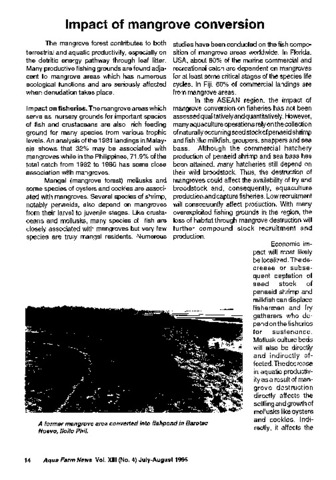
Impacts of mangrove conversion
(Aquaculture Department, Southeast Asian Fisheries Development Center, 1995)The article presents the impact of mangrove conversion on fisheries and on coastal areas. The mangrove areas which serve as nursery grounds for important species of fish and crustaceans are also rich feeding ground for many species from various trophic levels. Thus, the destruction of mangroves could affect the availability of fry and broodstock and, consequently, aquaculture production and fisheries. While in coastal areas, the destruction of mangroves increased the risk of coastal erosion from storm surges and winds, accelerates the erosion of riverbanks, exposes acid sulfate soils, leading to poor production and mass mortality of stocks, and affects the freshwater supply through salt intrusion upstream among others. -
Evaluation of hatchery-based enhancement of the mud crab, Scylla spp., fisheries in mangroves: comparison of species and release strategies
Lebata, Ma. Junemie Hazel L. ; ; ; ; Quinitio, Emilia T. ; ; Primavera, Jurgenne (CSIRO Publishing, 2009)
Ranching, stock enhancement and restocking are management approaches involving the release of wild or hatchery-bred organisms to enhance, conserve or restore fisheries. The present study, conducted from April 2002 to November 2005, evaluated the effectiveness of releasing wild and hatchery-reared (HR) mud crabs in the mangroves of Ibajay, Aklan, Philippines where preliminary studies demonstrated declining fishery yields, abundance and size of crabs. Comparison of survival and growth of wild-released and HR Scylla olivacea and HR Scylla serrata demonstrated the effect of nursery conditioning, size-at-release and species differences. Overall yield and catch per unit effort (CPUE) increased by 46% after stock enhancement trials. Recapture rates of released crabs were highest in wild-released S. olivacea and in crabs measuring 65.0–69.9 mm carapace width (CW) and lowest in non-conditioned HR S. serrata. Growth rates were highest for conditioned HR S. olivacea and lowest for conditioned HR S. serrata (11.7 and 3.7 mm month-1 respectively). Fishing mortality was highest for S. olivacea, whereas natural mortality was greater for S. serrata. Conditioning hatchery-bred animals before release is also important in obtaining higher survival. S. olivacea was the more appropriate of the two species for release in mangrove habitats inundated with low-salinity water. However, there is a need for site-specific studies to evaluate the effectiveness of releases.
; ; ; ; Quinitio, Emilia T. ; ; Primavera, Jurgenne (CSIRO Publishing, 2009)
Ranching, stock enhancement and restocking are management approaches involving the release of wild or hatchery-bred organisms to enhance, conserve or restore fisheries. The present study, conducted from April 2002 to November 2005, evaluated the effectiveness of releasing wild and hatchery-reared (HR) mud crabs in the mangroves of Ibajay, Aklan, Philippines where preliminary studies demonstrated declining fishery yields, abundance and size of crabs. Comparison of survival and growth of wild-released and HR Scylla olivacea and HR Scylla serrata demonstrated the effect of nursery conditioning, size-at-release and species differences. Overall yield and catch per unit effort (CPUE) increased by 46% after stock enhancement trials. Recapture rates of released crabs were highest in wild-released S. olivacea and in crabs measuring 65.0–69.9 mm carapace width (CW) and lowest in non-conditioned HR S. serrata. Growth rates were highest for conditioned HR S. olivacea and lowest for conditioned HR S. serrata (11.7 and 3.7 mm month-1 respectively). Fishing mortality was highest for S. olivacea, whereas natural mortality was greater for S. serrata. Conditioning hatchery-bred animals before release is also important in obtaining higher survival. S. olivacea was the more appropriate of the two species for release in mangrove habitats inundated with low-salinity water. However, there is a need for site-specific studies to evaluate the effectiveness of releases. -
The yellow mangrove: its ethnobotany, history of maritime collection, and needed rehabilitation in the central and southern Philippines
Primavera, Jurgenne; (University of San Carlos Publications, 2000)
Most mangrove reforestation program in the Philippines and elsewhere in Asia focus on the genus Rhizophora, hence there is a need to identify and develop planting and harvesting techniques for other mangrove species, especially those in high demand by coastal communities. The yellow mangrove Ceriops tagal is one such species. Its many uses as firewood, poles for fish-corrals and traps, house construction, medicine (wound cleansing, treatment of hemmorhages), in the production of dyes (for dyeing fish nets, ropes, cloth and rice as a festive food) and as a mordant from bark are widely reported from the Philippines and all over Southeast and South Asia. An extensive sea-based industry for collecting C. tagal bark or tungog existed in the Philippines in the 1930s-1950s. It is heretofore described as undocumented industry including the boats used, collecting sites, markets, financing system and profit-sharing. Because C. tagal lacks reserve meristems, cutting of the trunk during bark gathering causes tree mortality. This explains the wholesale disappearance of the species from areas where it has been harvested throughout the Philippines, Southeast and South Asia, and East Africa. Research is needed to refine planting techniques and develop bark harvesting methods that do not kill the tree. Until nondestructive procedures for bark collection are finally perfected, C. tagal stands can be planted and harvested on a rotation basis.