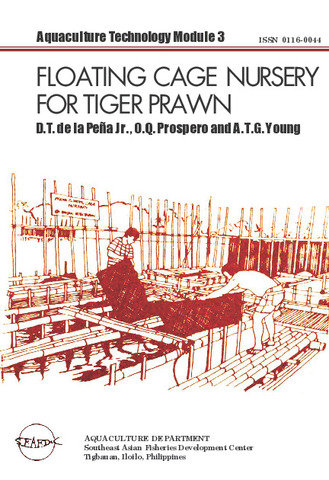
Floating cage nursery for tiger prawn

Date
1985Page views
123,954ASFA keyword

AGROVOC keyword
Taxonomic term

Metadata
Show full item recordShare
Suggested Citation
de la Peña, D. T., Jr., Prospero, O. Q., & Young, A. T. G. (1985). Floating cage nursery for tiger prawn. Tigbauan, Iloilo, Philippines: Aquaculture Department, Southeast Asian Fisheries Development Center.
Type
BookISSN
0116-0044ISBN
9718511075Series
Aquaculture technology module / SEAFDEC Aquaculture Department; No. 3Collections
Related items
Showing items related by title, author, creator and subject.
-
Aquaculture-based restoration and stock enhancement of tiger shrimps in the Philippines
(Training Department, Southeast Asian Fisheries Development Center, 2016)In central Philippines, the Aquaculture Department of the Southeast Asian Fisheries Development Center (SEAFDEC/AQD), with strong collaboration and support from the Research Institute for Humanity and Nature (RIHN) of Kyoto, Japan, has been looking into the stock enhancement of tiger shrimp Penaeus monodon in the New Washington Estuary (NWE), province of Aklan, central Philippines. The NWE was a productive fishing ground that has been suffering from degenerating brackishwater fisheries and estuarine environment. Average daily catch declined from 24 kg in 1970s to only 0.7 kg at present. Shrimp fisheries, the most important livelihood, declined in quality and quantity. Tiger shrimps were abundant in catch until the early 1990s when these were observed to decline in volume, replaced by smaller and cheaper species. This was coincidental with the rapid decline in mangrove cover for ponds and huge increase in fishing pressure. It is clear that crucial interventions are required to restore the tiger shrimp fisheries in the NWE in order to increase income of local fishers, while promoting reduction of fishing gears and restoration of mangroves. Stock enhancement of tiger shrimps shows good potential in answering these needs. Site-specific assessments were conducted to evaluate prospects of shrimp stock enhancement in NWE. Conservative simulations of capture of released stocks showed that fishers can increase income by 300%. To decrease fishing pressure in the area, number of gears per fisher may have to be reduced but shrimp catches will be relatively high-priced. Comparative experiments using aquaculture techniques were done to identify strategies especially in the delicate intermediate acclimation rearing. Aquaculture protocols like those for pond preparation were also adapted to be used in a mangrove pen nursery rearing system for shrimps. Supplemental feeding with formulated feeds increased carrying capacity of the culture area, while enhancing growth and survival of stocks. Culture experiments showed that shrimps grow to 0.5 g within 1 mo and >1g in 2 mo. High stocking density of 40-60 shrimps m-2 can be used for <2 mo rearing in a mangrove pen. Release experiments showed that 60-d old shrimps have higher chances of survival when released in the estuaries. With strong support from local communities, government and other sectors, together with effective management and law enforcement, aquaculture-based stock enhancement of tiger shrimps can be a viable intervention to restore livelihood and promote estuarine rehabilitation in the NWE. -
Tiger shrimp pens in Thailand
(Aquaculture Department, Southeast Asian Fisheries Development Center, 1994)The article discusses the tiger shrimp (Penaeus monodon) pen culture practices in Thailand. Suitable sites, pen construction, rearing and harvesting techniques, and return on investment are also discussed. -
Grow-out of the tiger shrimp Penaeus monodon in floating net cages in Batan Bay, northern Panay
(Bureau of Agricultural Research, Department of Agriculture, 2007)The effects of two stocking densities and two feed combinations on growth, survival and production of the giant tiger shrimp Penaeus monodon in floating net cages were studied in an attempt to refine the existing technology on cage culture of tiger shrimp for the benefit of small- and medium-scale fish farmers. Four treatments were tested, replicated in time: stocking density of 100 shrimp/m2, feeding with 70% commercial shrimp pellets P and 30% 'trash fish' F; 100 shrimp/m2 and 50% P + 50% F; 200 shrimp/m2 and 70% P + 30% F; and 200 shrimp/m2 and 50% P + 50% F. Harvested after 93–95 d, the shrimps at the lower density treatments were significantly larger and had greater proportion of good sizes (>18 g body weight). Although the combination of 70% P + 30% F resulted in better growth, the combination of 50% P + 50% F resulted in more good-size shrimps. Survival, production, and gross income were not significantly different among treatments. None of the treatments in this study was economically viable. Gross income was very low due to poor growth and survival, mostly due to luminous vibriosis, then a new disease that eventually wiped out many shrimp hatcheries and ponds around Panay Island.