A prototype warm water shrimp hatchery

Share
Abstract
A description is given of the prototype warm water shrimp hatchery established and operated by SEAFDEC Aquaculture Department since 1982. Hatchery design, operation and management, larval rearing in small indoor tanks, larval rearing in large nursery tanks, routine hatchery management, harvesting and transportation and financial aspects are covered.
Description
Reprinted June 1989 as Aquaculture Extention manual; no. 12.
Suggested Citation
Kungvankij, P., Tiro, L. B. Jr., Pudadera, B. J. Jr., Borlongan, E., Tech, E. T., & Chua, T.-E. (1989). A prototype warm water shrimp hatchery. Tigbauan, Iloilo, Philippines: Reprinted [by] Aquaculture Department, Southeast Asian Fisheries Development Center.
Type
BookSeries
NACA technology series; No. 4 | Aquaculture extension manual; No. 12Format
32 p. : ill.
Collections
Related items
Showing items related by title, author, creator and subject.
-
Philippine National Standard: Organic aquaculture
(Bureau of Agriculture and Fisheries Standards, 2016)The Philippine National Standard (PNS) for Organic Aquaculture (PNS/BAFS 112:2016) was originally prepared and adopted in 2012. Organic aquaculture encourages polyculture production system, promotes the use of indigenous/endemic species under the extensive and semi-intensive culture systems, reduces/minimizes inputs of artificial ingredients, prohibits the use of genetically modified organisms (GMOs), and considers ecological conditions necessary for sustainable aquaculture production. The PNS for Organic Aquaculture was revised by the Technical Working Group (TWG) organized by the Bureau of Agriculture and Fisheries Standards (BAFS) through a Department of Agriculture (DA) Special Order No.476, Series of 2015. The TWG is composed of members representing the Bureau of Fisheries and Aquatic Resources (BFAR), Organic Certification Center of the Philippines (OCCP), Southeast Asian Fisheries Development Center Aquaculture Department (SEAFDEC-AQD), Philippine Council for Agriculture, Aquatic and Natural Resources Research and Development (PCAARRD) and Central Luzon State University (CLSU). This PNS was presented and reviewed during the consultative meetings with the concerned stakeholders in Region I (Pangasinan) and Region XI (Davao City). Comments gathered during the consultations were carefully evaluated by the TWG and included accordingly in the final version of this standard. Drawn from the general principles of the Philippine National Standard on Organic Agriculture, this PNS on Organic Aquaculture attempts to cover the aquaculture production and postharvest operations in order to ensure the integrity of organic products. The requirements for the inclusion of Substances and Criteria for the development of the list of substances shall follow the Philippine National Standards for Organic Aquaculture and the Guidelines for the Production, Processing, Labelling and Marketing of Organically Produced Foods (GL 32-1999). The revision of this PNS was undertaken in order to achieve equivalence with the existing international standards and its future amendment, and takes into consideration the new developments and inclusion of the identified potential species for organic aquaculture. Thus, this PNS identifies minimum requirements on documentation, conversion to organic aquaculture, parallel production, selection of site, interaction with surrounding ecosystem, organic fertilization, aquatic plants, aquatic animal sources/origin, breeding and hatchery management, aquatic animal nutrition and feeding, aquatic animal health and welfare, harvesting, post-harvest handling, transport and processing, storage, and social aspects. -
Adoption of modified commercial scale mud crab hatchery and nursery systems in Alaminos City, Pangasinan
(Aquaculture Department, Southeast Asian Fisheries Development Center, 2017)Pangasinan’s vast fishpond and mangrove areas have not been fully tapped for mud crab (Scylla serrata) production. The main reason identified for this is the limited supply of crab seedstock. At present, there is no reliable source of seedstock in Pangasinan. The total requirement of Pangasinan for crab seedstock is estimated at 8.89 million based on the total area (ha) devoted to mud crab polyculture in the province. Mud crab growers in Pangasinan procure wild juvenile crabs from Cagayan, Bicol and Visayas but the volume is limited. Thus, an adoption of a modified commercial scale mud crab hatchery and nursery systems in Alaminos City would be helpful. A model mud crab hatchery will be constructed to enable the local government unit (LGU) of Alaminos City to produce seedstock in commercial quantity to boost the production in Pangasinan and nearby provinces. The hatchery aims to produce 480,000 juvenile crabs per year to supply the nursery and grow-out ponds. Likewise, the hatchery technology will promote the mud crab hatchery and nursery technologies in the city of Pangasinan and coastal towns (Infanta, Dasol, Burgos, Agno, Bolinao, Anda, Bani, Sual, Labrador, Lingayen, Binmaley, Dagupan City and San Fabian), and nearby provinces of La Union, Ilocos Sur, Ilocos Norte and Zambales. -
Series: Aquaculture extension manual; No. 34
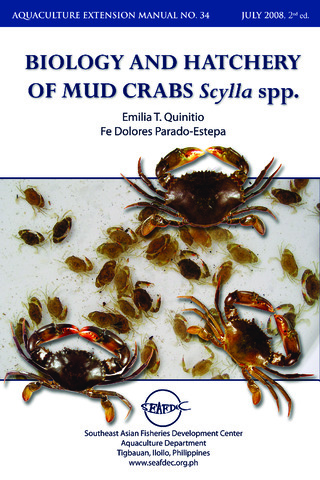
Biology and hatchery of mud crabs Scylla spp.
Quinitio, Emilia T. ; (Aquaculture Department, Southeast Asian Fisheries Development Center, 2008)
This manual includes the biology of mud crab, and describes principles and procedures for spawning the mature crabs (Scylla serrata, S. tranquebarica, and S. olivacea) and rearing the zoea to fly size crabs. It focuses on the hatchery rearing of S. serrata as this species is more economically viable than the two other species. The techniques may be modified depending on the conditions or problems encountered in a specific site.
; (Aquaculture Department, Southeast Asian Fisheries Development Center, 2008)
This manual includes the biology of mud crab, and describes principles and procedures for spawning the mature crabs (Scylla serrata, S. tranquebarica, and S. olivacea) and rearing the zoea to fly size crabs. It focuses on the hatchery rearing of S. serrata as this species is more economically viable than the two other species. The techniques may be modified depending on the conditions or problems encountered in a specific site.