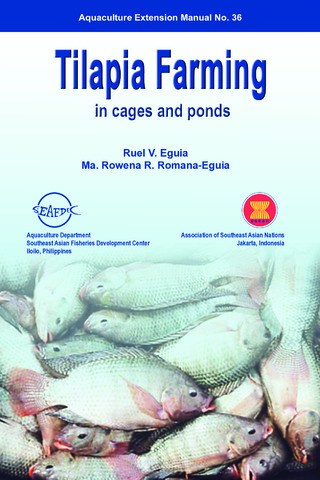
Tilapia farming in cages and ponds

Date
2004Author
Page views
7,460ASFA keyword

AGROVOC keyword
Taxonomic term

Metadata
Show full item recordShare
Description
This 40-page manual describes the farming practices for tilapia in cages, pens, ponds, and tanks. Also details selection of quality seedstock, maintenance of stock (feeding, water management), and harvesting. A list of institutions working on tilapia R&D is included.
Suggested Citation
Eguia, R. V., & Romana-Eguia, M. R. R. (2004). Tilapia farming in cages and ponds. Aquaculture Department, Southeast Asian Fisheries Development Center.
Type
BookSeries
Aquaculture extension manual; No. 36Format
40 p. : ill. (some col.)
Collections
Related items
Showing items related by title, author, creator and subject.
-
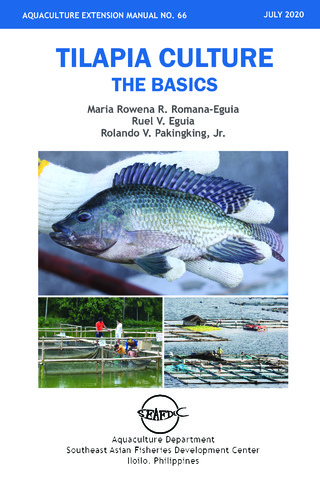
Series: Aquaculture extension manual; No. 66
Tilapia culture: The basics
Romana-Eguia, Maria Rowena R. ; ; Pakingking, Rolando V., Jr. (Aquaculture Department, Southeast Asian Fisheries Development Center, 2020-07)
This new aquaculture extension manual revisits the basics of tilapia culture with updated information on the grow-out technology in cages and ponds. Updated cost and returns analyses were also included to guide farmers regarding the profitability of farming tilapia. A fresh chapter on tilapia health management is also included to promote the prevention of tilapia diseases.
; ; Pakingking, Rolando V., Jr. (Aquaculture Department, Southeast Asian Fisheries Development Center, 2020-07)
This new aquaculture extension manual revisits the basics of tilapia culture with updated information on the grow-out technology in cages and ponds. Updated cost and returns analyses were also included to guide farmers regarding the profitability of farming tilapia. A fresh chapter on tilapia health management is also included to promote the prevention of tilapia diseases. -
Vibrio load and percentage composition of sucrose‐fermenting vibrios in Nile tilapia (Oreochromis niloticus) cultured in brackish water earthen ponds and biocontrol potential of recycled tilapia‐conditioned greenwater against population growth of V. parahaemolyticus and non‐sucrose‐fermenting vibrios in the grow‐out culture of white leg shrimp (Litopenaeus vannamei)
Pakingking, Rolando V., Jr.; Palma, Peter ; ; Usero, Roselyn (Wiley, 2022-10-20)
Vibrio are known opportunistic pathogens of pond-cultured fish and shrimp. This study determined the presumptive Vibrio count (PVC) and percentage composition of “beneficial” sucrose-fermenting vibrios (SFVs) and “pathogenic” non-SFVs in the water, sediment, gills and intestines of healthy tilapia Oreochromis niloticus collected every 2 weeks from Days 30 to 120 post-stocking in brackish water earthen ponds. PVCs in water and sediment ranged from 102–104 CFU/ml/CFU/g while in tilapias' gills and intestines, PVCs ranged from 103–106 CFU/g and 102–106 CFU/g, respectively, with SFVs dominating in water, sediment, gills (≥50%), and intestines (≥80%) of tilapia. Because use of tilapia-conditioned green water (TCGW) for shrimp's grow-out culture has been reported effective against acute hepatopancreatic necrosis disease outbreaks caused by V. parahaemolyticus, PVC, SFVs/non-SFVs (%), and V. parahaemolyticus count (VPC) in the recycled TCGW and Litopenaeus vannamei's hepatopancreas were also examined from stocking until 105 days of culture (DOC) in earthen ponds. PVCs ranging from 102–103 CFU/ml and 103–104 CFU/g were noted in water and shrimp's hepatopancreas, respectively. While non-SFVs population in water varied, a downward trend typified by an abrupt 50% reduction was noted in hepatopancreas at DOC 42, and remained or further dropped until DOC 105. VPCs in water likewise varied (undetectable–102 CFU/ml) while in hepatopancreas, counts dropped to undetectable level from DOC 70 onwards. Current data illustrate that remarkable shift of SFVs' dominance in the water and concomitantly in shrimp's hepatopancreas, plays a pivotal role in regulating non-SFVs proliferation in shrimp's hepatopancreas via competitive exclusion. -
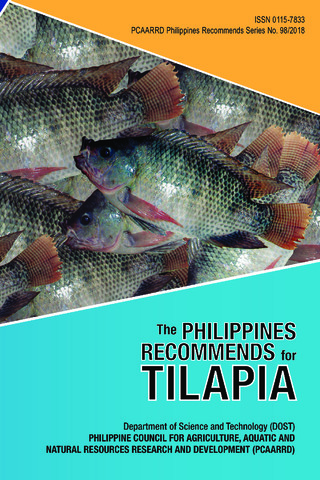
Series: Philippines Recommends Series; No. 98/2018
The Philippines recommends for tilapia
(DOST-PCAARRD, 2018)Tilapia is one of the most commercially important commodities in fisheries and aquaculture. Although tilapia is relatively easy to propagate and culture, the Philippine tilapia industry needs the necessary boost in the ...