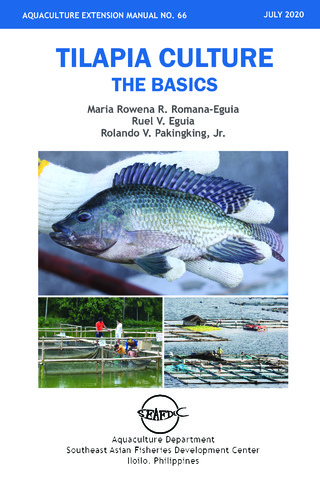
Tilapia culture: The basics
View/

Date
2020-07Page views
NaNASFA keyword

AGROVOC keyword
Taxonomic term

Metadata
Show full item recordShare
Abstract
This new aquaculture extension manual revisits the basics of tilapia culture with updated information on the grow-out technology in cages and ponds. Updated cost and returns analyses were also included to guide farmers regarding the profitability of farming tilapia. A fresh chapter on tilapia health management is also included to promote the prevention of tilapia diseases.
Subjects
Tilapia--Breeding Tilapia--Feeding and feeds Fish culture--Economic aspects Fishes--Diseases Fish culture Handbooks and manuals
Suggested Citation
Romana-Eguia, M. R. R., Eguia, R. V., & Pakingking Jr., R. V. (2020). Tilapia culture: The basics. Tigbauan, Iloilo, Philippines: Aquaculture Department, Southeast Asian Fisheries Development Center.
Type
BookISSN
0115-5369Series
Aquaculture extension manual; No. 66Format
[vii], 54 pages : illustrations (chiefly color)
Collections
Related items
Showing items related by title, author, creator and subject.
-
Nursery and grow-out operation for tilapia and carp
(Aquaculture Department, Southeast Asian Fisheries Development Center, 1988)Most researches conducted at the Binangonan Freshwater Station of the SEAFDEC Aquaculture Department were directed toward enhancing growth and survival of the young tilapia and carp in the nursery as well as increasing yields in grow-out cages, pens, and ponds. Studies included the culture and evaluation of phytoplankton and zooplankton as feeds of the tilapia and carp fry to fingerlings; determination of protein and amino acid requirements of young Nile tilapia; development of practical dry diets; evaluation of feeding regimes, feeding rates, and feeding frequencies ; and the use of fertilizers in nursery ponds. For the grow-out aspect, one of the earliest studies demonstrated the profitability of the monoculture of tilapia in cages which triggered the initial proliferation of tilapia cage culture by the private sector in areas near the Station. Subsequently, supplemental feeds were developed and evaluated; non-conventional feedstuffs were tested as feeds or feed components; and the growth rates of Nile tilapia fingerlings in cages at varying stocking densities were evaluated at three distinct rearing periods covering one year. Prior to the successful mass production of bighead carp fingerlings at the Station, studies on polyculture of tilapia, milk fish, and different species of carp were conducted in cages and pens with remarkable results. This led to the technology-verification projects on polyculture at various areas in Laguna Lake. With the availability of freshwater fishponds for research purposes, studies on polyculture in ponds were also conducted. -
Effect of different sizes of saline red tilapia hybrid Oreochromis niloticus Linnaeus x O. mossambicus Peters on the growth of luminous bacteria Vibrio harveyi
Tendencia, Eleonor ; (College of Agriculture, University of the Philippines Los Baños, 2010)
Luminous bacterial disease caused by Vibrio harveyi has devasted the shrimp industry. The use of different strains of tilapia and other fish species polycultured with shrimp cultured at a salinity of 24 ppt to control luminous bacteria has been reported. These species, however, could not tolerate salinities higher than 24 ppt. Alternative species/strains that could be used to control luminous bacteria at high salinities need to be investigated. Likewise, the effect of fish size on the growth of luminous bacteria is worth studying. Shrimp (Penaeus monodon Fabricius) were stocked in concrete tanks filled with 34 ppt cartridge filtered seawater. Tanks were stocked with two sizes (16 pcs, average body weight (ABW) = 55 g and 6 pcs ABW=250 g) of the red tilapia hybrid Oreochromis mossambicus Peters x O. niloticus Linnaeus, except for the tanks that served as the control. Luminous bacteria (V. harveyi) were inoculated into the tank water to a density of 104 Cfu mL-1. Significantly lower luminous bacterial count was observed in tanks with either of the two sizes of red tilapia hybrid compared with the control, after 5-7 d. Bacteria isolated from the fish feces, mucus and rearing water; and the fish feces and mucus themselves demonstrated anti-V. harveyi activity. Results showed that the red tilapia hybrid could be used to control luminous bacteria at salinities as high as 34 ppt and that the size of the fish did not affect its efficiency. The ability of the red tilapia hybrid to control the growth of the luminous bacteria V. harveyi is attributed to different factors such as the mucus, the feces and the bacteria associated with tilapia culture. Bacteria associated with the fish mucus and feces also contributed to the anti-V. harveyi activity of these biological substances.
; (College of Agriculture, University of the Philippines Los Baños, 2010)
Luminous bacterial disease caused by Vibrio harveyi has devasted the shrimp industry. The use of different strains of tilapia and other fish species polycultured with shrimp cultured at a salinity of 24 ppt to control luminous bacteria has been reported. These species, however, could not tolerate salinities higher than 24 ppt. Alternative species/strains that could be used to control luminous bacteria at high salinities need to be investigated. Likewise, the effect of fish size on the growth of luminous bacteria is worth studying. Shrimp (Penaeus monodon Fabricius) were stocked in concrete tanks filled with 34 ppt cartridge filtered seawater. Tanks were stocked with two sizes (16 pcs, average body weight (ABW) = 55 g and 6 pcs ABW=250 g) of the red tilapia hybrid Oreochromis mossambicus Peters x O. niloticus Linnaeus, except for the tanks that served as the control. Luminous bacteria (V. harveyi) were inoculated into the tank water to a density of 104 Cfu mL-1. Significantly lower luminous bacterial count was observed in tanks with either of the two sizes of red tilapia hybrid compared with the control, after 5-7 d. Bacteria isolated from the fish feces, mucus and rearing water; and the fish feces and mucus themselves demonstrated anti-V. harveyi activity. Results showed that the red tilapia hybrid could be used to control luminous bacteria at salinities as high as 34 ppt and that the size of the fish did not affect its efficiency. The ability of the red tilapia hybrid to control the growth of the luminous bacteria V. harveyi is attributed to different factors such as the mucus, the feces and the bacteria associated with tilapia culture. Bacteria associated with the fish mucus and feces also contributed to the anti-V. harveyi activity of these biological substances. -
Quantitative and qualitative analyses of the bacterial microbiota of tilapia (Oreochromis niloticus) cultured in earthen ponds in the Philippines
Pakingking, Rolando V., Jr.; Palma, Peter ; (Springer Verlag, 2015)
The quantity and composition of the bacterial microbiota in the rearing water, sediment, gills and intestines of tilapia Oreochromis niloticus collected every 2 weeks from Day 30 to Day 120 after stocking for grow-out culture in 6 earthen brackish water ponds in the Philippines were examined. The total heterotrophic aerobic bacterial counts obtained in the water, sediment, gills and intestines of tilapia ranged from 103 to 104 c.f.u. ml−1, 103–105, 105–107 and 104–107 c.f.u. g−1, respectively. In terms of composition, a total of 20 bacterial genera and 31 species were identified with the preponderance of gram-negative bacteria constituting 84% of all bacterial isolates examined. Aeromonas hydrophila, Bacillus spp., Plesiomonas shigelloides, Shewanella putrefaciens, Pseudomonas fluorescens, Staphylococcus spp. and Vibrio cholerae were the dominant bacteria identified in the gills and intestine of tilapia. These bacteria also dominated in the pond sediment and rearing water, except for the nil isolation of S. putrefaciens and V. cholerae in the water samples examined, indicating that resident bacteria in the pond water and sediment congruently typify the composition of bacterial microbiota in the gills and intestine of tilapia which under stressful conditions may propel the ascendance of disease epizootics.