A perspective of the carp industry in the Philippines


Share
Abstract
Fish farmers in Laguna de Bay are facing conflict of the use of the lake which is being tapped as freshwater source for domestic use. The article documents the perspectives of some fish farmers and researchers on the development of carp aquaculture industry in the lake. According to carp farmers and researchers, the industry is profitable however, marketing, post harvest and processing strategies remain poor. In these regard, Southeast Asian Fisheries Development Center, Aquaculture Department (SEAFDEC/AQD) should be the frontline ally of carp growers since SEAFDEC/AQD developed the technology for lake culture.
Suggested Citation
SEAFDEC/AQD (1996). A perspective of the carp industry in the Philippines. Aqua Farm News , 14(6), 4-5. http://hdl.handle.net/10862/2442
Type
magazineArticleISSN
0116-6573Collections
- Aqua Farm News [286]
Related items
Showing items related by title, author, creator and subject.
-
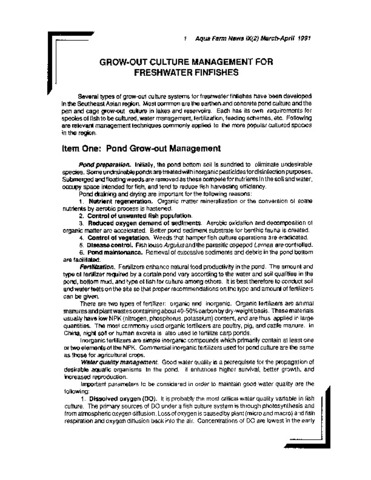
Grow-out culture management for freshwater finfishes
(Aquaculture Department, Southeast Asian Fisheries Development Center, 1991) -
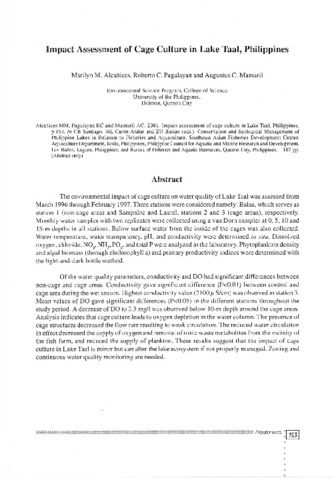
Impact assessment of cage culture in Lake Taal, Philippines
(Aquaculture Department, Southeast Asian Fisheries Development Center; Philippine Council for Aquatic and Marine Research and Development (PCAMRD), Department of Science and Technology; Bureau of Fisheries and Aquatic Resources, 2001)The environmental impact of cage culture on water quality of Lake Taal was assessed from March 1996 through February 1997. Three stations were considered namely: Balas, which serves as station 1 (non-cage area) and Sampaloc and Laurel, stations 2 and 3 (cage areas), respectively. Monthly water samples with two replicates were collected using a van Dorn sampler at 0, 5, 10 and 15-m depths in all stations. Below surface water from the inside of the cages was also collected. Water temperature, water transparency, pH, and conductivity were determined in situ. Dissolved oxygen, chloride, NO3, NH3, PO4, and total P were analyzed in the laboratory. Phytoplankton density and algal biomass (through cholorophyll a) and primary productivity indices were determined with the light-and-dark bottle method. Of the water quality parameters, conductivity and DO had significant differences between non-cage and cage areas. Conductivity gave significant difference (P<0.01) between control and cage area during the wet season. Highest conductivity value (2100 µ S/cm) was observed in station 3. Mean values of DO gave significant differences (P<0.05) in the different stations throughout the study period. A decrease of DO to 2.5 mg/1 was observed below 10-m depth around the cage areas. Analysis indicates that cage culture leads to oxygen depletion in the water column. The presence of cage structures decreased the flow rate resulting to weak circulation. The reduced water circulation in effect decreased the supply of oxygen and removal of toxic waste metabolites from the vicinity of the fish farm, and reduced the supply of plankton. These results suggest that the impact of cage culture in Lake Taal is minor but can alter the lake ecosystem if not properly managed. Zoning and continuous water quality monitoring are needed. -
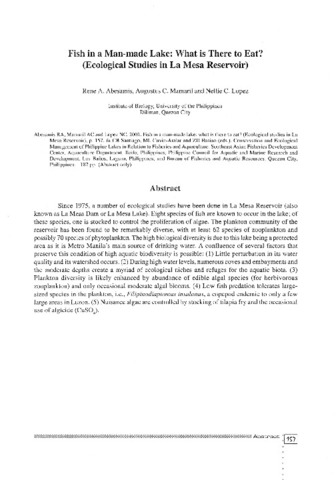
Fish in a man-made lake: what is there to eat? (Ecological studies in La Mesa Reservoir)
(Aquaculture Department, Southeast Asian Fisheries Development Center; Philippine Council for Aquatic and Marine Research and Development (PCAMRD), Department of Science and Technology; Bureau of Fisheries and Aquatic Resources, 2001)Since 1975, a number of ecological studies have been done in La Mesa Reservoir (also known as La Mesa Dam or La Mesa Lake). Eight species of fish are known to occur in the lake; of these species, one is stocked to control the proliferation of algae. The plankton community of the reservoir has been found to be remarkably diverse, with at least 62 species of zooplankton and possibly 70 species of phytoplankton. The high biological diversity is due to this lake being a protected area as it is Metro Manila's main source of drinking water. A confluence of several factors that preserve this condition of high aquatic biodiversity is possible: (1) Little perturbation in its water quality and its watershed occurs. (2) During high water levels, numerous coves and embayments and the moderate depths create a myriad of ecological niches and refuges for the aquatic biota. (3) Plankton diversity is likely enhanced by abundance of edible algal species (for herbivorous zooplankton) and only occasional moderate algal blooms. (4) Low fish predation tolerates large-sized species in the plankton, i.e., Filipinodiaptomus insulanus, a copepod endemic to only a few large areas in Luzon. (5) Nuisance algae are controlled by stocking of tilapia fry and the occasional use of algicide (CuSO4).