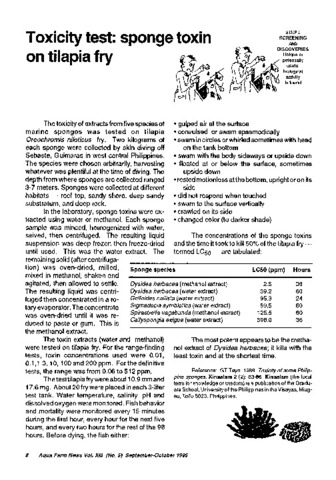
Toxicity test: Sponge toxin on tilapia fry


Share
抄録
The research was conducted to determine the toxicity of extracts from five Philippine species of marine sponges on tilapia Oreochromis niloticus fry. It was found out that the most potent was the methanol extract of Dysidea herbacea, it kills with the least toxin and at the shortest time.
Suggested Citation
SEAFDEC/AQD (1995). Toxicity test: Sponge toxin on tilapia fry. Aqua Farm News , 13(5), 8. http://hdl.handle.net/10862/2483
Type
magazineArticleISSN
0116-6573Collections
- Aqua Farm News [286]
Related items
Showing items related by title, author, creator and subject.
-
Toxifying and detoxifying shellfish
(Aquaculture Department, Southeast Asian Fisheries Development Center, 1990) -
Some marine toxins
(Aquaculture Department, Southeast Asian Fisheries Development Center, 1995)The article presents some toxins of marine origin. These are tetrodotoxin from pufferfish, saxitoxins from red microalgae that mussels and shellfish ingest, and palitoxin the most toxic marine product isolated from zoonthurian Palythoa toxica. -
Acute toxicity of nitrite to mud crab Scylla serrata (Forsskål) larvae
(Blackwell Publishing, 2007)Early larval stages of mud crab Scylla serrata were exposed to different concentrations of nitrite (40, 80 and 160 mg L−1 and a control, without added nitrite) and three salinity levels (25, 30 and 35 g L−1) using a static renewal method. No interactive effect of nitrite and salinity was detected. Estimated LT50 in 96-h toxicity tests decreased in all stages with increasing nitrite concentrations in all salinity levels. The 96-h LC50 values of nitrite-N were 41.58, 63.04, 25.54, 29.98 and 69.93 mg L−1 for zoea 1, 2, 3, 4 and 5 respectively. As the larvae grew, they showed a progressive increase in tolerance to nitrite. The toxicity of nitrite to larvae increased with exposure time. The median lethal concentration was not affected by salinity. The chloride component of salinity within 25–35 g L−1 did not seem to be as effective in alleviating toxicity as has been reported in other crustacean species. Based on 96-h LC50 and an application factor of 0.1, the ‘safe level’ of rearing mud crab larvae was calculated to be 4.16, 6.30, 2.55, 2.99 and 6.99 mg L−1 nitrite-N for zoea 1, 2, 3, 4 and 5 respectively.