Financial and economic analysis of grow-out tilapia cage farming in Laguna de Bay, Philippines

Share
Abstract
A survey of grow-out tilapia cage farming in Laguna de Bay, Philippines was conducted in two towns in Rizal Province. the resulting analyses indicate low financial performance and poor economic viability of grow-out tilapia cage farming in this part of the lake during the 1980-1982 seasons. Overcrowding of cages in limited areas, poaching and typhoon damage were the major reasons for poor performance.
Type
Conference paperCollections
- Conference Proceedings [300]
Related items
Showing items related by title, author, creator and subject.
-
Antibacterial activity of tilapia Tilapia hornorum against Vibrio harveyi
Tendencia, Eleonor ; ; ; ; ; (Elsevier, 2004)
Disease due to luminous Vibrio has been a major problem of the shrimp industry. Different technologies have been introduced to control the disease. One of the techniques reported to work against luminous bacteria in the Philippines is the green water culture system (or finfish–shrimp integrated culture system). A green water culture system is an innovative technique wherein shrimp are cultured in water collected from a pond where tilapia or other fish species are grown. In some cases, the fish are cultured in an isolated net pen inside the shrimp culture pond. This study clarifies the effect of one component of the green water culture system, the presence of all male tilapia (Tilapia hornorum) on luminous bacteria Vibrio harveyi. Results showed that stocking tilapia at a biomass not lower than 300 g/m3 efficiently inhibited the growth of luminous bacteria in shrimp (biomass=80 g/m3) rearing water without the growth of microalgae.
; ; ; ; ; (Elsevier, 2004)
Disease due to luminous Vibrio has been a major problem of the shrimp industry. Different technologies have been introduced to control the disease. One of the techniques reported to work against luminous bacteria in the Philippines is the green water culture system (or finfish–shrimp integrated culture system). A green water culture system is an innovative technique wherein shrimp are cultured in water collected from a pond where tilapia or other fish species are grown. In some cases, the fish are cultured in an isolated net pen inside the shrimp culture pond. This study clarifies the effect of one component of the green water culture system, the presence of all male tilapia (Tilapia hornorum) on luminous bacteria Vibrio harveyi. Results showed that stocking tilapia at a biomass not lower than 300 g/m3 efficiently inhibited the growth of luminous bacteria in shrimp (biomass=80 g/m3) rearing water without the growth of microalgae. -
An investigation of enzyme and other protein polymorphisms in Japanese stocks of the tilapias Oreochromis niloticus and Tilapia zillii
(Elsevier, 1984)Samples of Oreochromis niloticus and Tilapia zillii were collected from the hatcheries of Osaka Prefecture Fisheries Experimental Station and Shiga Prefecture Fisheries Experimental Station, Japan, respectively. The samples were used for screening polymorphisms in 13 enzymes, skeletal muscle proteins and hemoglobins by horizontal starch gel electrophoresis. Among 35 loci examined, 12 loci for the 10 enzymes, sarcoplasmic protein and hemoglobins were polymorphic in O. niloticus and 2 loci for 2 enzymes were polymorphic in T. zillii. The observed numbers of phenotypes for respective loci agreed well with Hardy-Weinberg expectations. The genetic basis for each polymorphism is discussed. This investigation provides basis information on the status of these tilapias in Japan. -
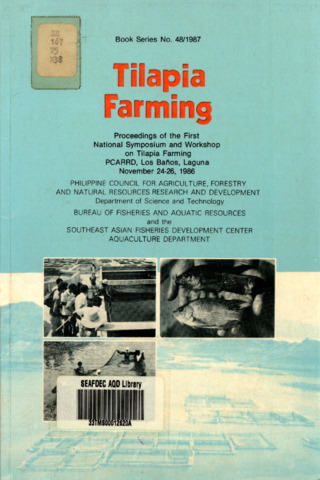
Tilapia Farming: Proceedings of the First National Symposium and Workshop on Tilapia Farming, PCARRD, Los Baños, Laguna, November 24-26, 1986
(Philippine Council for Agriculture, Forestry and Natural Resources Research and Development, 1987)