Microbial diseases of prawns


Share
Suggested Citation
SEAFDEC/AQD (1988). Microbial diseases of prawns. Aqua Farm News , 6(1), 2. http://hdl.handle.net/10862/2675
Type
magazineArticleISSN
0116-6573Collections
- Aqua Farm News [286]
Related items
Showing items related by title, author, creator and subject.
-
Series: Aquaculture extension manual; No. 16
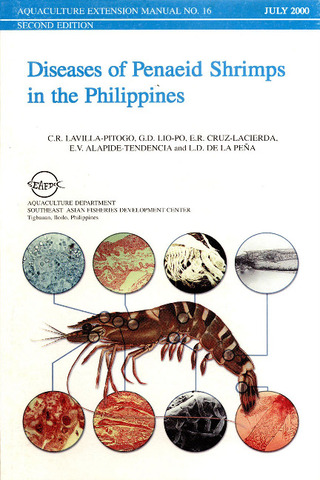
Diseases of penaeid shrimps in the Philippines
; ; ; Tendencia, Eleonor ; (Aquaculture Department, Southeast Asian Fisheries Development Center, 2000)
The manual provides information on the diseases that affect the 3 major species of shrimps cultured in the Philippines: Penaeus monodon, P. merguiensis and P. indicus. It includes the common name of the disease, causative agent, species affected, stages affected, gross signs, effects on the host and methods of prevention and treatment. This revised edition includes newly discovered diseases. It is hoped that the manual will be of considerable help to shrimp farmers in identifying the disease and lead to prevention or early disease diagnosis and control.
; (Aquaculture Department, Southeast Asian Fisheries Development Center, 2000)
The manual provides information on the diseases that affect the 3 major species of shrimps cultured in the Philippines: Penaeus monodon, P. merguiensis and P. indicus. It includes the common name of the disease, causative agent, species affected, stages affected, gross signs, effects on the host and methods of prevention and treatment. This revised edition includes newly discovered diseases. It is hoped that the manual will be of considerable help to shrimp farmers in identifying the disease and lead to prevention or early disease diagnosis and control. -
Series: Aquaculture extension manual; No. 16
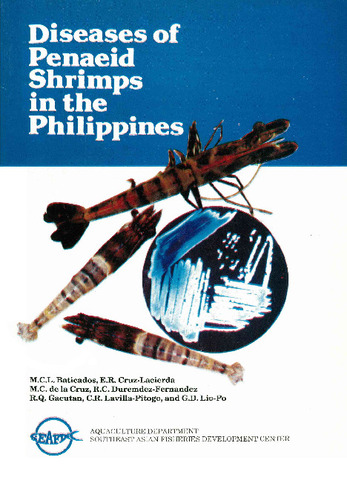
Diseases of penaeid shrimps in the Philippines
(Aquaculture Department, Southeast Asian Fisheries Development Center, 1990)The manual provides information on the diseases that affect the 3 major species of shrimps culture in the Philippines: Penaeus monodon, P. merguiensis and P. indicus. It includes the common name of the disease, causative agent, species affected, stages affected, gross signs, effects on the host and methods of prevention and treatment. -
Important diseases of Penaeid shrimps
(National Taiwan Ocean University; The Fisheries Society of Taiwan; Asian Fisheries Society; World Aquaculture Society, 2016)In tropical Asia, the two main species of penaeid shrimps that are widely cultured are the black tiger shrimp (Penaeus monodon) and the Pacific white shrimp (Penaeus (Litopenaeus) vannamei). The former species is indigenous in most Asian countries while the latter is indigenous in the Americas and was introduced to Asian countries in the late 1990s. In this chapter, only details of the economically-important microbial infections in Asia in these two penaeid shrimps are presented and arbitrarily grouped as viral, bacterial, fungal and parasitic diseases. Viral infections are divided further into two groups: DNA viruses; and, RNA viruses. The infections attributed to DNA viruses are: White Spot Disease (WSD) Disease, Penaeus stylirostris densovirus (PstDNV) previously known as Infectious Hypodermal and Hematopoietic Necrosis Virus (IHHNV) Disease, Penaeus monodon densovirus (PmDNV) formerly known as Hepatopancreatic Parvo-like Virus (HPV) Disease and Penaeus monodon nucleopoly-hedrovirus (PemoNPV) previously known as Monodon Baculovirus (MBV) Disease. The shrimp infections caused by RNA viruses are: Yellow Head Virus (YHV) Disease, Taura Syndrome Virus (TSV) Disease, and Infectious Myonecrosis Virus (IMNV) Disease. For bacterial diseases, the list includes Luminous Bacterial Disease, Non-luminous Vibrio Infections, and Acute Hepatopancreatic Necrosis Disease (AHPND). Fungal disease includes Larval mycosis, while parasitic disease includes the current emerging threat to the shrimp industry, the Hepatopancreatic Microsporidiosis caused by Enterocytozoon hepatopenaei (EHP).