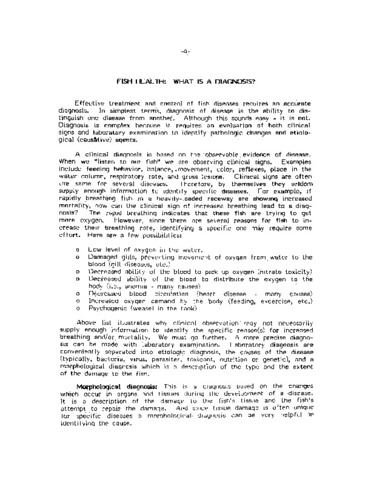
Fish health: what is a diagnosis


Share
Suggested Citation
SEAFDEC/AQD (1988). Fish health: what is a diagnosis. Aqua Farm News , 6(6), 4-5. http://hdl.handle.net/10862/2700
Type
magazineArticleISSN
0116-6573Collections
- Aqua Farm News [286]
Related items
Showing items related by title, author, creator and subject.
-
Transboundary aquatic animal diseases: History and impacts in ASEAN aquaculture
(Aquaculture Department, Southeast Asian Fisheries Development Center, 2019)Aquaculture is one of the important sectors in the economy of most Asia-Pacific countries. However, majority of aquaculture farms are small-scale and most often lack the necessary facilities to comply with or are not well informed of the product standards imposed by concerned authorities, especially for international trade. Most countries in the region have a high reliance on aquatic animals as the major source of protein for their populations. In the past 20 years, farming of shrimp and fish for export has become a major employer and revenue earner for many countries in the region. Aquaculture is a major employer, contributes significantly to national economies, assists in poverty reduction, and is an important element in food security and other national development priorities. Aquaculture has developed rapidly in the region and is now a significant component in the national economies of many countries. However, recent disease events in fish and shrimp farming have indicated that preparedness and response measures are lacking, contributing to spread of disease across large areas of the countries involved. The growth of aquaculture in recent decades has been dependent on the international movement of aquatic animals and, in particular, the introduction of non-native species. The movement of live aquatic animals and their products has the potential to spread pathogens from one country or region to another, which may result to disease outbreaks. In shrimps as example, most major disease outbreaks were associated with the movement of live animals (broodstock, nauplii and postlarvae) when the patterns of disease spread were analyzed. Many aquatic animal diseases, once established, are often difficult to treat or to eliminate. Over the past 30 years, the Asia-Pacific region has been swept by a number of devastating diseases of aquatic animals which have caused massive economic and social losses. These include spread and outbreaks of infection with Aphanomyces invadans (EUS) in freshwater fish, viral nervous necrosis (VNN) in marine fish, viral hemorrhagic septicaemia (VHS) in marine and freshwater fish, and several viral diseases in shrimps such as white spot disease (WSD), white tail disease (WTD), yellow head disease (YHD) and infectious myonecrosis (IMN) among others. This demonstrates the vulnerability of the aquaculture industry as well as the wild populations to disease emergence in the region. The impacts of these diseases have been aggravated by the lack of effective preparedness and response whenever diseases emerge. Although some national, regional and international actions towards disease emergencies have paved way to disease spread prevention in recent years (e.g. Acute hepatopancreatic necrosis diseases; AHPND), there are still several emerging diseases that need to be considered by aquaculture-producing countries, especially in the ASEAN, through a harmonized and effective emergency preparedness and disease response. -
Aquatic emergency preparedness and response system in Thailand
(Aquaculture Department, Southeast Asian Fisheries Development Center, 2019)In Thailand, Department of Fisheries (DoF) is the competent authority for various aspects of aquatic animals including aquatic animal health. There are two principal legislation giving DoF power to apply for aquatic animal disease prevention and control measures in the country as well as import-export control; namely, Royal Ordinance on Fisheries and Animal Epidemic Act. DoF has two national reference laboratories for aquatic animal health, one is Aquatic Animal Health Research and Development Division (AAHRDD) for freshwater aquatic animal disease diagnosis and another is Songkhla Aquatic Animal Health Research Center (SAAHRC) for brackish water aquatic animal disease diagnosis. Both are ISO/IEC 17025 accredited laboratories. Besides, there are 19 regional laboratories of DoF located in different areas of the country. All of 21 laboratories are responsible for performing disease diagnosis service for fish farmers as well as for disease surveillance. There are a number of surveillance and control programs for aquatic animal diseases in Thailand. Passive surveillance: information can be collected from disease reporting and other sources such as scientific research, news, publications, social network, or rumor. Active surveillance: to provide assurance of disease status for trade purposes, DoF has setup nationally active targeted surveillance program for demonstrating a number of diseases free status of country or farm establishment in accordance with OIE Aquatic Animal Health Code. There are several farm standards in Thailand such as Good Aquaculture Practices for Hatchery of Disease Free Pacific White Shrimp, Good Aquaculture Practices for Marine Shrimp Farm, and Aquaculture Establishment for Export of Aquatic Animals. Each standard includes necessary biosecurity practices in order to prevent the introduction of pathogenic agent into or spread within or release from the farm. To control domestic movement of live aquatic animals, in normal situation, Aquatic Animal Movement Document should be gained when purchasing as it is beneficial to traceability. However if the disease free zone or disease zone is announced according to Animal Epidemic Act, all transportation of target aquatic animals or carcasses in or out of the defined zone is prohibited, unless a written permission is obtained. DoF had developed contingency plan for dealing with aquatic animal disease emergencies. In contingency plan, the Provincial Fisheries Officer in responsible area will act as Director of Emergency Aquatic Animal Disease Control Center while Inland Aquaculture Research and Development Center/Coastal Aquaculture Research and Development Center/AAHRDD/SAAHRC will act as disease investigator and laboratory testing. DoF maintains early warning system by supporting staff to attend the meeting and workshop where there is occurrence of new disease, regularly checking local/regional/international disease report database, communicate with competent authority of trade partner, and regularly reporting disease situation to regional and international system. For early detection system, DoF has not only supported expertise and facilities required for laboratories to diagnose different diseases but also conducted training courses for fish farmers, traders and DoF staffs to recognize signs of the listed disease and emerging disease and encouraged them for rapid reporting of the event to the nearest DoF agency for the purpose of immediate investigation. For early response system, when there is serious disease outbreak, aquatic animals in that epidemiological unit should be contained in safety area. Waste water also should not be released from that area without disinfection. Meanwhile, the DoF staffs should investigate the outbreak urgently in order to define disease zone and find out what factors associated with the outbreak so that the disease management or control measure can be applied properly. -
Bacterial diseases in tiger shrimp culture in the Philippines
(Aquaculture Department, Southeast Asian Fisheries Development Center, 1998)