Malalison makes full circle: AQD writes finis to a community fishery resource management project


Share
Suggested Citation
Surtida, M. B. (1998). Malalison makes full circle: AQD writes finis to a community fishery resource management project. SEAFDEC Asian Aquaculture , 20(6), 12-13. http://hdl.handle.net/10862/2892
Type
magazineArticleISSN
0115-4974Collections
Related items
Showing items related by title, author, creator and subject.
-
Potentials and prospects of Southeast Asian eel resources for sustainable fisheries and aquaculture development
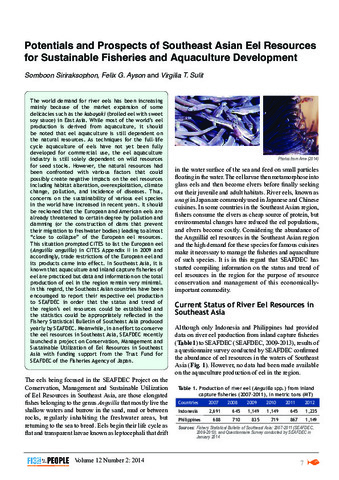
(Secretariat, Southeast Asian Fisheries Development Center, 2014)The world demand for river eels has been increasing mainly because of the market expansion of some delicacies such as the kabayaki (broiled eel with sweet soy sauce) in East Asia. While most of the world’s eel production is derived from aquaculture, it should be noted that eel aquaculture is still dependent on the natural resources. As techniques for the full-life cycle aquaculture of eels have not yet been fully developed for commercial use, the eel aquaculture industry is still solely dependent on wild resources for seed stocks. However, the natural resources had been confronted with various factors that could possibly create negative impacts on the eel resources including habitat alteration, overexploitation, climate change, pollution, and incidence of diseases. Thus, concerns on the sustainability of various eel species in the world have increased in recent years. It should be reckoned that the European and American eels are already threatened to certain degree by pollution and damming (or the construction of dams that prevent their migration to freshwater bodies) leading to almost “close to collapse” of the European eel resources. This situation prompted CITES to list the European eel (Anguilla anguilla) in CITES Appendix II in 2009 and accordingly, trade restrictions of the European eel and its products came into effect. In Southeast Asia, it is known that aquaculture and inland capture fisheries of eel are practiced but data and information on the total production of eel in the region remain very minimal. In this regard, the Southeast Asian countries have been encouraged to report their respective eel production to SEAFDEC in order that the status and trend of the region’s eel resources could be established and the statistics could be appropriately reflected in the Fishery Statistical Bulletin of Southeast Asia produced yearly by SEAFDEC. Meanwhile, in an effort to conserve the eel resources in Southeast Asia, SEAFDEC recently launched a project on Conservation, Management and Sustainable Utilization of Eel Resources in Southeast Asia with funding support from the Trust Fund for SEAFDEC of the Fisheries Agency of Japan. -
Beginnings: SEAFDEC/AQD, CFRM, and Malalison Island
(Aquaculture Department, Southeast Asian Fisheries Development Center, 1996)The paper documents the community fishery resources management activities of Southeast Asian Fisheries Development Center, Aquaculture Department (SEAFDEC/AQD) in Malalison Island, Antique, Philippines. -
State of Philippine coastal fisheries
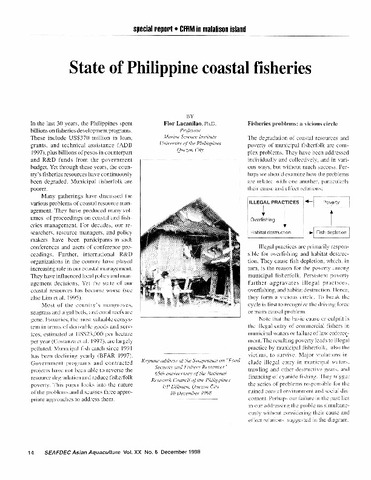
(Aquaculture Department, Southeast Asian Fisheries Development Center, 1998)