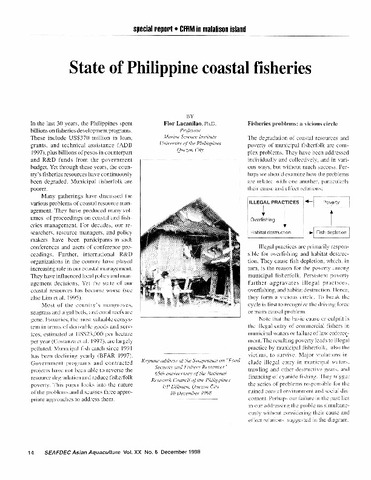
State of Philippine coastal fisheries

Date
1998Page views
1,842ASFA keyword
brackishwater environment 
inland water environment
marine environment
coastal fisheries
coastal zone management
environmental degradation
fishermen
fisheries development
fishery management
fishery regulations
illegal fishing
overfishing
policies
resource conservation
resource management
restoration
socioeconomic aspects
sociology
inland water environment
marine environment
coastal fisheries
coastal zone management
environmental degradation
fishermen
fisheries development
fishery management
fishery regulations
illegal fishing
overfishing
policies
resource conservation
resource management
restoration
socioeconomic aspects
sociology
AGROVOC keyword
Metadata
Show full item recordShare
Suggested Citation
Lacanilao, F. (1998). State of Philippine coastal fisheries. SEAFDEC Asian Aquaculture , 20(6), 14-17. http://hdl.handle.net/10862/2893
Type
magazineArticleISSN
0115-4974Collections
Related items
Showing items related by title, author, creator and subject.
-
Beginnings: SEAFDEC/AQD, CFRM, and Malalison Island
(Aquaculture Department, Southeast Asian Fisheries Development Center, 1996)The paper documents the community fishery resources management activities of Southeast Asian Fisheries Development Center, Aquaculture Department (SEAFDEC/AQD) in Malalison Island, Antique, Philippines. -
Malalison makes full circle: AQD writes finis to a community fishery resource management project
(Aquaculture Department, Southeast Asian Fisheries Development Center, 1998) -
CRM in the Philippines: Lessons learned
(Aquaculture Department, Southeast Asian Fisheries Development Center, 1996)Philippine coastal communities can become capable fishery resource managers and that their management practices can become largely self-sustaining if the project approach focuses on assisting fishermen to learn how to help themselves. Community organization is an essential part of the process and should not be viewed as an end product in itself. There are also no quick fixes, and projects require a complex array of activities if large numbers of coastal residents are to be assisted. In some of these projects, the control of illegal fishing combined with limiting of commercial fishing to offshore areas and good coastal habitat management resulted in a doubling of daily fish catch and income for small-scale fishermen. However, even with the best of management, the total fishery harvest is limited and further increases in individual fishing income can only come from reducing total fishing effort. This will require a system of control on access to the resource to limit the number and kind of fishing gears and to divide the resource equitably. Assisting coastal communities to devise and implement realistic equitable access controls is the major challenge facing coastal resource co-management.