Dietary substitution of protein concentrate of Ulva lactuca for soybean meal in the black tiger shrimp Penaeus monodon fry

Download URL
www.abah.bioflux.com.roDate
2014Page views
1,042ASFA keyword

AGROVOC keyword
Metadata
Show full item recordShare
Abstract
A feeding trial was conducted to test the protein concentrate of the green seaweed Ulva lactuca as a substitute for soybean meal in the diet of the black tiger shrimp Penaeus monodon fry. Experimental diets containing various replacement levels for soybean meal by weight were prepared, namely 0 (control diet), 15, 30 or 45% Ulva protein concentrate (UPC). Survival rate was not affected by the diets. Feed intake (FI) was statistically similar in shrimp fed the control diet and diet containing 15% UPC replacement while the FI of shrimps fed diets containing 30% and 45% were lower and were not significantly different from each other. SGR of shrimps fed the control diet was not significantly different from the values of those fed diets containing 15% and 30% UPC replacements while those fed diets containing 45% UPC replacement exhibited significantly the lowest SGR. Protein gained of shrimps were statistically similar between those fed the control diet and those fed diets with 15% and 30% UPC while those fed diets at 45% UPC was significantly lower than the three groups. Protein efficiency ratio (PER) was unaffected by the dietary treatments. Ulva protein concentrate could be a substitute for soybean meal in the diet of Penaeus monodon fry up to 30% without compromising the survival, growth and feed utilization efficiency of the shrimp despite lower feed intake.
Suggested Citation
Serrano, A. E., Jr., & Santizo, R. B. (2014). Dietary substitution of protein concentrate of Ulva lactuca for soybean meal in the black tiger shrimp Penaeus monodon fry. Animal Biology and Animal Husbandry , 6(2), 140-147. http://hdl.handle.net/10862/2920
Type
ArticleISSN
2066-7612; 2067-6344Collections
- Journal Articles [1267]
Related items
Showing items related by title, author, creator and subject.
-
New records of a marine macrobenthic algae of Panay and Guimaras Islands
(Science and Technology Information Institute, 1992)Thirty new records of macrobenthic algae for Panay and Guimaras Islands are reported, consisting of 12 species of Chlorophyceae, 4 Phaeophyceae and 14 Rhodophyceae. -
Enriched Ulva pertusa as partial replacement of the combined fish and soybean meals in juvenile abalone Haliotis asinina (Linnaeus) diet
(Springer Verlag, 2020)The potential of enriched Ulva pertusa meal as feed ingredient in abalone juveniles, Haliotis asinina was evaluated. Four isonitrogenous and isolipidic diets were formulated which contain 27% protein and 5% lipid. Enriched U. pertusa meal replaced 0% (control), 10%, 20%, and 30% of protein from fish and soybean meals in the formulated diets. Thirty randomly selected abalone juveniles with average weight and shell length of 0.45 g ± 0.01 and 12.71 mm ± 0.01, respectively, were placed in each of the twelve 60-L oval fiberglass tanks equipped with a flow-through seawater system. Abalone were given diets at 3–5% body weight daily for 120 days in three replicate samples. Results showed no significant differences (p > 0.05) in percent weight gain, shell length, specific growth rate, feed conversion ratio, and protein efficiency ratio even up to 30% replacement level. Apparent dry matter digestibility of U. pertusa meal in abalone diet was 92%. Crude protein content of the abalone fed diets 1 (10% enriched U. pertusa meal) and 3 (30% enriched U. pertusa meal) was significantly (p < 0.05) higher than those fed on basal diet. Enriched U. pertusa meal can partially replace fish and soybean meals as protein source in formulated diets for abalone, Haliotis asinina juveniles. -
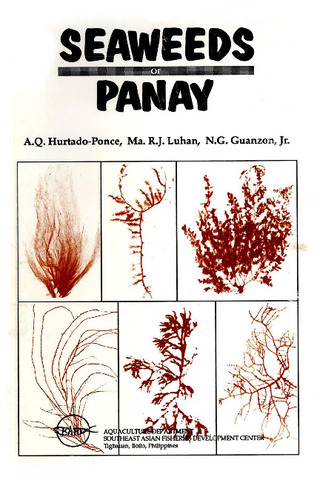
Seaweeds of Panay
(Aquaculture Department, Southeast Asian Fisheries Development Center, 1992)This practical book on the seaweeds of Panay, Philippines, acquaints and provides information to members of the academe and research institutions, policy makers, fishermen and businessmen regarding the taxonomy, distribution, ecology and economic importance of these resources. It consists of 4 major parts: (1) Introduction, which reviews the literature, habitat, distribution, morphological structure and reproduction; 2) Classification, which describes the classes to which the seaweeds generally belong; 3) Collection and preservation, which explains the procedure used in treatment of specimens; and, 4) Taxonomic list. A glossary is included, covering technical terms used. All species listed and described in this book are macrobenthic and were collected in Panay and Guimaras Islands.