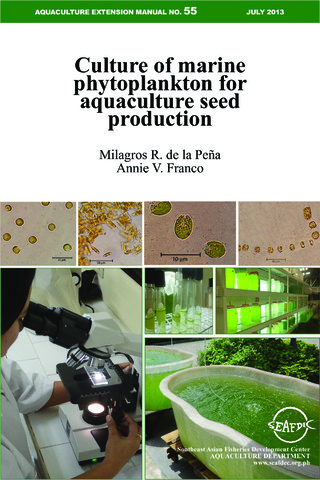
Culture of marine phytoplankton for aquaculture seed production

Share
นามธรรม
The 32-page extension manual describes the biology, culture techniques and maintenance and mass propagation of 12 phytoplankton species used as live feed in marine hatcheries.
การอ้างอิง
de la Peña, M. R., & Franco, A. V. (2013). Culture of marine phytoplankton for aquaculture seed production. Tigbauan, Iloilo, Philippines: Aquaculture Department, Southeast Asian Fisheries Development Center.
Type
BookISSN
0115-5369ชุด
Aquaculture extension manual; No. 55Format
33 pages : illustrations (some color) ; 23 cm.
คอลเลกชัน
Related items
Showing items related by title, author, creator and subject.
-
The macronutrient composition of natural food organisms mass cultured as larval feed for fish and prawns
(Society of Israeli Aquaculture and Marine Biotechnology, 1990)The macronutrient composition of natural food organisms that are mass cultured as feed for the larval stages of fish and prawns in the SEAFDEC Aquaculture Department was determined by chemical analysis. The food organisms included five species of marine phytoplanktons (algae): Chaetoceros calcitrans, Skeletonema costatum, Tetraselmis chui, Chlorella vulgaris and Isochrysis galbana, and two zooplanktons: Artemia sp. nauplii (San Francisco Bay strain) and Brachionus plicatilis. The algal species were grown in batches on Guillard and Ryther media and harvested during the exponential phase of growth using a procedure which preserved cellular integrity and prevented cell lysis. The zooplankton were cultured using standard techniques adopted at the SEAFDEC Larval Food Laboratory. Each species was analyzed for proximate composition (protein, fat, fiber and ash) and for mineral content (calcium and phosphorous). Nitrogen-free extract (NFE) was determined by difference. For the five algal species, the protein, fat and NFE contents varied from 22% to 48%, 2% to 16% and 14% to 24%, respectively. The zooplanktons had higher protein and fat contents than any of the phytoplankton species except I. galbana which had the highest fat content. On the other hand, the phytoplanktons, particularly the diatoms which have a siliceous cell wall, contained significantly higher quantities of inorganic matter (ash). C. vulgaris had the highest fiber content which may be attributed to its cellulosic cell wall. -
Biomass yield of Isochrysis galbana (Parke; clone T-ISO) and growth of Brachionus rotundiformis (Tschugunoff) using continuous cultivation method
(College of Agriculture, University of the Philippines Los Baños, 2014)Batch culture of Isochrysis galbana clone T-ISO is difficult due to its unstable biomass production; hence, the effect of continuous cultivation at different dilution rates was investigated to compare its productivity with that of batch culture. Significantly higher total algal cell yield was attained in continuous cultures (1.70 × 10⁸ and 1.03 × 10⁸ cells L-1 at 0.60 d-1 and 0.30 d-1 dilution rates, respectively) compared with batch culture (0.16 × 10⁸ cells L-1); the batch culture did not receive any inflow of nutrients. The amount of protein per cell was similar in both batch and continuous cultures at 0.60 d-1 dilution rate after 24 h and 5 d in both culture systems. Chlorophyll a yield was not affected by dilution rate but decreased as the culture aged. The dry weight yield was also similar in both batch and continuous cultures. The higher nitrate concentration supplemented in the batch culture resulted in higher cell density and elevated protein content of the alga. Rotifer (Brahionus rotundiformis) cultures that received inflow of nutrients from the algal tanks had significantly higher (P<0.05) peak population count (28 and 33 individuals mL-1 at 0.30 and 0.60 d-1 dilution rates, respectively) compared with rotifer cultures that did not receive an inflow of food (18.22 individuals mL-1). The higher biomass yield of T-ISO using continuous cultivation method can increase the population growth of rotifer under tropical conditions. -
Culture and screening of food organisms as potential larval food for finfish and shellfish
(South China Sea Fisheries Development and Coordinating Programme, 1982)The culture of food organisms for fin and shellfish larvae is discussed in detail. Some of the artificial and enriched media that have been developed and tested for microalgae culture are enumerated and some isolation methods are given. Culture methods for phytoplankton and zooplankton are described. The screening, evaluation, nutritive value and suitability of food organisms are considered and some criteria for the selection of food organisms and best food conditions for larvae are presented.