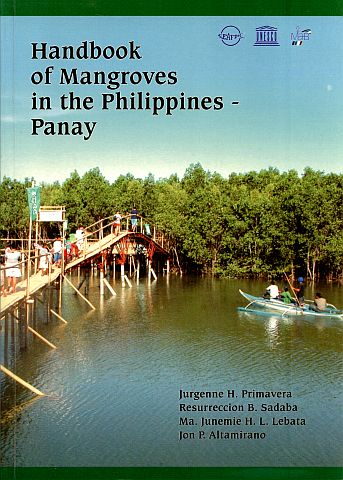
Handbook of mangroves in the Philippines - Panay


Share
Abstract
A 106-page guide is a user-friendly presentation of technical botanical description and illustrations of Philippine mangrove species in Panay Island, Guimaras and Aurora Province. Vegetative and reproductive structures of 34 mangrove species that are readily observed in the field are emphasized and presented in color photographs and as graphic icons. Also discussed: importance of mangroves; mangrove decline and legislation; conservation and rehabilitation; and mangrove-friendly aquaculture.

Suggested Citation
Primavera, J. H., Sadaba, R. B., Lebata, M. J. H. L., & Altamirano, J. P. (2004). Handbook of mangroves in the Philippines - Panay. Tigbauan, Iloilo, Philippines: Aquaculture Department, Southeast Asian Fisheries Development Center.
Type
BookISBN
9718511652Format
vi, 106 p. : col. ill., col. maps ; 21 cm.
Collections
- Handbooks [6]
Related items
Showing items related by title, author, creator and subject.
-
Collection of the clam Anodontia edentula in mangrove habitats in Panay and Guimaras, central Philippines
Primavera, Jurgenne ; Lebata, M. J. H. L. ; ; Altamirano, Jon (Kluwer Academic Publishers, 2002)
The mangrove clam Anodontia edentula is highly prized in the Philippines for its flavor and large size. Because this infaunal species is found down to one meter deep in mangrove areas, harvesting the clam reportedly damages mangrove stands. To evaluate such reports, a survey of collection methods was undertaken in Panay and Guimaras, central Philippines in August 1997-December 1999. Host to chemosynthetic bacterial symbionts that utilize sulfide as energy source, A. edentula are strategically situated in sulfide-rich anoxic substrates but also gain access to oxygenated seawater through a ventilation burrow or tube. By locating the opening of this burrow, collectors can detect the presence of a buried clam and harvest it nondestructively with a blade or bare hands. In contrast, the indiscriminate tilling of wide mangrove areas can damage mangrove plants. Most collectors were 40-45 years old with 22-30 years collection experience, married with 5-7 children, and had low educational attainment. They sold clams directly in the local markets or through middlemen (to restaurants and beach resorts); sales provided from 10% to 100% of daily family income. Collectors complained of decreasing clam sizes and numbers and the physically strenuous work of collecting.
; Lebata, M. J. H. L. ; ; Altamirano, Jon (Kluwer Academic Publishers, 2002)
The mangrove clam Anodontia edentula is highly prized in the Philippines for its flavor and large size. Because this infaunal species is found down to one meter deep in mangrove areas, harvesting the clam reportedly damages mangrove stands. To evaluate such reports, a survey of collection methods was undertaken in Panay and Guimaras, central Philippines in August 1997-December 1999. Host to chemosynthetic bacterial symbionts that utilize sulfide as energy source, A. edentula are strategically situated in sulfide-rich anoxic substrates but also gain access to oxygenated seawater through a ventilation burrow or tube. By locating the opening of this burrow, collectors can detect the presence of a buried clam and harvest it nondestructively with a blade or bare hands. In contrast, the indiscriminate tilling of wide mangrove areas can damage mangrove plants. Most collectors were 40-45 years old with 22-30 years collection experience, married with 5-7 children, and had low educational attainment. They sold clams directly in the local markets or through middlemen (to restaurants and beach resorts); sales provided from 10% to 100% of daily family income. Collectors complained of decreasing clam sizes and numbers and the physically strenuous work of collecting. -
Establishing a mangrove nursery
(Aquaculture Department, Southeast Asian Fisheries Development Center, 2000)Mangroves play an important role in creating habitats for a diverse community of organisms ranging from bacteria and fungi to fishes and mammals. They grow in intertidal flats, estuaries and offshore islands. In the Philippines, mangrove forests have dramatically decreased in area since the start of the century, and therefore there is a need to reforest. However, first mangrove nurseries must be established since they serve as sources of planting materials for different mangrove species. Furthermore, nurseries would mean a sustainable source of livelihood for coastal communities because of continuous demand for propagules. A brief account is given of procedures as to the establishment of a mangrove nursery, describing the construction of a nursery, preparation of potting materials, seed collection, seed sowing, and maintenance and protection. Details are provided of the most common true mangrove species in the Philippines. The mangrove nursery is a place for raising and tending seedlings until they are ready for permanent planting. The establishment of mangrove nurseries is in line with government s efforts to rehabilitate the coastal and mangrove ecosystems. -
Mangroves and shrimp pond culture effluents in Aklan, Panay Is., central Philippines
Primavera, Jurgenne; ; Lebata, M. J. H. L. ; ; (University of Miami, Rosenstiel School of Marine and Atmospheric Science, 2007)
The capacity of a natural mangrove system in Ibajay, Aklan province, central Philippines to process shrimp pond culture effluents was assessed through analysis of mangrove community structure and 24-hr monitoring of water quality parameters (NH3-N, NO3-N, PO4-P, sulfide, and total suspended solids). Results from the latter showed decreased nutrient levels within 6 hrs after daytime draining of effluents into the mangrove stand, but only nitrate reduction was statistically significant. Based on nitrate loss, volume of water drained, mangrove area, and shrimp farming data (e.g., N loss from ponds, feed composition, feeding rate), calculations show that 1.8–5.4 ha of mangroves are required to remove nitrate wastes from 1 ha of shrimp pond. N uptake by the mangrove macroflora was supported by data showing longer nipa palm leaflets and faster mangrove seedling growth in the experimental mangrove receiving effluents compared to a control mangrove, but not from mangrove biomass measurements. These results have significant implications for the Philippine brackishwater pond culture industry to conserve or rehabilitate mangroves as potential pond biofilters, to implement legally mandated 20- and 50-m greenbelts, and to reverse the national 0.5 ha mangrove: 1.0 ha pond ratio.