Library and databanking services of SEAFDEC/AQD
 AQD Access


Share
Subjects
Southeast Asian Fisheries Development Center. Aquaculture Department. Library Special libraries Libraries Online library catalogs
Description
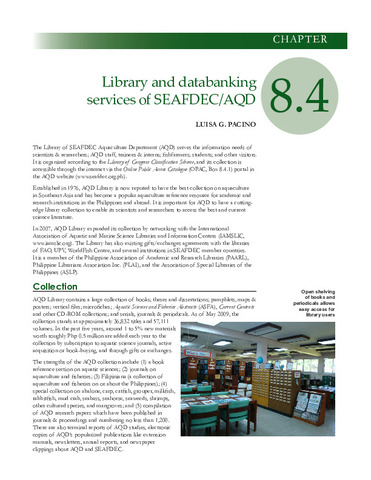
The Library of SEAFDEC Aquaculture Department (AQD) serves the information needs of scientists & researchers; AQD staff, trainees & interns; fish farmers; students; and other visitors. It is organized according to the Library of Congress Classification Scheme, and its collection is accessible through the internet via the Online Public Access Catalogue portal on the AQD website (www.seafdec.org.ph).
Established in 1976, AQD Library is now reputed to have the best collection on aquaculture in Southeast Asia and has become a popular aquaculture reference resource for academic and research institutions in the Philippines and abroad. It is important for AQD to have a cutting-edge library collection to enable its scientists and researchers to access the best and current scientific literature.
In 2007, AQD Library expanded its collection by networking with the International Association of Aquatic and Marine Science Libraries and Information Centers (IAMSLIC, www.iamslic.org). The Library has also existing gifts/exchanges agreements with the libraries of FAO, UPV, WorldFish Centre, and several institutions in SEAFDEC member countries. It is a member of the Philippine Association of Academic and Research Libraries (PAARL), the Philippine Librarians Association Inc. (PLAI), and the Association of Special Libraries of the Philippines (ASLP).
Suggested Citation
Pacino, L. G. (2009). Library and databanking services of SEAFDEC/AQD. In Training Handbook on Rural Aquaculture (pp. 293-296). Tigbauan, Iloilo, Philippines: Aquaculture Department, Southeast Asian Fisheries Development Center.
Type
Book chapterISBN
9789718511893Collections
Related items
Showing items related by title, author, creator and subject.
-
Unifying the art, science and business of aquaculture through the information resources and services of SEAFDEC Aquaculture Department Library
Alayon, Stephen ; Superio, Daryl ; ; Nemiz, Elvi S. (Secretariat, Southeast Asian Fisheries Development Center, 2013)
Established in 1973 in Tigbauan, Iloilo, Philippines, the Aquaculture Department (AQD) is one of four Departments of the Southeast Asian Fisheries Development Center (SEAFDEC). AQD is mandated to conduct scientific research to generate aquaculture technologies relevant and appropriate for the region; develop human resources; and produce, disseminate and exchange information on aquaculture. AQD is committed to sustainable development and the responsible stewardship of aquaculture resources through science-based research and the promotion of appropriate technologies and information relevant to the Southeast Asian region (SEAFDEC/AQD, 2009). The need to disseminate AQD’s research results is as important as the conduct of research in fisheries and aquaculture as referred to in the Code of Conduct for Responsible Fisheries (Wilkinson and Collins, 2007). In cognizance of the role that AQD should play with respect to its function of disseminating and exchanging information on aquaculture, the AQD Library was established to support the information needs of AQD scientists and staff. In addition, the Library also provides services to visiting researchers, local and international trainees and students, as well as the diverse users from AQD’s partner institutions. During the strategic planning workshop conducted by AQD in 2009, one of the goals identified was for AQD to strengthen the capacities of the aquaculture sector. Matching with such goal, the Library and Data Banking Services Section of the Training and Information Division identified its information dissemination and services target for 2012. Primarily, AQD Library aims to improve accessibility to archived and updated information, and to create a digital library collection of AQD publications and documents. In keeping up its goal of providing quality, current and relevant information, the Library continues to avail of quality print and non-print information resources, to ensure that it keeps abreast of the advancements in aquaculture and fulfil the diverse information needs of users. The Library also introduces innovations in its services with the purpose of unifying the art, science and business of aquaculture, and strengthens its local and international linkages for efficient sharing of knowledge and resources.
; Superio, Daryl ; ; Nemiz, Elvi S. (Secretariat, Southeast Asian Fisheries Development Center, 2013)
Established in 1973 in Tigbauan, Iloilo, Philippines, the Aquaculture Department (AQD) is one of four Departments of the Southeast Asian Fisheries Development Center (SEAFDEC). AQD is mandated to conduct scientific research to generate aquaculture technologies relevant and appropriate for the region; develop human resources; and produce, disseminate and exchange information on aquaculture. AQD is committed to sustainable development and the responsible stewardship of aquaculture resources through science-based research and the promotion of appropriate technologies and information relevant to the Southeast Asian region (SEAFDEC/AQD, 2009). The need to disseminate AQD’s research results is as important as the conduct of research in fisheries and aquaculture as referred to in the Code of Conduct for Responsible Fisheries (Wilkinson and Collins, 2007). In cognizance of the role that AQD should play with respect to its function of disseminating and exchanging information on aquaculture, the AQD Library was established to support the information needs of AQD scientists and staff. In addition, the Library also provides services to visiting researchers, local and international trainees and students, as well as the diverse users from AQD’s partner institutions. During the strategic planning workshop conducted by AQD in 2009, one of the goals identified was for AQD to strengthen the capacities of the aquaculture sector. Matching with such goal, the Library and Data Banking Services Section of the Training and Information Division identified its information dissemination and services target for 2012. Primarily, AQD Library aims to improve accessibility to archived and updated information, and to create a digital library collection of AQD publications and documents. In keeping up its goal of providing quality, current and relevant information, the Library continues to avail of quality print and non-print information resources, to ensure that it keeps abreast of the advancements in aquaculture and fulfil the diverse information needs of users. The Library also introduces innovations in its services with the purpose of unifying the art, science and business of aquaculture, and strengthens its local and international linkages for efficient sharing of knowledge and resources. -
The information-seeking behavior of aquatic science librarians in response to a query
Superio, Daryl; Oliveros, Mary Grace H. ; Palcullo, Vince Ervin ; Geromiano, Joy F. (Routledge, 2020-10-01)
When searching for information in response to a query, their own library’s online public access catalog (OPAC) and databases remain the most preferred resource for most aquatic science librarians. This preference does not vary regardless of age, gender, educational degree, position or designation, country classification, or type of library. While the Internet acts as a supplement to the library collection, whenever the requested information is not available at the library, librarians prefer Googling instead of looking at other sources. Other than aquatic science-specific open access repositories and databases, some of the librarians have identified Google Scholar, DOAJ, ResearchGate, and Academia, among many others as valuable resources that help them fulfill their clientele’s query. -
Does age matter?: The information-seeking behavior of Filipino aquaculture researchers
Superio, Daryl (Taylor & Francis, 2018)
Findings of previous studies revealed that regardless of the objective, age does affect the information-seeking behavior of an individual. Likewise, this study found the same results. Although all of the younger Filipino aquaculture researchers preferred the Internet to begin their search process, it was found that they were more frequent library users, and more reliant on librarians than their older counterparts. Likewise, they preferred the combination of print and electronic formats when reading. Thus, they would print and save the retrieved electronic copy of information at least very often. The study is a valuable addition to the information-seeking behavior studies on Filipinos, and the first to tackle the effects of age on the information-seeking behavior of Filipino aquaculture researchers.