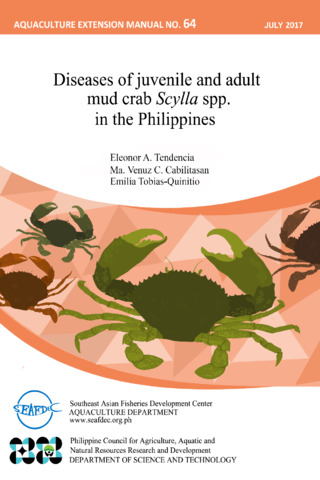
Diseases of juvenile and adult mud crab Scylla spp. in the Philippines
View/
Date
2017Author
Page views
7,210ASFA keyword

AGROVOC keyword
Taxonomic term

Metadata
Show full item recordShare
Abstract
This manual aims to provide updated information on the diseases of mud crabs initially authored by Lavilla-Pitogo and dela Peña (2004). It includes the name of the disease, causative agent, stages affected, effects on mud crab and methods of prevention and control. Except for the infectious diseases caused by viruses, which can be detected through molecular methods, most of the diseases can be visually diagnosed. Photographs of the external and internal anatomy of a normal mud crab, including the different sexes and species are included to help readers differentiate a normal from a diseased mud crab.
Description
A 30-page manual detailing the different diseases of mud crab and the corresponding prevention/control measures.
Suggested Citation
Tendencia, E. A., Cabilitasan, M. V. C., & Tobias-Quinitio, E. (2017). Diseases of juvenile and adult mud crab Scylla spp. in the Philippines. Tigbauan, Iloilo, Philippines: Aquaculture Department, Southeast Asian Fisheries Development Center.
Type
BookISSN
0115-5369Series
Aquaculture extension manual; No. 64Format
30 pages : color illustrations.
Collections
Related items
Showing items related by title, author, creator and subject.
-
Diseases affecting wild and farmed mud crab in the Philippines
Tendencia, Eleonor ; (Aquaculture Department, Southeast Asian Fisheries Development Center, 2017)
Mortalities due to cannibalism and diseases have been reported as major problems in the grow-out phase of mud crab production. This study aimed to identify and describe diseases affecting farmed and wild mud crab (mangrove crab) including predisposing, risk and protective factors, and possible prevention and control measures. A total of 767 wild and farmed mud crab samples were collected. External examination showed abnormalities such as short abdominal flap, discoloration of the abdominal region, darker carapace, lesions on carapace, claws and legs, and presence of epibionts like algae and the barnacles Balanus sp. on the carapace. Internally, necrotic, black and brown gills, and discolored gonads were observed. Stalked barnacles, Octolasmis spp., were observed in the gills. White spot syndrome virus (WSSV) was detected in 14 samples sourced from farms and Infectious hypodermal and haematopoietic necrosis virus (IHHNV) in 2 wild samples. WSSV was implicated in mortality cases. Low temperature and presence of WSSV positive shrimp were identified as risk factors for WSSV infection or outbreak. Pathogenicity tests for some isolated bacteria suggested that these may cause mortality in mud crab under stressful conditions. To prevent mortality due to WSSV infection, it is recommended to avoid polyculture of mud crab with shrimp and/or other crustaceans.
; (Aquaculture Department, Southeast Asian Fisheries Development Center, 2017)
Mortalities due to cannibalism and diseases have been reported as major problems in the grow-out phase of mud crab production. This study aimed to identify and describe diseases affecting farmed and wild mud crab (mangrove crab) including predisposing, risk and protective factors, and possible prevention and control measures. A total of 767 wild and farmed mud crab samples were collected. External examination showed abnormalities such as short abdominal flap, discoloration of the abdominal region, darker carapace, lesions on carapace, claws and legs, and presence of epibionts like algae and the barnacles Balanus sp. on the carapace. Internally, necrotic, black and brown gills, and discolored gonads were observed. Stalked barnacles, Octolasmis spp., were observed in the gills. White spot syndrome virus (WSSV) was detected in 14 samples sourced from farms and Infectious hypodermal and haematopoietic necrosis virus (IHHNV) in 2 wild samples. WSSV was implicated in mortality cases. Low temperature and presence of WSSV positive shrimp were identified as risk factors for WSSV infection or outbreak. Pathogenicity tests for some isolated bacteria suggested that these may cause mortality in mud crab under stressful conditions. To prevent mortality due to WSSV infection, it is recommended to avoid polyculture of mud crab with shrimp and/or other crustaceans. -
Updates on the seed production of mud crab
Quinitio, Emilia T.; ; ; (Aquaculture Department, Southeast Asian Fisheries Development Center, 2015)
Widespread interest in mud crab species is increasing because these are highly prized both in domestic and export markets. Among the three mud crab species commonly found in the Philippines, Scylla serrata, S. olivacea, and S. tranquebarica, S. serrata is preferred by farmers because it is larger and less aggressive than the other species. Likewise, S. serrata is the most widely distributed species in the Indo-west Pacific region. Hatchery-produced seedstock are presently used by some crab farmers in their grow-out operations. In the hatchery phase, feeding mud crab larvae with shrimp formulated diets and natural food was found to reduce the occurrence of molt death syndrome, one of the major problems in seed production. Larvae given 25% formulated diet (FD) + 75% natural food (NF; rotifers and Artemia) and 50% FD + 50% NF showed better performance than those larvae fed 100% FD, 100% NF and 75% FD + 25% NF indicating that usage of natural food, especially the expensive Artemia, can be reduced. Since the early crab instar (C) produced in the hatchery need to be grown further before stocking in grow-out ponds, two phases of nursery culture have been developed. C1-2 are grown to 1.5-2.0 cm carapace width (CW) size in the first phase and further grown to 3.0-4.0 cm CW in the second phase. Nursery rearing is done in net cages installed in ponds for easy retrieval. A combination of mussel or trash fish and formulated diet is used as feed. Domestication of the mud crab S. serrata as a prerequisite to selective breeding has been done at SEAFDEC/AQD. Likewise, defining criteria for the determination of quality of newly hatched zoeae for stocking in the hatchery was initiated. Newly hatched zoeae were subjected to starvation and stress test using formalin. Starvation failed to elicit responses that were significantly different between the good and poor quality larvae hence it is not suitable for larval quality evaluation. Based on three-year data, the formalin stress test gave mean cumulative mortalities of 2.38±0.32, 8.24±0.88, 20±1.58 in good quality larvae, and 43.74±2.39 while 22.93±4.19, 63.68±7.17, 84.29±3.88 and 97.65±1.06 for poor quality larvae at 0 (control), 20, 30 and 40 ppm formalin, respectively. As formalin level increased, cumulative larval mortality also increased regardless of the quality of the larvae. Formalin stress test proved to be a reliable method to determine whether a batch of newly hatched zoeae was of good or poor quality. -
Updates on the larviculture of mud crab at SEAFDEC/AQD
Quinitio, Emilia T.; ; ; (Aquaculture Department, Southeast Asian Fisheries Development Center, 2017)
Although the mud crab (Scylla serrata) hatchery technology has been developed, issues such as high cost of production due to the need for additional facilities and labor for natural food culture, inconsistent survival rate at megalopa stage due to Molt Death Syndrome (MDS), and disease due to luminescent bacteria (Vibrio spp.), remain to be addressed. Refinements on the existing mud crab larviculture technology were done to address these problems. Poor nutrition, low water temperature and application of prophylaxis during the zoea l stage have been identified as possible causes of MDS. Six shrimp formulated diets (FD) were tested, and 3 of these proved to be suitable for mud crab larvicuture. Larval performance was compared using the 3 diets + natural food (NF, rotifers and Artemia) and NF alone as control. No significant difference was noted in the survival among the 4 treatments, although BP Nippai fed larvae had higher values. Lesser occurrence of MDS was observed in all the larvae fed FD+NF. Three mud crab larval diets with various attractants (squid, annelids, and squid + annelids) were also formulated and fed to the larvae. Results showed no significant difference among the 3 diets. The results of another experiment investigating the effects of the reduction of natural food showed that larvae fed 50% NF + 50% FD and 75%NF + 25% FD had higher survival compared to those fed 75% AD +25% NF and no NF at all. The results indicate that the larvae cannot survive with formulated diet alone. It has been observed that frequency of antibiotic application can be reduced to every 5 days if good quality mud crab larvae are used. Formalin stress test proved to be a reliable method to determine the quality of a batch of newly hatched zoeae. All prophylactic treatments are stopped when megalopae reach the benthic stage. To accelerate the dissemination of science-based mud crab hatchery technology to industry stakeholders, SEAFDEC/AQD entered into an agreement with private hatchery operators, State Universities and Colleges, and Local Government Units on giving assistance during initial hatchery operations. Technicians were given free training, followed by in-situ hatchery operations with assistance from SEAFDEC/AQD with the funding from PCAARRD-DOST. Crablets are now being produced by the collaborators. Increase in the production of hatchery-reared crablets will eventually reduce the dependence on wild-sourced mud crab seed stock for farming.