SEAFDEC/AQDINSTITUTIONAL REPOSITORY
    • English
    • 日本語
    • ไทย
    • Bahasa Indonesia
  • English 
    • English
    • 日本語
    • ไทย
    • Bahasa Indonesia
  • Login
View Item 
  •   SEAFDEC/AQD Institutional Repository Home
  • 03 SEAFDEC/AQD External Publications
  • Journal Articles, Conference Papers and Book Chapters by SEAFDEC Staff
  • Journal Articles
  • View Item
  •   SEAFDEC/AQD Institutional Repository Home
  • 03 SEAFDEC/AQD External Publications
  • Journal Articles, Conference Papers and Book Chapters by SEAFDEC Staff
  • Journal Articles
  • View Item
JavaScript is disabled for your browser. Some features of this site may not work without it.

Gonad development and size‐at‐maturity of silver therapon Leiopotherapon plumbeus (Kner 1864; Teleostei:Terapontidae) in tropical volcanic lakes in south Luzon, Philippines

  • Global styles
  • MLA
  • Vancouver
  • Elsevier - Harvard
  • APA
  • Help
Thumbnail
View/Open
Date
2019
Author
Denusta, Pastor Jones ORCID
de Jesus-Ayson, Evelyn Grace
Laron, Manuel A.
Aya, Frolan ORCID
Garcia, Luis Maria ORCID
Page views
2,733
ASFA keyword
habitats ASFA
fish ASFA
environmental degradation ASFA
spawning ASFA
germ cells ASFA
dry season ASFA
males ASFA
oogenesis ASFA
fishing mortality ASFA
developmental stages ASFA
body size ASFA
spermatogenesis ASFA
gonads ASFA
fisheries ASFA
seasons ASFA
spermatozoa ASFA
inland waters ASFA
females ASFA
ovaries ASFA
lakes ASFA
fishing ASFA
annual variations ASFA
silver ASFA
ova ASFA
wet season ASFA
tropical climate ASFA
AGROVOC keyword
Philippines AGROVOC
maturity AGROVOC
Taxonomic term
Leiopotherapon plumbeus GBIF
Geographic names
Philippines TGN
Taal, Lake TGN
Metadata
Show full item record


Share 
 
Abstract
Gonad development of the silver therapon Leiopotherapon plumbeus in two volcanic crater lake habitats (Sampaloc Lake, Taal Lake) in south Luzon, Philippines was examined during the annual reproductive cycle. The minimum body size‐at‐maturity of fish in these two lake habitats was also compared. Four gonad development stages were characterized as basis for the classification of ovarian (immature, maturing, mature, spawned) and testicular maturation (immature, maturing, mature) phases. The occurrence of all development stages in individual gonads suggest an asynchronous development whereby advanced stages are recruited continuously from a pool of younger stage germ cells to result in elevated female and male GSI throughout the annual cycle due to active gonadogenesis. Together with the increasing occurrence of advanced stage oocytes and spermatozoa from March until October, the elevated GSI of fish may indicate peak gonadal growth during the onset of the dry season (December–January) for eventual spawning from the beginning (May–June) until the end of the wet season (October–November). In both lake habitats, male fish were smaller than females but, regardless of sex, the minimum size‐at‐maturity of fish in Sampaloc Lake was significantly smaller than fish in Taal Lake. Overall, asynchronous development during oogenesis and spermatogenesis allows for year‐round reproduction of silver therapon, with elevated gonad growth in the dry season in preparation for spawning during the wet season. Compared with fish in Taal Lake, a smaller size‐at‐maturity of fish in Sampaloc Lake may be a response of the wild fishery stock to long‐term high fishing mortality and degradation of the lake habitat.
Keywords
fish oogenesis gonad development silver therapon size-at-maturity spermatogenesis volcanic lake
URI
http://hdl.handle.net/10862/3520
Suggested Citation
Denusta, P. J., de Jesus-Ayson, E. G., Laron, M. A., Aya, F., & Garcia, L. M. (2019). Gonad development and size‐at‐maturity of silver therapon Leiopotherapon plumbeus (Kner 1864; Teleostei:Terapontidae) in tropical volcanic lakes in south Luzon, Philippines. Journal of Applied Ichthyology, 35(4), 933-943. https://doi.org/10.1111/jai.13915 
DOI
10.1111/jai.13915
Type
Article
ISSN
0175-8659; 1439-0426
Collections
  • Journal Articles [1267]

Related items

Showing items related by title, author, creator and subject.

  • Thumbnail

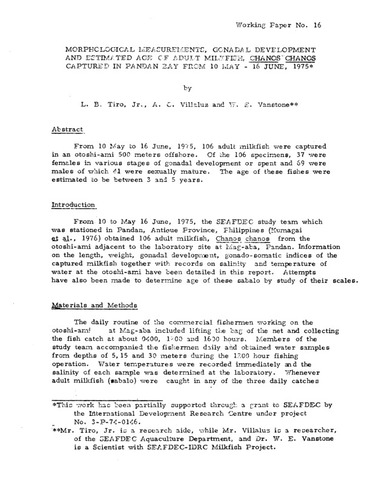
    Morphological measurements, gonadal development and estimated age of adult milkfish, Chanos chanos captured in Pandan Bay from 10 May - 16 June, 1975 

    Tiro Jr., Leonardo B.; Villaluz, Antonio C.; Vanstone, William E. (Aquaculture Department, Southeast Asian Fisheries Development Center, 1976)
    From 10 May to 16 June, 1975, 106 adult milkfish were captured in an otoshi-ami 500 meters offshore. Of the 106 specimens, 37 were females in various stages of gonadal development or spent and 69 were males of which 41 were sexually mature. The age of these fishes were estimated to be between 3 and 5 years.
  • Thumbnail

    Gonadal maturation, fecundity, spawning and timing of reproduction in the mud snail, Cerithidea cingulata, a pest in milkfish ponds in the Philippines 

    Lantin-Olaguer, Imelda; Bagarinao, Teodora ORCID (Taylor & Francis, 2001)
    Gonadal maturation, spawning, fecundity and timing of reproduction of the snail Cerithidea cingulata in a brackish water pond in Molo, Iloilo, Philippines, are described. Snails 4–41 mm in shell length were sampled monthly from May 1997 to May 1998; 25% were <25 mm, 67% were 20–30 mm, and 8% were >30 mm. The sexes are separate and could first be distinguished at 15 mm. Males are aphallic, have narrower shells than females of the same length, and have bright yellow-orange testes overlying the digestive gland deep inside the shell. Females have more robust shells, an ovipositor at the right side of the foot, and yellow-green ovaries overlying the digestive gland. The sex ratio was one male to two females in the pond population studied. Gonadal maturation was monitored by means of gonadosomatic index (GSI, gonad weight as a percent of visceral weight); maturation stages were based on the gonad appearance (immature, developing, mature) and histology (immature, developing, mature, redeveloping). GSI increased with snail size, and reached 16% in a 33-mm female. The smallest mature males and females were 18–19 mm, and most snails >20 mm were mature, spawning, or redeveloping. Histological sections showed all stages of gametogenesis in mature male snails. The oocyte size-frequency distributions in mature females showed mostly mature oocytes and secondary oocytes, but also oogonia and primary oocytes. GSI and the frequency of snails at different maturation stages varied over the year. Both GSI and the frequency of mature snails were highest during the summer months, April to August. Nevertheless, mature snails occurred throughout the whole year, as did mating and egg-laying. Fecundity (= number of oocytes >70 pμ) increased with size in mature females 2041 mm; an average 25-mm female produced about 1,500 oocytes and larger females produced a maximum of about 2,500 oocytes. Eggs strings laid on the pond bottom were 45–75 mm long; an average 64-mm string contained 2,000 eggs 210+20 pm in diameter. The density of eggs strings was highest (80–120/m2) during March-September. Eggs hatched after 6–7 d into planktonic veligers, which in turn settle on the pond bottom 11–12 d later as juveniles. Juveniles 2–6-mm long were most abundant in the pond during August-October.
  • Thumbnail

    Meristic and morphometric variation in the silver perch, Leiopotherapon plumbeus (Kner, 1864), from three lakes in the Philippines 

    Quilang, J. P.; Basiao, Zubaida U.; Pagulayan, R. C.; Roderos, R. R.; Barrios, E. B. (Blackwell Publishing, 2007)
    A number of researchers have applied multivariate methods to elucidate the population structure of fishes. In this study, we also used multivariate techniques to examine meristic and morphological variations in the silver perch, Leiopotherapon plumbeus (Kner, 1864), from three Philippine lakes, namely, Laguna de Bay, Sampaloc Lake, and Taal Lake. We also aimed to determine whether or not there are meristic and morphological differences among the populations of silver perch from the three lakes, considering that this fish species was introduced from Laguna de Bay into Sampaloc Lake and Taal Lake in the late 1950s and early 1970s, respectively. A total of 710 specimens from four different sites were used in the study: 155 each from Binangonan and Tanay areas of Laguna de Bay and 200 each from Sampaloc Lake and Taal Lake. Based on analysis of variance, eight meristic and 26 transformed morphometric characters were selected for subsequent analyses. Nineteen (19) principal components extracted from the 34 significant variables accounted for 82.3% of the variation in the original variables. Factor analysis using varimax rotation produced four factors: factor 1 was dominated by fin measurements while the highest loadings for factor 2 were gill raker counts. Factors 3 and 4 were dominated by various body and head measurements. Cluster analysis showed specimens from Sampaloc Lake and Taal Lake in one group, while majority of the specimens from Binangonan and Tanay are in another cluster. This suggests a closer morphological similarity between specimens from Sampaloc and Taal. Discriminant analysis gave relatively high correct classification rates (76.13–95.50%). Lower gill raker count was the most discriminating variable. Since both the silver perch from Sampaloc Lake and Taal Lake were introduced from Laguna de Bay, the observed clustering and morphological variation could be attributed to similarities and differences in the lake environments. Laguna de Bay is a shallow eutrophic lake, while Sampaloc Lake and Taal Lake are deep lakes. Further studies, however, are needed to determine which of the myriad of biological and/or physico–chemical factors might have the greatest influence on the observed morphological divergence between the source population and transplanted populations that we found in our study.

© SEAFDEC/AQD  2026
Send Feedback | Subscribe


Browse

All of SAIRCommunities & CollectionsBy Issue DateAuthorsTitlesSubjectsThis CollectionBy Issue DateAuthorsTitlesSubjects

My Account

LoginRegister

Statistics

View Usage Statistics

© SEAFDEC/AQD  2026
Send Feedback | Subscribe


Export citations

Export the current results of the search query as a citation list. Select one of the available citation styles, or add a new one using the "Citations format" option present in the "My account" section.

The list of citations that can be exported is limited to items.

Export citations

Export the current item as a citation. Select one of the available citation styles, or add a new one using the "Citations format" option present in the "My account" section.

Export Citations

DOCUMENT REQUEST NOT AVAILABLE

This publication is still available (in PRINT) and for sale at AQD bookstore. The library is currently restricted to send PDF of publications that are still for sale.

You may contact bookstore@seafdec.org.ph or visit AQD bookstore for orders.

FILE UNDER EMBARGO

This file associated with this publication is currently under embargo. This will be available for download after the embargo date.