
Newsletter Articles
Browse by
Recent Submissions
-
Black tiger shrimp revival program stepping up at AQD
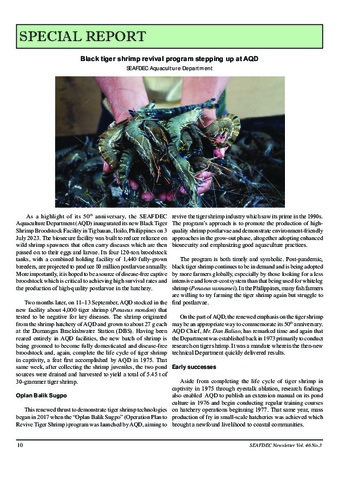
(Secretariat, Southeast Asian Fisheries Development Center, 2023-11)As a highlight of its 50th anniversary, the SEAFDEC Aquaculture Department (AQD) inaugurated its new Black Tiger Shrimp Broodstock Facility in Tigbauan, Iloilo, Philippines on 3 July 2023. The biosecure facility was built to reduce reliance on wild shrimp spawners that often carry diseases which are then passed on to their eggs and larvae. Its four 120-ton broodstock tanks, with a combined holding facility of 1,440 fully-grown breeders, are projected to produce 80 million postlarvae annually. More importantly, it is hoped to be a source of disease-free captive broodstock which is critical to achieving high survival rates and the production of high-quality postlarvae in the hatchery. -
Research breakthrough seen to curb shortage of 'poor man's fish'
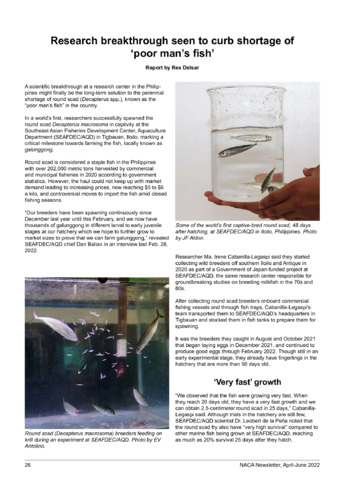
(Network of Aquaculture Centres in Asia-Pacific (NACA), 2022)A scientific breakthrough at a research center in the Philippines might finally be the long-term solution to the perennial shortage of round scad (Decapterus spp.), known as the “poor man’s fish” in the country. In a world’s first, researchers successfully spawned the round scad Decapterus macrosoma in captivity at the Southeast Asian Fisheries Development Center, Aquaculture Department (SEAFDEC/AQD) in Tigbauan, Iloilo, marking a critical milestone towards farming the fish, locally known as galunggong. -
Efficacy of tilapia oral vaccine coupled with a nanocomposite biomaterial as carrier for vaccine delivery
; ; Pakingking, Rolando V., Jr. ; Argayosa, Anacleto (Food and Agriculture Organization of the United Nations, 2021-12)
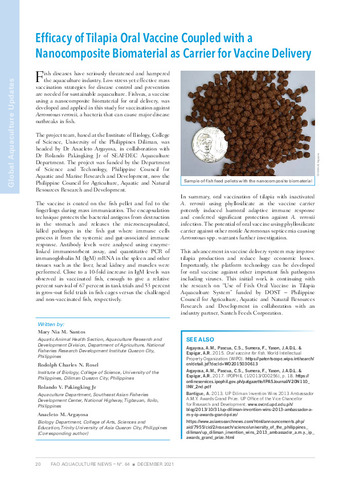
Fish diseases have seriously threatened and hampered the aquaculture industry. Low stress yet effective mass vaccination strategies for disease control and prevention are needed for sustainable aquaculture. Fishvax, a vaccine using a nanocomposite biomaterial for oral delivery, was developed and applied in this study for vaccination against Aeromonas veronii, a bacteria that can cause major disease outbreaks in fish. The project team, based at the Institute of Biology, College of Science, University of the Philippines Diliman, was headed by Dr. Anacleto Argayosa, in collaboration with Dr. Rolando Pakingking Jr. of SEAFDEC Aquaculture Department. The project was funded by the Department of Science and Technology, Philippine Council for Aquatic and Marine Research and Development, now the Philippine Council for Agriculture, Aquatic and Natural Resources Research and Development.
; Argayosa, Anacleto (Food and Agriculture Organization of the United Nations, 2021-12)
Fish diseases have seriously threatened and hampered the aquaculture industry. Low stress yet effective mass vaccination strategies for disease control and prevention are needed for sustainable aquaculture. Fishvax, a vaccine using a nanocomposite biomaterial for oral delivery, was developed and applied in this study for vaccination against Aeromonas veronii, a bacteria that can cause major disease outbreaks in fish. The project team, based at the Institute of Biology, College of Science, University of the Philippines Diliman, was headed by Dr. Anacleto Argayosa, in collaboration with Dr. Rolando Pakingking Jr. of SEAFDEC Aquaculture Department. The project was funded by the Department of Science and Technology, Philippine Council for Aquatic and Marine Research and Development, now the Philippine Council for Agriculture, Aquatic and Natural Resources Research and Development. -
Aquaculture seeds and feeds at the core of AQD’s collaboration with the government of the Philippines
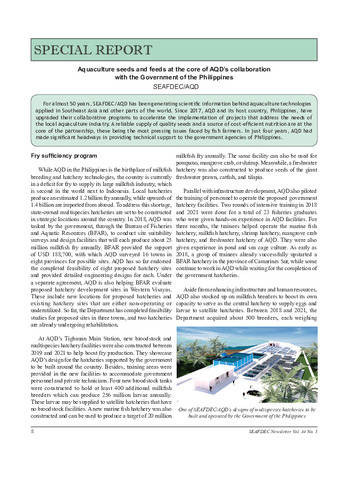
(Secretariat, Southeast Asian Fisheries Development Center, 2021-12-15)For almost 50 years, SEAFDEC/AQD has been generating scientific information behind aquaculture technologies applied in Southeast Asia and other parts of the world. Since 2017, AQD and its host country, Philippines, have upgraded their collaborative programs to accelerate the implementation of projects that address the needs of the local aquaculture industry. A reliable supply of quality seeds and a source of cost-efficient nutrition are at the core of the partnership, these being the most pressing issues faced by fish farmers. In just four years, AQD had made significant headways in providing technical support to the government agencies of Philippines. -
Breeding marine aquarium animals: The anemonefish
(International Center for Living Aquatic Resources Management, 1989-07)A brief account is given of experiments undertaken regarding the breeding of anemonefish (Amphiprion), a species popular among marine aquarists. Findings indicate these fish to be good candidates for reproductive physiology research; they produce large eggs and larvae, spawn frequently in captivity, are hardly to handle and can be maintained in small tanks. Future prospects for the culture of tropical marine aquarium fish are believed to be good. -
Oyster and mussel farming in Western Visayas, Philippines
(International Center for Living Aquatic Resources Management, 1992)The slipper oyster (talaba) and the green mussel (tahong) are the only mollusc species farmed in the Philippines. They are farmed for their meat, and consumption is mainly for the domestic market. The Western Visayas region, situated in central Philippines (Fig. 1), is one of the major sources of oysters and mussels. Natural population of oysters and mussels along rivers and bays and the need to augment income from fishing have led to the proliferation of oyster and mussel farms. Their farming started as early as the 1950s. Today, an estimated 2,000 coastal families engage in mollusc farming in the region. -
Economic assessment of shrimp (Penaeus monodon) hatchery industry in Panay Island, Philippines
(International Center for Living Aquatic Resources Management, 1994-07)Results of the economic assessment of shrimp hatchery industry in Panay Island, Philippines are presented. In order to ensure continuous viability of hatcheries, the critical areas of concern are: financing of operating capital and improvement of facilities; collective marketing efforts through cooperatives; updating of technology especially in disease prevention and control; and diversification strategies.
 RSS 1.0