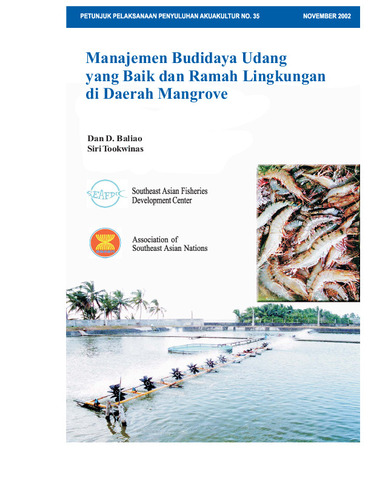
Manajemen budidaya udang yang baik dan ramah lingkungan di daerah mangrove

Date
2002Page views
10,609ASFA keyword
feeding 
shrimp culture
pond culture
recirculating aquaculture systems
wastewater aquaculture
prawn culture
ponds
mangroves
aquaculture development
aquaculture techniques
aquaculture systems
crustacean culture
environmental impact
brackishwater environment
ecosystems
water pollution
water quality
fishery management
shrimp culture
pond culture
recirculating aquaculture systems
wastewater aquaculture
prawn culture
ponds
mangroves
aquaculture development
aquaculture techniques
aquaculture systems
crustacean culture
environmental impact
brackishwater environment
ecosystems
water pollution
water quality
fishery management
AGROVOC keyword
Metadata
Show full item recordShare
Description
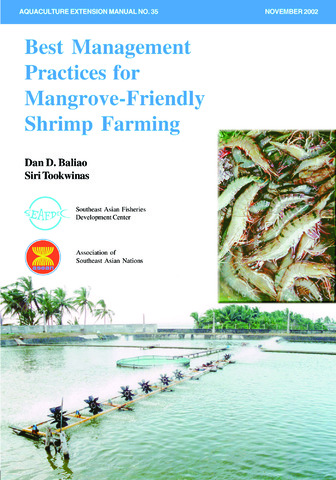
This 50-page manual puts together the best practices that SEAFDEC/AQD has developed with the Department of Fisheries in Thailand. These practices include the use of biomanipulators and greenwater system, the use of settling ponds with baffles and biofilters, the use of sludge collectors among others. These practices have been field-tested in Thailand, the Philippines, Myanmar and Viet Nam.
Suggested Citation
Baliao, D. D., & Tookwinas, S. (2002). Manajemen budidaya udang yang baik dan ramah lingkungan di daerah mangrove (Direktorat Jenderal Perikanan Budidaya, Trans.). Tigbauan, Iloilo, Philippines: Aquaculture Department, Southeast Asian Fisheries Development Center; Bangkok, Thailand: Association of Southeast Asian Nations.
Type
BookISBN
9718511644Series
Aquaculture extension manual; No. 35Format
iii, 50 p. : col. ill.
Collections
Related items
Showing items related by title, author, creator and subject.
-
Aqua-mangrove integrated farming: Shrimp and mud crab culture in coastal and inland tidal flats with existing reforested or natural growth of mangroves
(Aquaculture Department, Southeast Asian Fisheries Development Center, 2000)Throughout the tropics, mangroves are being destroyed at an increasing rate for the development of aquaculture ponds. In the Philippines, for instance, mangroves were about 400,000 to 500,000 ha in 1918 but were reduced to 100,564 ha in 1987. On the average, about 3,500 ha of mangroves are lost every year in the country to accommodate the aquaculture industry (Baconguis et al., 1990). Loss of mangroves means loss of habitat, fishery, income, and livelihood for many coastal inhabitants. The annual catches of major fishing grounds in the Philippines were positively correlated with the areas of existing mangroves (Bagarinao, 1998). Restoration programs of the government such as mangrove reforestation and afforestation were attempted but could not catch up with the unending destruction. An alternative source of income which is directly supportive of resource management was therefore proposed to mitigate ecosystem degradation with the fisher communities in mind. Fishing villages in the Philippines are generally located in the fringes of arable land along coastal plains and are dependent on fishing as a source of income. The common denominator of these villages is the presence of large areas of tidal flats with existing mangroves. To utilize the aquaculture potential of these mangroves, aqua-mangrove integrated farming development projects were introduced to provide alternative livelihood for the fishers in the village. This integrated approach to conservation and utilization of mangrove resource allows for maintaining a relatively high level of integrity in the mangrove area while capitalizing on the economic benefits of brackishwater aquaculture. The projects took off from the concept of co-management, that is, taking into account the partnership between the local community, the local government unit, and the SEAFDEC Aquaculture Department (SEAFDEC/AQD) in the management of the project. -
Wise-use technologies in mangrove-friendly aquaculture: Vietnam experience
(Aquaculture Department, Southeast Asian Fisheries Development Center, 2000)This report refers to the status of aquaculture technologies in coastal areas in general. Some mangrove-friendly aquaculture systems in Vietnam are also discussed including several measures to develop aquaculture in mangroves suitably and sustainably. -
Series: Aquaculture extension manual; No. 35
Best management practices for a mangrove-friendly shrimp farming
(Aquaculture Department, Southeast Asian Fisheries Development Center; Association of Southeast Asian Nations, 2002)This 50-page manual puts together the best practices that SEAFDEC/AQD has developed with the Department of Fisheries in Thailand. These practices include the use of biomanipulators and greenwater system, the use of settling ...